
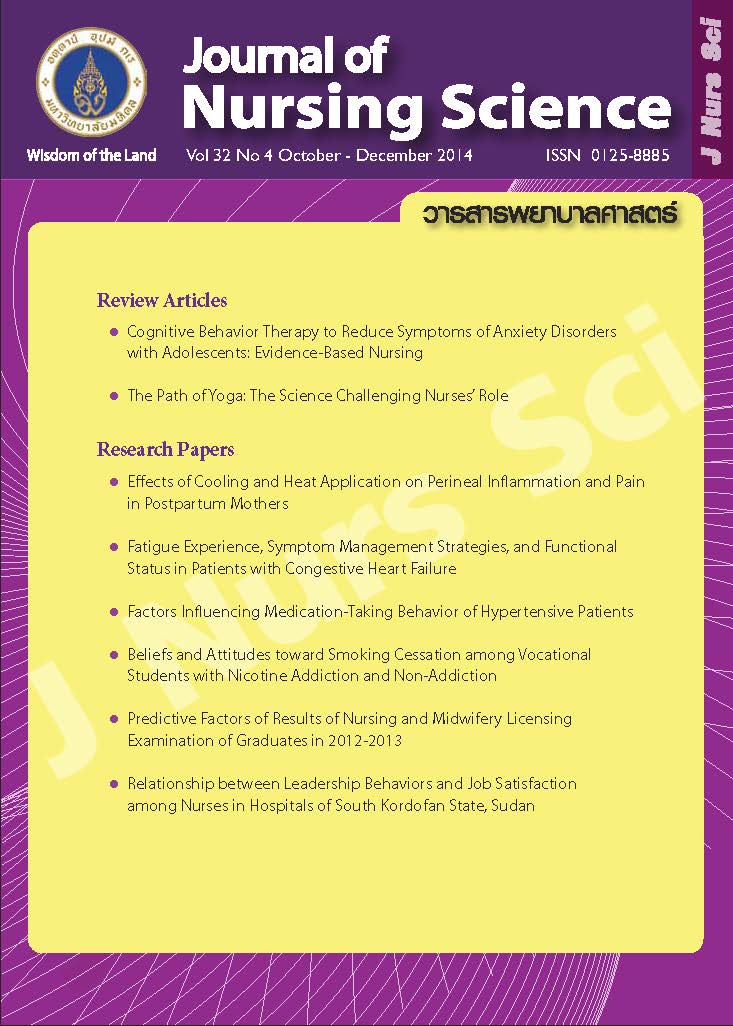
Fatigue Experience, Symptom Management Strategies, and Functional Status in Patients with Congestive Heart Failure
Article Sidebar
Main Article Content
บทคัดย่อ
Purpose: To explore symptom experience, management strategies, and functional status and to examine the relationships between fatigue experience, management strategies, and functional status of patients with congestive heart failure (CHF).
Design: Descriptive correlational study.
Methods: The sample included 88 patients with CHF at the heart failure clinic and the cardiac medical ward of a tertiary hospital in Nonthaburi province. Data were collected using questionnaires on demographic characteristics, the Piper fatigue scale-12, management strategies, and the Functional Performance Inventory Short Form (PFI-SF). Data were analyzed using descriptive statistics and Pearson’s Product Moment Correlation Coefficient.
Main findings: The mean score of fatigue experience was at a high level (mean = 7.32, SD = .59). The fatigue management strategy that was most commonly used and most effective was sleeping. The mean score of functional status was at a moderate level (mean = 1.23, SD = .30). Fatigue experience was negatively correlated with functional status (r = - .32, p < .01) and fatigue management strategies were positively correlated with functional status (r = .36, p < .05).
Conclusion and recommendations: Nurses should assess fatigue experience in patients with CHF and provide them with guidance on good sleep hygiene. For further research, a sleep hygiene program should be developed to manage their fatigue and promote their functional status.
Keywords: fatigue experience, fatigue management strategies, functional status, congestive heart failure
ประสบการณ์อาการเหนื่อยล้า กลวิธีการจัดการอาการและภาวะการทำหน้าที่ในผู้ป่วยภาวะหัวใจล้มเหลว
บทคัดย่อ
วัตถุประสงค์: เพื่อศึกษาประสบการณ์อาการเหนื่อยล้า กลวิธีการจัดการ และภาวะการทำหน้าที่ และศึกษาความสัมพันธ์ระหว่างประสบการณ์อาการเหนื่อยล้า กลวิธีการจัดการ กับภาวะการทำหน้าที่ในผู้ป่วยภาวะหัวใจล้มเหลว
รูปแบบการวิจัย: การศึกษาความสัมพันธ์เชิงบรรยาย
วิธีดำเนินการวิจัย: กลุ่มตัวอย่างคือ ผู้ป่วยภาวะหัวใจล้มเหลวจำนวน 88 คนที่มารับการรักษาที่คลินิกโรคหัวใจล้มเหลว และหอผู้ป่วยอายุรกรรมหัวใจ ของโรงพยาบาลตติยภูมิแห่งหนึ่ง ในจังหวัดนนทบุรี เก็บข้อมูลโดยใช้แบบสอบถามประกอบด้วย 1) แบบบันทึกข้อมูลส่วนบุคคล 2) ประสบการณ์อาการเหนื่อยล้า 3) กลวิธีการจัดการกับอาการ และ 4) ภาวะการทำหน้าที่ วิเคราะห์ข้อมูลด้วยสถิติเชิงพรรณนา และวิเคราะห์ความสัมพันธ์โดยใช้ค่าสัมประสิทธิ์สหสัมพันธ์เพียร์สัน
ผลการวิจัย: คะแนนเฉลี่ยประสบการณ์อาการเหนื่อยล้าอยู่ในระดับสูง (mean = 7.32, SD = .59) กลวิธีจัดการอาการที่ใช้บ่อยและมีประสิทธิภาพสูงสุด คือ การนอนหลับ คะแนนเฉลี่ยภาวะการทำหน้าที่อยู่ในระดับปานกลาง (mean = 1.23, SD = .30) ประสบการณ์อาการเหนื่อยล้ามีความสัมพันธ์เชิงลบกับภาวะการทำหน้าที่อย่างมีนัยสำคัญ (r = - .32, p < .01) และกลวิธีการจัดการอาการเหนื่อยล้ามีความสัมพันธ์เชิงบวกกับภาวะการทำหน้าที่อย่างมีนัยสำคัญ (r = .36, p < .05)
สรุปและข้อเสนอแนะ: พยาบาลควรมีการประเมินประสบการณ์อาการเหนื่อยล้าในผู้ป่วยภาวะหัวใจล้มเหลว และให้แนวทางแก่ผู้ป่วยในการฝึกสุขวิทยาการนอนที่ดี ในการทำวิจัยครั้งต่อไปควรพัฒนาโปรแกรมเพื่อส่งเสริมสุขวิทยาการนอน ซึ่งจะส่งเสริมให้เกิดภาวะการทำหน้าที่ที่ดี
คำสำคัญ: ประสบการณ์อาการเหนื่อยล้า กลวิธีจัดการอาการเหนื่อยล้า ภาวะการทำหน้าที่ ภาวะหัวใจล้มเหลว
Article Details
ลิขสิทธิ์: วารสารพยาบาลศาสตร์เป็นเจ้าของลิขสิทธิ์ในการเผยแพร่ผลงานที่ตีพิมพ์ ห้ามผู้ใดนำบทความที่ได้รับการตีพิมพ์ในวารสารพยาบาลศาสตร์ไปเผยแพร่ในลักษณะต่างๆ ดังต่อไปนี้ การส่งบทความไปตีพิมพ์เผยแพร่ที่อื่น การนำบทความเผยแพร่ออนไลน์ การถ่ายเอกสารบทความเพื่อกิจกรรมที่ไม่ใช่การเรียนการสอน ยกเว้นเสียแต่ได้รับอนุญาตจากวารสารพยาบาลศาสตร์
Disclaimer: เนื้อหาบทความหรือข้อคิดเห็นใดๆ ในวารสารพยาบาลศาสตร์ ถือเป็นความรับผิดชอบของผู้เขียน กองบรรณาธิการไม่จำเป็นต้องเห็นด้วยและไม่มีส่วนรับผิดชอบแต่อย่างใด