
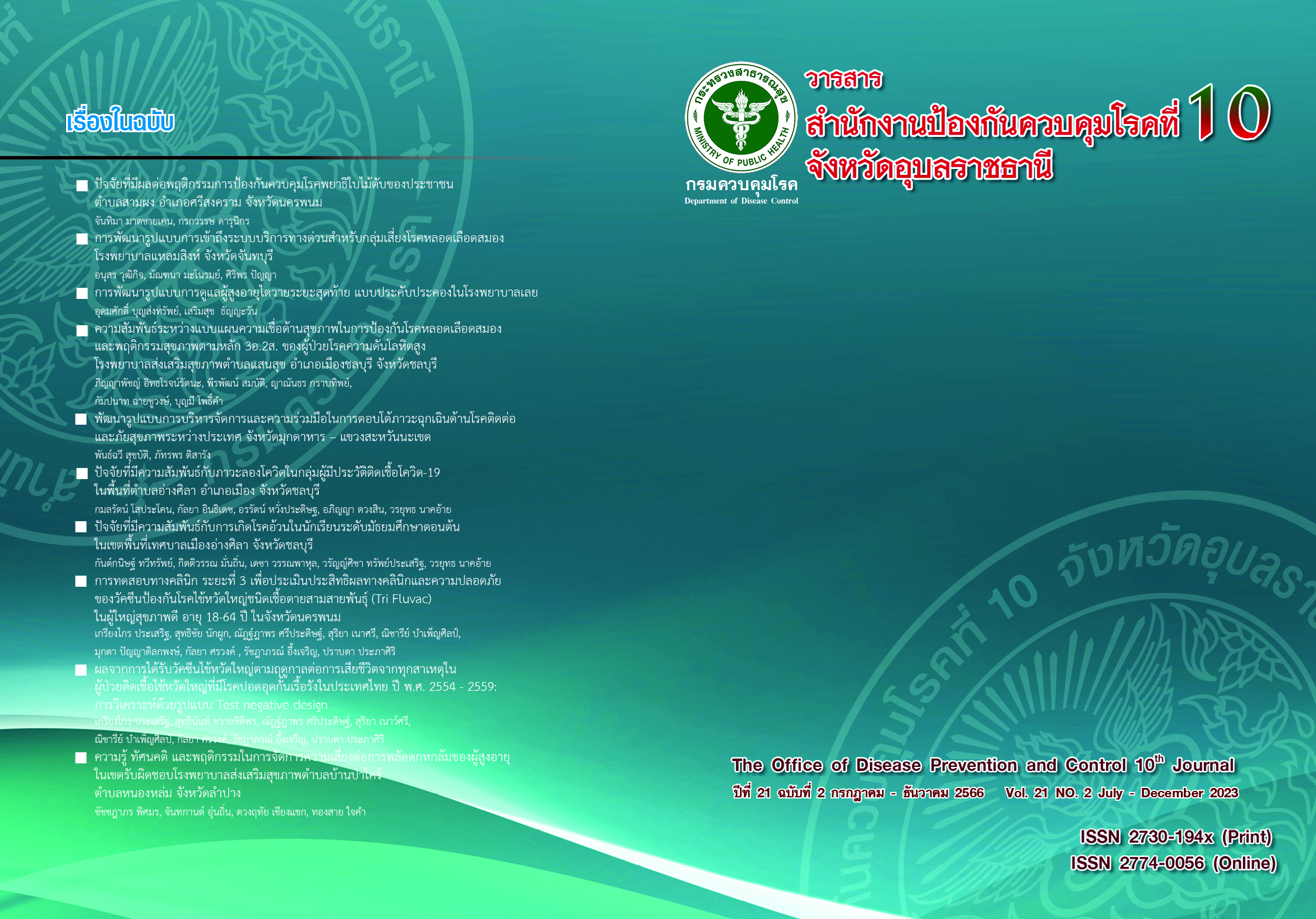
ความสัมพันธ์ระหว่างแบบแผนความเชื่อด้านสุขภาพในการป้องกันโรคหลอดเลือดสมอง และพฤติกรรมสุขภาพตามหลัก 3อ.2ส. ของผู้ป่วยโรคความดันโลหิตสูง โรงพยาบาลส่งเสริมสุขภาพตำบลแสนสุข อำเภอเมืองชลบุรี จังหวัดชลบุรี
คำสำคัญ:
พฤติกรรมสุขภาพ, 3อ.2ส., โรคหลอดเลือดสมอง, โรคความดันโลหิตสูงบทคัดย่อ
การวิจัยแบบภาคตัดขวางเชิงพรรณนาหาความสัมพันธ์ครั้งนี้ มีวัตถุประสงค์เพื่อศึกษาความสัมพันธ์ระหว่างแบบแผนความเชื่อด้านสุขภาพในการป้องกันโรคหลอดเลือดสมองและพฤติกรรมสุขภาพตามหลัก 3อ.2ส. ของผู้ป่วยโรคความดันโลหิตสูง โรงพยาบาลส่งเสริมสุขภาพตำบลแสนสุข อำเภอเมืองชลบุรี จังหวัดชลบุรี จำนวน 154 ราย ที่ได้จากการสุ่มแบบเป็นระบบโดยทำการเรียงรายชื่อประชากรตามวันนัดพบแพทย์ และสุ่มเลือกตัวอย่างโดยกำหนดช่วงการสุ่มเท่ากับ 2 หน่วย ระหว่างเดือนกรกฎาคม 2565 ถึง มีนาคม 2566 เก็บรวบรวมข้อมูลโดยใช้แบบสอบถามประเภทตอบเองซึ่งผ่านการตรวจสอบคุณภาพ โดยมีค่าเฉลี่ยของดัชนีความสอดคคล้องเท่ากับ 0.92 และค่าสัมประสิทธิ์แอลฟาครอนบาคเท่ากับ 0.85 วิเคราะห์ข้อมูลด้วยสถิติเชิงพรรณนา ได้แก่ ความถี่ ร้อยละ ค่าเฉลี่ย ส่วนเบี่ยงเบนมาตรฐาน ค่ามัธยฐาน ค่าต่ำสุด และค่าสูงสุด และวิเคราะห์ความสัมพันธ์ด้วยสถิติเชิงอนุมาน ได้แก่ การทดสอบสัมประสิทธิ์สหสัมพันธ์สเปียร์แมนด้วยระดับนัยสำคัญทางสถิติที่ 0.05
ผลการศึกษาพบว่า กลุ่มตัวอย่างเป็นเพศหญิง ร้อยละ 65.6 อายุมากกว่า 60 ปีขึ้นไป ร้อยละ 69.5 มีดัชนีมวลกายเกินเกณฑ์มาตรฐาน ร้อยละ 73.4 และมีระดับการรับรู้เกี่ยวกับแบบแผนความเชื่อด้านสุขภาพในการป้องกันโรคหลอดเลือดสมองอยู่ในระดับสูง ระดับการปฏิบัติพฤติกรรมสุขภาพตามหลัก 3อ.2ส. อยู่ในระดับพอใช้ โดยแบบแผนความเชื่อด้านสุขภาพในการป้องกันโรคหลอดเลือดสมองมีความสัมพันธ์ทางบวกในระดับต่ำกับพฤติกรรมสุขภาพตามหลัก 3อ.2ส. (rs=0.48) อย่างมีนัยสำคัญทางสถิติที่ระดับ 0.05 แต่ในด้านการรับรู้อุปสรรคในการป้องกันโรคหลอดเลือดสมองไม่มีความสัมพันธ์กับพฤติกรรมสุขภาพตามหลัก 3อ.2ส. (rs=0.07) ดังนั้น บุคลากรทางด้านสุขภาพควรจัดกิจกรรมเพื่อปรับเปลี่ยนพฤติกรรมสุขภาพโดยประยุกต์ใช้แบบแผนความเชื่อด้านสุขภาพ โดยกำหนดประเด็นที่มีความน่าสนใจ เข้าใจง่าย และตรงกับกลุ่มเป้าหมายที่ส่วนใหญ่เป็นผู้สูงอายุ เพื่อช่วยให้กลุ่มเป้าหมายสามารถเกิดการเรียนรู้เพื่อปรับเปลี่ยนพฤติกรรมสุขภาพได้อย่างถูกต้องและเหมาะสม
เอกสารอ้างอิง
Feigin VL, Brainin M, Norrving B, Martins S, Sacco RL, Hacke W, et al. World Stroke Organization (WSO): global stroke fact sheet 2022. Int J Stroke 2022; 17(1):18-29.
กองโรคไม่ติดต่อ. ประเด็นการรณรงค์วันอัมพาตโลกหรือวันอัมพาตโลก 2565 เน้นสร้างความตระหนักรู้เกี่ยวกับสัญญาณเตือนโรคหลอดเลือดสมองให้กับประชาชน. [อินเตอร์เน็ต]. 2565. [เข้าถึงเมื่อ 30 ต.ค. 2565] เข้าถึงได้จาก: https://pr.moph.go.th/print.php?url=pr/print/2/02/180623/
ประไพศรี คงหาสุข, สมสมัย รัตนกรีฑากุล, สุวรรณา จันทร์ประเสริฐ. ปัจจัยที่มีอิทธิพลต่อพฤติกรรมการป้องกันโรคหลอดเลือดสมองในผู้เป็นโรคเรื้อรัง จังหวัดชลบุรี. วารสารวิทยาลัยพยาบาลพระปกเกล้า จันทบุรี 2563; 31(2):28-40.
สำนักงานสาธารณสุขจังหวัดชลบุรี. สถานการณ์โรคหลอดเลือดสมอง จังหวัดชลบุรี. ชลบุรี: สำนักงานสาธารณสุขอำเภอเมืองชลบุรี; 2565.
สำนักงานสาธารณสุขอำเภอเมืองชลบุรี. สถานการณ์โรคหลอดเลือดสมอง อำเภอเมืองชลบุรี จังหวัดชลบุรี.ชลบุรี: สำนักงานสาธารณสุขอำเภอเมืองชลบุรี; 2565.
โรงพยาบาลส่งเสริมสุขภาพตำบลแสนสุข. สรุปรายงานผลการดำเนินงานผู้ป่วยโรคไม่ติดต่อเรื้อรังโรงพยาบาลส่งเสริมสุขภาพตำบลแสนสุข. ชลบุรี: โรงพยาบาลส่งเสริมสุขภาพตำบลแสนสุข; 2565.
กองสุขศึกษา. แนวทางการดำเนินงานเฝ้าระวังพฤติกรรมสุขภาพ. กรุงเทพมหานคร: ยี่สิบห้า มีเดีย จำกัด; 2565.
สุริยา หล้าก่ำ, ศิราณีย์ อินธรหนองไผ่. ความสัมพันธ์ระหว่างการรับรู้ความเชื่อด้านสุขภาพและพฤติกรรมการป้องกันโรคหลอดเลือดสมองในผู้ป่วยกลุ่มเสี่ยงสูง ตำบลเหนือเมือง อำเภอเมืองร้อยเอ็ด จังหวัดร้อยเอ็ด. วารสารพยาบาลตำรวจ 2560; 9(2):85-94.
จตุพงษ์ พันธ์วิไล, นิรมัย มณีรัตน์, สุพัตรา ปวนไฝ, สุชารินี ศรีสวัสดิ์, วินัฐ ดวงแสนจันทร์. ความสัมพันธ์ระหว่างความรู้ ความเชื่อด้านสุขภาพ และพฤติกรรมการป้องกันการเกิดโรคหลอดเลือดสมองในผู้สูงอายุที่มีภาวะเสี่ยงโรงพยาบาลประสาทเชียงใหม่. วารสารศูนย์อนามัยที่ 9 วารสารส่งเสริมสุขภาพและอนามัยสิ่งแวดล้อม 2565; 16(3):882-95.
พรศิริ พันธสี, กาญจนา ศรีสวัสดิ์. ความสัมพันธ์ระหว่างความเชื่อด้านสุขภาพกับพฤติกรรมสุขภาพตามหลัก 3อ.2ส. ของผู้สูงอายุ สมาคมแต้จิ๋วแห่งประเทศไทย แขวงทุ่งวัดดอน เขตสาทร กรุงเทพมหานคร. วารสารสุขภาพกับการจัดการสุขภาพ 2563; 6(1):45-57.
Rosenstock M, Strecher J, Becker H. Social learning theory and the health belief model. Health Educ Q 1988; 15(2):175-83.
Daniel WW. Biostatistics: a foundation for analysis in the health sciences, 7th edition. New York: John Wiley and Sons Inc; 1999.
ชื่นกมล สิทธิยอดยิ่ง. แบบแผนความเชื่อด้านสุขภาพที่มีความสัมพันธ์กับพฤติกรรมการดูแลตนเองเพื่อป้องกันโรคหลอดเลือดสมองของผู้ป่วยที่ไม่สามารถควบคุมความดันโลหิตได้ โรงพยาบาลนภาลัย จังหวัดสมุทรสงคราม. วารสารศาสตร์สุขภาพและการศึกษา 2565; 2(2):46-60.
ดาวน์โหลด
เผยแพร่แล้ว
รูปแบบการอ้างอิง
ฉบับ
ประเภทบทความ
สัญญาอนุญาต
ลิขสิทธิ์ (c) 2023 สำนักงานป้องกันควบคุมโรคที่ 10 จังหวัดอุบลราชธานี

อนุญาตภายใต้เงื่อนไข Creative Commons Attribution-NonCommercial-NoDerivatives 4.0 International License.
บทความที่ได้รับการตีพิมพ์เป็นลิขสิทธิ์ของ สำนักงานป้องกันควบคุมโรคที่ 10 จังหวัดอุบลราชธานี
ข้อความที่ปรากฏในบทความแต่ละเรื่องในวารสารวิชาการเล่มนี้เป็นความคิดเห็นส่วนตัวของผู้เขียนแต่ละท่านไม่เกี่ยวข้องกับสำนักงานป้องกันควบคุมโรคที่ 10 จังหวัดอุบลราชธานีและบุคลากรท่านอื่นๆในสำนักงานฯ แต่อย่างใด ความรับผิดชอบองค์ประกอบทั้งหมดของบทความแต่ละเรื่องเป็นของผู้เขียนแต่ละท่าน หากมีความผิดพลาดใดๆ ผู้เขียนแต่ละท่านจะรับผิดชอบบทความของตนเองแต่ผู้เดียว


