
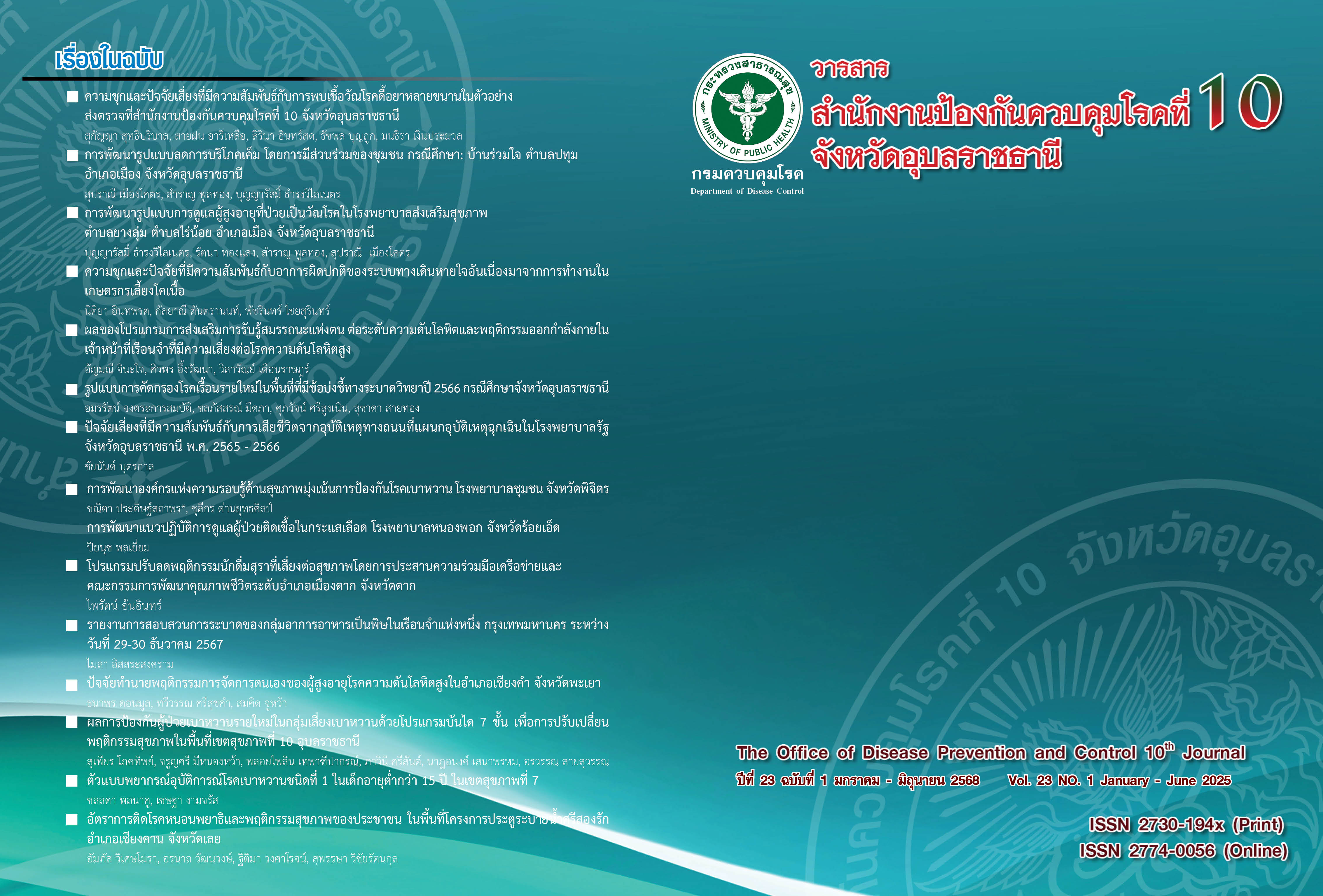
ผลของโปรแกรมการส่งเสริมการรับรู้สมรรถนะแห่งตน ต่อระดับความดันโลหิต และพฤติกรรมออกกำลังกายในเจ้าหน้าที่เรือนจำที่มีความเสี่ยงต่อโรคความดันโลหิตสูง
คำสำคัญ:
โปรแกรมการส่งเสริมการรับรู้สมรรถนะแห่งตน, ความดันโลหิต, พฤติกรรมออกกำลังกาย, เจ้าหน้าที่เรือนจำบทคัดย่อ
งานวิจัยแบบกึ่งทดลองครั้งนี้มีวัตถุประสงค์เพื่อเปรียบเทียบค่าเฉลี่ยความดันโลหิต คะแนนเฉลี่ยพฤติกรรมออกกำลังกาย ระหว่างกลุ่มทดลองและกลุ่มควบคุม ที่เข้าร่วมโปรแกรมส่งเสริมการรับรู้สมรรถนะแห่งตน เป็นระยะเวลา 8 สัปดาห์ กลุ่มตัวอย่างคือเจ้าหน้าที่เพศชายที่ปฏิบัติหน้าที่ในเรือนจำที่เป็นกลุ่มเสี่ยงโรคความดันโลหิตสูง จำนวน 40 ราย แบ่งเป็นกลุ่มทดลอง 20 ราย และกลุ่มควบคุม 20 ราย โดยโปรแกรมฯ พัฒนาจากแนวคิดทฤษฎีการรับรู้สมรรถนะแห่งตนของแบนดูรา เครื่องมือในการรวบรวมข้อมูล ประกอบด้วย แบบสอบถามข้อมูลทั่วไป และแบบสอบถามพฤติกรรมออกกำลังกาย ตรวจสอบค่าดัชนีความตรงของเนื้อหา เท่ากับ 0.95 และค่าความเชื่อมั่น ค่าสัมประสิทธิ์อัลฟาครอนบาค เท่ากับ 0.84 วิเคราะห์ข้อมูลโดยใช้สถิติพรรณนา สถิติ The Mann-Whitney U test, The Wilcoxon Signed-Rank และ Independent t-test
ผลการวิจัย พบว่า ความดันโลหิตซิสโตลิก และความดันโลหิตไดแอสโตลิก ของกลุ่มทดลองหลังได้รับโปรแกรมการส่งเสริมการรับรู้สมรรถนะแห่งตน ต่ำกว่าก่อนได้รับโปรแกรมฯ (SBP: Median = 134.00, 137.50; DBP: Median = 85.00, 88.00 ตามลำดับ) ที่ระดับนัยสำคัญ 0.05 ทั้งนี้ความดันโลหิตซิสโตลิก และความดันโลหิตไดแอสโตลิก ของกลุ่มทดลองที่ได้รับโปรแกรมฯ ต่ำกว่ากลุ่มควบคุมที่ได้รับการพยาบาลตามปกติ (SBP: Median = 134.00, 138.00; DBP: Median = 85.00, 87.50 ตามลำดับ) ที่ระดับนัยสำคัญ 0.05 นอกจากนี้ คะแนนพฤติกรรมการออกกำลังกายของกลุ่มทดลองหลังได้รับโปรแกรมฯ สูงกว่าก่อนได้รับโปรแกรมฯ (Median = 4.67, 2.80 ตามลำดับ) ที่ระดับนัยสำคัญ 0.05 อีกทั้งคะแนนพฤติกรรมการออกกำลังกายของกลุ่มทดลองที่ได้รับโปรแกรมฯ สูงกว่ากลุ่มควบคุมที่ได้รับการพยาบาลตามปกติ (Mean = 4.66, 2.78 ตามลำดับ) ที่ระดับนัยสำคัญ 0.05
เอกสารอ้างอิง
World Health Organization. First WHO report details devastating impact of hypertension and ways to stop it [Internet]. Geneva: WHO; 2023 [cited 2024 Jan 1]. Available from: https://www.who.int/news-room/fact-sheets/detail/hypertension
ระบบคลังข้อมูลด้านการแพทย์และสุขภาพ กระทรวงสาธารณสุข. อัตราป่วยรายใหม่ของโรคความดันโลหิตสูงต่อแสนประชากร ในปีงบประมาณ [อินเตอร์เน็ต]. นนทบุรี: กระทรวงสาธารณสุข; 2567 [เข้าถึงเมื่อ 1 ม.ค. 2567]. เข้าถึงได้จาก: https://hdcservice.moph.go.th/
สมาคมความดันโลหิตสูงแห่งประเทศไทย. แนวทางการรักษาโรคความดันโลหิตสูง ในเวชปฏิบัติทั่วไป. พิมพ์ครั้งที่ 1. เชียงใหม่: ทริค ธิงค์; 2562.
American College of Sports Medicine. ACSM’s guidelines for exercise testing and prescription Eleventh Edition. 11th edition. Philadelphia: Wolters Kluwer; 2021.
Pender N. Health promotion innursing practice. 3rd edition. Stamford, Conn: Appleton and Lange; 1996.
Bandura A. Self-efficacy: toward a unifying theory of behavioral change. Psychological Review 1997; 84(2):191-215.
Cohen J. Statistical Power Analysis for the Behavioral Sciences. 2nd edition. Hillsdale, NJ: Lawrence Erlbaum Associates; 1998
นวพร วุฒิธรรม, รัตนา ช้อนทอง, ชุติญา สมประดิษฐ์. ผลของการเสริมสร้างการรับรู้สมรรถนะแห่งตน ต่อการควบคุมระดับความดันโลหิต ในกลุ่มเสี่ยงโรคความดันโลหิตสูง. วารสารพยาบาลทหารบก 2563; 21(1):309-18.
ณัฐพงษ์ ปานบุตร, ชุลีกร ด่านยุทธศิลป์, อนามัย นาอุดม. ผลของโปรแกรมการส่งเสริมการรับรู้ความสามารถตนเองต่อพฤติกรรมออกกำลังกายระดับความดันโลหิต และค่าดัชนีมวลกายของกลุ่มเสี่ยงโรคความดันโลหิตสูงที่มีน้ำหนักเกิน จังหวัดสุโขทัย. วารสารการพยาบาลและการดูแลสุขภาพ 2566; 17(3):39-51.
Hayes P, Ferrara A, Keating A, McKnight K, O’Regan A. Physical Activity and Hypertension. Journal of Cardio vascular Medicine 2022; 23(9):1-13.
จารุวรรณ ภู่สาลี, สุนิดา ปรีชาวง. ผลของโปรแกรมการส่งเสริมพฤติกรรมสุขภาพที่เน้นการเต้นแอโรบิกแบบมวยไทยต่อความดันโลหิตและดัชนีมวลกายของผู้ที่มีภาวะความดันโลหิตเกือบสูง. วารสารพยาบาลทหารบก 2557; 15(3):218-55.
อัญชลี เกาะอ้อม, ยุพิน อังสุโรจน์, ระพิณ ผลสุข. ผลของโปรแกรมการสร้างแรงจูงใจร่วมกับออกกำลังกายแบบบาสโลบต่อระดับความดันโลหิตของกลุ่มเสี่ยงความดันโลหิตสูง. จุฬาลงกรณ์เวชสาร 2562; 1(5):463-72.
ฐาณมาศ เกษเพ็ชร, ศุภมาศ ขำแสง, อริสา โพธิ์ชัยสาร, พิมลพร เชาวน์ไวพจน์. ผลของการเดินแบบนอร์ดิกต่อความดันโลหิต และประสิทธิภาพในการออกกำลังกาย ในผู้ที่มีภาวะเสี่ยงต่อโรคความดันโลหิตสูงในจังหวัดนครนายก. วารสารการแพทย์และวิทยาศาสตร์สุขภาพ 2562; 26(2):10-21.
ลลิตา บุญงาม, ชนัญชิดาดุษฎี ทูลศิร, สุวรรณา จันทร์ประเสริฐ. ผลของโปรแกรมการออกกำลังกายแบบชี่กงต่อระดับความดันโลหิตของสตรีกลุ่มเสี่ยงโรคความดันโลหิตสูง. วารสารคณะพยาบาลศาสตร์ มหาวิทยาลัยบูรพา 2560; 25(1):82-94.
ชินวัฒน์ ไข่เกตุ, สุนีย์ เงินยวง. ความรู้ ทัศนคติ และพฤติกรรมการออกกําาลังกายของนักวิ่งหน้าใหม่จังหวัดเชียงใหม่. วารสารมนุษยศาสตร์และสังคมศาสตร์มหาวิทยาลัยมหาสารคาม 2566; 42(1):97-108.
ชาญชัย ศิริพันธุ์, วัชชิรา ศักดิ์สนิท, สมศักดิ์ รักอยู่, นิติพันธ์ สระภักดิ์, เจริญ เครือทิวา. การสํารวจความคิดเห็นของนักศึกษาเกี่ยวกับการบูรณาการกิจกรรมทางกายในหมวดวิชาศึกษาทั่วไป: กรณีศึกษา มหาวิทยาลัยกรุงเทพธนบุรี. วารสารสหวิทยาการวิจัยและวิชาการ 2566; 3(4):205-16.
พงศกร จันทร์ฉาย, จีรพัชร บุณยพรหม, อุดมลักษม์ กูลศรีโรจน์, ศิริรัตน์ ศรีสอาด. การใช้บุคคลต้นเเบบเพื่อเสริมสร้างเเรงจูงใจในตนเอง. วารสารปัญญาภิวัฒน์ 2566; 15(3):352-67.
Peifer C, Schönfeld P, Wolters G, Aust F, Margraf J. Well done! effects of positive feedback on perceived self-efficacy, flow and performance in a mental arithmetic task. Frontiers in Psychology 2020; 11:1–11.
จุฑามาศ แหนจอน. สมองกับอารมณ์: มหัศจรรย์ความเชื่อมโยง. วารสารราชพฤก 2558; 13(3):10-9.
ดาวน์โหลด
เผยแพร่แล้ว
รูปแบบการอ้างอิง
ฉบับ
ประเภทบทความ
สัญญาอนุญาต
ลิขสิทธิ์ (c) 2025 สำนักงานป้องกันควบคุมโรคที่ 10 จังหวัดอุบลราชธานี

อนุญาตภายใต้เงื่อนไข Creative Commons Attribution-NonCommercial-NoDerivatives 4.0 International License.
บทความที่ได้รับการตีพิมพ์เป็นลิขสิทธิ์ของ สำนักงานป้องกันควบคุมโรคที่ 10 จังหวัดอุบลราชธานี
ข้อความที่ปรากฏในบทความแต่ละเรื่องในวารสารวิชาการเล่มนี้เป็นความคิดเห็นส่วนตัวของผู้เขียนแต่ละท่านไม่เกี่ยวข้องกับสำนักงานป้องกันควบคุมโรคที่ 10 จังหวัดอุบลราชธานีและบุคลากรท่านอื่นๆในสำนักงานฯ แต่อย่างใด ความรับผิดชอบองค์ประกอบทั้งหมดของบทความแต่ละเรื่องเป็นของผู้เขียนแต่ละท่าน หากมีความผิดพลาดใดๆ ผู้เขียนแต่ละท่านจะรับผิดชอบบทความของตนเองแต่ผู้เดียว


