Evaluation of set up error in Exactrac Dynamic (EXTD) system for treating thoracic, abdominal and pelvic cancer patients
Keywords:
Setup error, Exactrac Dynamic (EXTD), Thoracic cancer, Abdominal cancer, Pelvic cancerAbstract
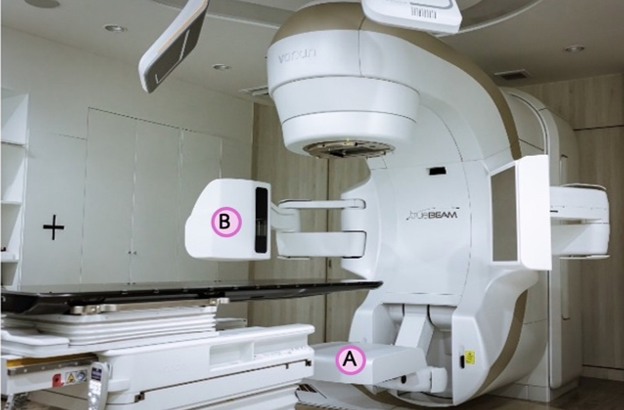
Background: ExacTrac Dynamic (EXTD) is a non-ionizing technology used for patient position verification and has been implemented as an alternative to radiation-based positioning systems. However, a limitation of EXTD is that it cannot directly assess internal organ motion. Objective: This study aims to evaluate the setup deviation in patient positioning using the ExacTrac Dynamic (EXTD) system for patients undergoing radiotherapy for thoracic, abdominal, and pelvic cancers. Methods: A total of 60 patients diagnosed with cancer in the thoracic, abdominal, or pelvic regions were positioned using the Surface-Guided Radiation Therapy (SGRT) function of the EXTD system. All patients received treatment with Volumetric Modulated Arc Therapy (VMAT) using the Varian TrueBeam linear accelerator at the Cancer Hospital’s Radiation Oncology Department. Cone-Beam Computed Tomography (CBCT) was used to verify setup deviations in six directions: vertical, longitudinal, lateral, pitch, roll, and yaw. CBCT images were compared against reference images from the treatment planning system. The mean difference between the EXTD setup and CBCT verification were analyzed to determine whether they remained within the limits set by the International Atomic Energy Agency (IAEA). Results: The mean difference recorded by SGRT using EXTD in the six directions were as follows: Vertical: -0.20 ± 1.87 mm (thoracic), -1.99 ± 1.99 mm (abdominal), -1.36 ± 2.47 mm (pelvic), Longitudinal: -1.76 ± 1.84 mm (thoracic), -1.50 ± 3.00 mm (abdominal), -0.93 ± 4.49 mm (pelvic), Lateral: -0.58 ± 1.40 mm (thoracic), -2.29 ± 2.58 mm (abdominal), -1.12 ± 2.14 mm (pelvic), Yaw: -0.63 ± 0.96° (thoracic), -0.47 ± 1.23° (abdominal), -0.28 ± 0.81° (pelvic), Pitch: -0.32 ± 0.70° (thoracic), 0.09 ± 1.27° (abdominal), -0.08 ± 0.93° (pelvic), Roll: 0.07 ± 0.80° (thoracic), 0.09 ± 0.58° (abdominal), 0.23 ± 0.93° (pelvic)All reported values were within the standard tolerances specified by the IAEA. Conclusion: The study found that patient setup errors using the ExacTrac Dynamic (EXTD) system were within acceptable limits based on international standards. EXTD can replace CBCT in some cases, especially for patients with tumors in the upper chest, upper abdomen, or pelvis, where internal organ motion is minimal. Using EXTD instead of CBCT in patients with low organ movement can reduce the number of repeated scans and the total imaging dose, while keeping treatment accuracy within IAEA standards.
Downloads
References
Withers HR. The four R’s of radiotherapy. In: Advances in radiation biology. New York: Elsevier; 1975. p. 241–271.
Bridge P, Crowe SB, Gibson G, Ellemor NJ, Hargrave C, Carmichael M. A virtual radiation therapy workflow training simulation. Radiography. 2016;22(1):e59–e63.
Miyabe Y, Sawada A, Takayama K, Kaneko S, Mizowaki T, Kokubo M, et al. Positioning accuracy of a new image-guided radiotherapy system. Med Phys. 2011;38(5):2535–2541.
van der Merwe D, Van Dyk J, Healy B, Zubizarreta E, Izewska J, Mijnheer B, et al. Accuracy requirements and uncertainties in radiotherapy: a report of the International Atomic Energy Agency. Acta Oncol. 2017;56(1):1–6.
Chow VUY, Cheung MLM, Kan MWK, Chan ATC. Shift detection discrepancy between ExacTrac Dynamic system and cone-beam computed tomography. J Appl Clin Med Phys. 2022;23(5):e13567.
Freislederer P, Kügele M, Öllers M, Swinnen A, Sauer TO, Bert C, et al. Recent advances in surface guided radiation therapy. Radiat Oncol. 2020;15(1):1–11.
Lee SK, Huang S, Zhang L, Ballangrud AM, Aristophanous M, Cervino LI, et al. Accuracy of surface-guided patient setup for conventional radiotherapy of brain and nasopharynx cancer. J Appl Clin Med Phys. 2021;22(5):48–57.
Weiss E, Vorwerk H, Richter S, Hess CF. Interfractional and intrafractional accuracy during radiotherapy of gynecologic carcinomas: a comprehensive evaluation using the ExacTrac system. Int J Radiat Oncol Biol Phys. 2003;56(1):69–79.
Downloads
Published
How to Cite
Issue
Section
License
Copyright (c) 2025 The Thai Society of Radiological Technologists

This work is licensed under a Creative Commons Attribution-NonCommercial-NoDerivatives 4.0 International License.
บทความที่ได้รับการตีพิมพ์เป็นลิขสิทธิ์ของสมาคมรังสีเทคนิคแห่งประเทศไทย (The Thai Society of Radiological Technologists)
ข้อความที่ปรากฏในบทความแต่ละเรื่องในวารสารวิชาการเล่มนี้เป็นความคิดเห็นส่วนตัวของผู้เขียนแต่ละท่านไม่เกี่ยวข้องกับสมาคมรังสีเทคนิคแห่งประเทศไทยและบุคคลากรท่านอื่น ๆในสมาคม ฯ แต่อย่างใด ความรับผิดชอบองค์ประกอบทั้งหมดของบทความแต่ละเรื่องเป็นของผู้เขียนแต่ละท่าน หากมีความผิดพลาดใดๆ ผู้เขียนแต่ละท่านจะรับผิดชอบบทความของตนเองแต่ผู้เดียว