
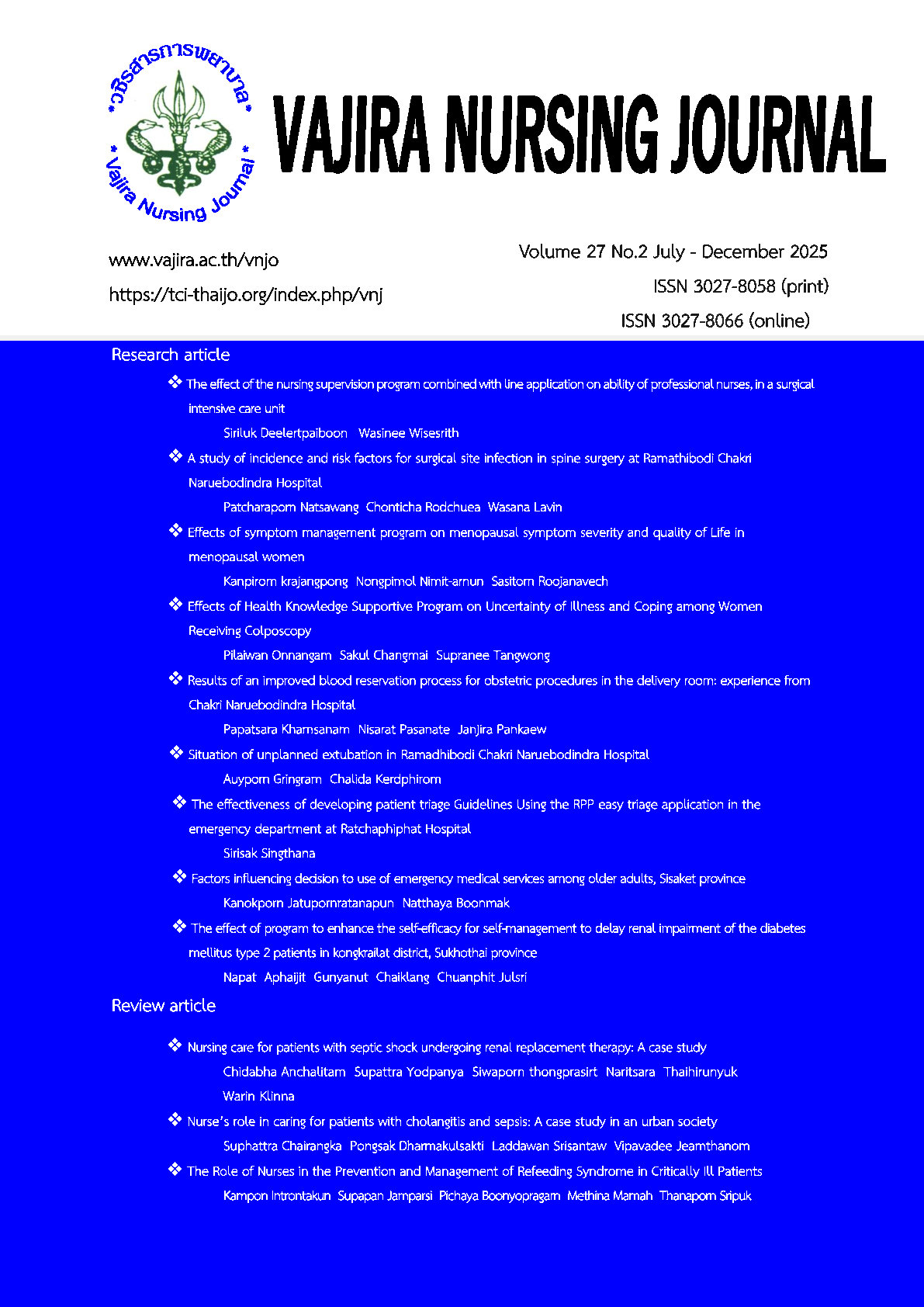
A study of incidence and risk factors for surgical site infection in spine surgery at Ramathibodi Chakri Naruebodindra Hospital
Article Sidebar
Main Article Content
Abstract
Surgical Site Infection (SSI) is a severe complication in spinal surgery. It is
significantly associated with medical costs, morbidity and mortality. The criteria
for diagnosing surgical wound infection are based on the US Centers for Disease
Control and Prevention (CDC), meaning infection that occurs within 30 days
after surgery. This retrospective study aimed to investigate the incidence of SSI
and factors associated with SSI among patients who received spinal surgery
at Ramathibodi Chakri Naruebodindra Hospital. The 183 samples were obtained
from medical data in Ramathibodi Chakri Naruebodindra hospital records by
selecting from ICD-10, who meet the inclusion criteria such as aged 15 years
and over, undergoing spine surgery by advanced appointment and having
an uninfected surgical wound between 1 January 2021 to 31 December 2022.
The data were analyzed using descriptive statistics, chi-square and fisher exact
test at a statistical significant level of .05. The results found that an incidence of
surgical site infection was found in 2 cases (1.09%). The factors associated with
SSI were found as following; Charlson comorbidity index greater than 4 points
(p-value=.020), length of hospital stay more than seven days (p-value=0.044),
and not receiving postoperative antibiotics (p-value=.033). Health care
professonals should plan the surgery and the design of care guidelines to reduce
surgical site infections and complications among patients safely.
Article Details

This work is licensed under a Creative Commons Attribution-NonCommercial-NoDerivatives 4.0 International License.
The content and information presented in articles published in the Vajira Nursing Journal reflect the views and responsibilities of the authors exclusively. The editorial board does not necessarily agree with or share any responsibility for these views.
All articles, information, content, images, etc., published in the Vajira Nursing Journal are the copyright of the journal. Any individual or organization wishing to reproduce, disseminate, or use any part or entirety of the published material must obtain prior written permission from the Vajira Nursing Journal.
References
Lee CH, Chung CK, Kim CH, Kwon JW. Health care burden of spinal diseases in the Republic of Korea: analysis of a nationwide database from 2012 through 2016. Neurospine 2018;15(1):66-76.
Makino T, Tsukazaki H, Ukon Y, Tateiwa D, Yoshikawa H, Kaito T. The biological enhancement of spinal fusion for spinal degenerative disease. Int J Mol Sci. 2018;19(8):1-21.
Yosakorn A. Complications in patients undergoing spinal surgery in Prasat neurological. VNJ 2021;23(2):44-56. (in Thai)
Buser Z, Ortega B, D’Oro A, Pannell W, Cohen JR, Wang J, et al. Spine degenerative conditions and their treatments: national trends in the United States of America. Global Spine J. 2018;8(1):57-67.
Spine Institute Bumrungrad International Hospital. Things to know before spinal surgery. [Internet]. 2024 [cited 2025]. Available from: https://www.bumrungrad. com/th/health-blog/ june-2016/things-to-know-before-surgery. (in Thai)
Aleem IS, Tan LA, Nassr A, Riew KD. Surgical Site Infection Prevention Following Spine Surgery. Global Spine J. 2020;10 (Suppl):92S-98S.
Awwad W, Alnasser A, Almalki A, Mumtaz R, Alsubaie B, Almaawi, et al. Predictors and Risk Factors of Surgical Site Infection (SSI) Following Adult Spine Surgery. IJMRHS 2021;10(2):131-37.
Deng H, Chan AK, Ammanuel S, Chan AY, Oh T, Skrehot HC, et al. Risk factors for deep surgical site infection following thoracolumbar spinal surgery. J Neurosurg Spine 2019;32(2):292–301.
Liu JM, Deng HL, Chen XY, Zhou Y, Yang D, Duan MS, et al. Risk Factors for surgical site infection after posterior Lumbar spinal surgery. J Spine 2018;43(10):732-7.
Zhou J, Wang R, Huo X, Xiong W, Kang L, Xue Y. Incidence of Surgical Site Infection After Spine Surgery: A Systematic Review and Meta-analysis. Spine (Phila Pa 1976). 2020;45(3):208-216.
Chaichana KL, Bydon M, Santiago- Dieppa DR, Hwang L, McLoughlin G, Sciubba DM, et al. Risk of infection following posterior instrumented lumbar fusion for degenerative spine disease in 817 consecutive cases. J Neurosurg Spine 2014;20(1):45-52.
Peng XQ, Sun CG, Fei ZG, Zhou QJ. Risk factors for surgical site infection after spinal surgery: a systematic review and meta- analysis based on twenty-seven studies. World Neurosurg 2019;123: e318-29.
Atlanta GA. Centers for Disease Control and Prevention. National and State Healthcare-Associated Infections Progress Report Published in 2016. [Internet] 2021 [Cited 2023]. Available from: https://www.cdcgov/hai/pdfs/ progress-report/hai-progress-report.pdf
Krejcie VR, Morgan WD. Determining sample size for research activity. Educ Psychol Meas 1970;60(4):607-10.
Williamson EJ, Walker AJ, Bhaskaran K, Bacon S, Bates C, Morton CE, et al. OpenSAFELY: Factors associated with COVID-19-related death using Nature. 2020;584(7821):430-6.
Lavin W, Yooyadmak P, Phenglai C. Risk of mortality among COVID-19 patients admitted to intermediate ICU: A study during the third wave of COVID-19 pandemic. Dis Control J. 2023,49(1): 11-20. (in Thai)
Asia pacific society of infection control. The APSIC Guideline for thr prevention of surgical site infections. [Internet] 2019 [Cited 2025]. Available from: https://apsic-apac.org/wp-content/ uploads/ 2019/02/APSIC-SSI-THAI-VERSION-JAN-2019.pdf. (in Thai)
Todsaporn T, Anansak J, Kaewjai S , Malina P, Wittaya C. The Development of Guidelines for the Prevention Surgical Infections in Spinal Surgery Patients at Thabo Crown Prince Hospital, Nongkhai Province. J Nurs Ther Care 2023;41(3): e264282. (in Thai)
Yamamoto EA, Mazur-Hart DJ, Yoo J, Orina JN. Surgical site infection in thoracic and lumbar fractures: incidence and risk factors in 11,401 patients from a nationwide administrative database. The Spine Journal 23(2023)281−286.
Bratzler DW, Dellinger EP, Olsen KM, Perl TM, Auwaerter PG, Bolon MK, et al. Clinical practice guidelines for antimicrobial prophylaxis in surgery. Am J Health Syst Pharm. 2013;70(3):195-283.
