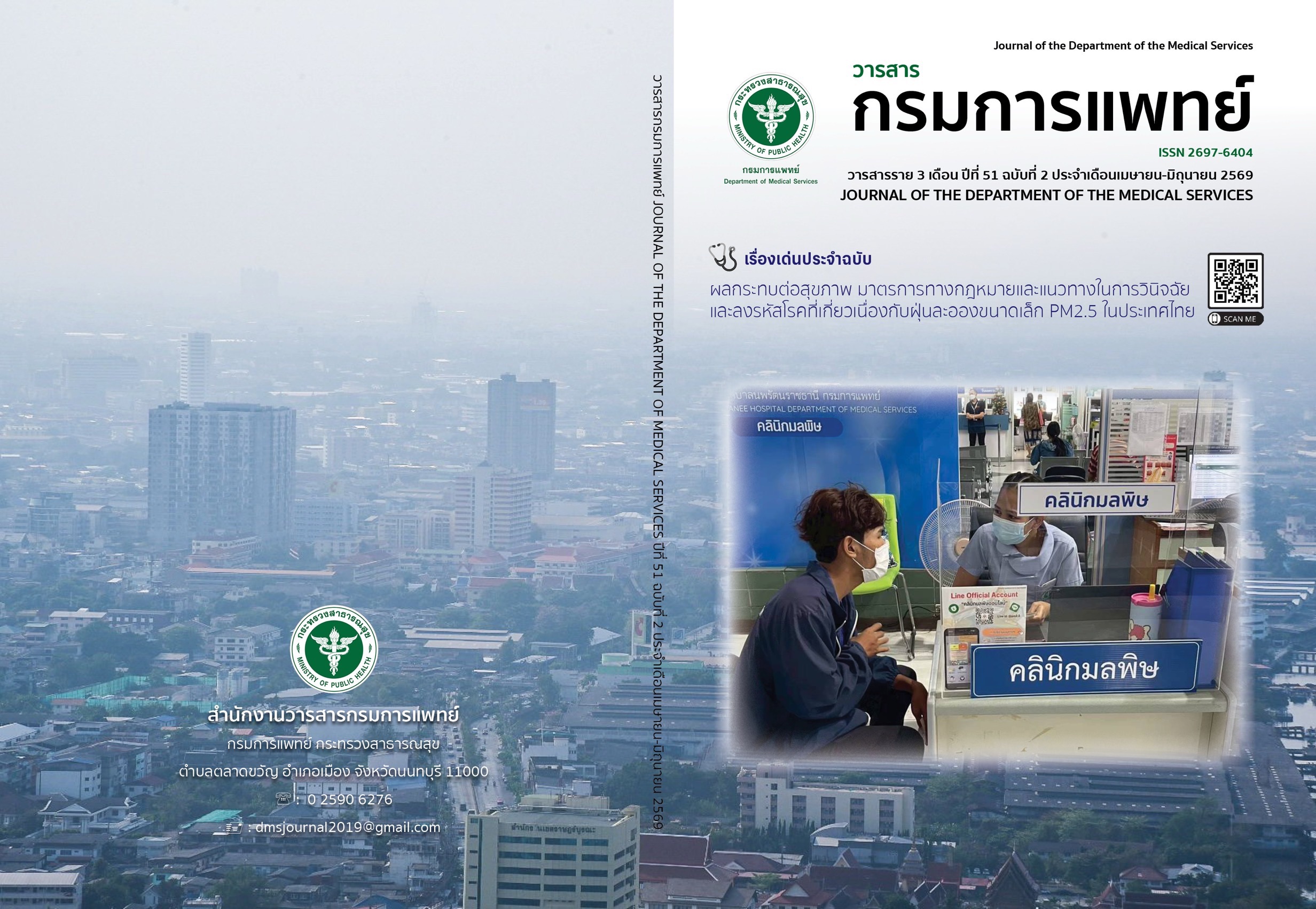
Health Impacts, Regulatory Frameworks, and Clinical Coding Guidelines for PM2.5 Exposure in Thailand
Keywords:
PM2.5, Clinical coding, Health surveillance system, Occupational and environmental medicineAbstract
Background: Fine particulate matter with an aerodynamic diameter of less than 2.5 micrometers (PM2.5) represents a critical environmental health risk factor. The World Health Organization (WHO) estimated that exposure to PM2.5 contributes to approximately 4-9 million premature deaths worldwide and 25,432 deaths annually in Thailand. Despite these severe impacts, statistical surveillance and the enforcement of regulatory frameworks in Thailand remain limited. Objective: To review scientific evidence regarding the health impacts of PM2.5 exposure within the context of occupational and environmental medicine; to analyze legal frameworks and ambient air quality standards in Thailand; and to identify clinical diagnosis and coding methods to enhance the statistical accuracy of tracking affected populations. Methods: A narrative literature review was conducted using PubMed and Scopus Databases, alongside relevant government policy documents published up to 2026. Results: PM2.5 exposure is significantly associated with various disease groups, while Thailand's annual average PM2.5 levels consistently exceed standard guidelines. In clinical practice, challenges persist in both differential diagnosis and the under-coding of co-morbidities. This article identifies guidelines for utilizing code Z58.1 (Exposure to air pollution) alongside code Y97 (Environmental-pollution-related condition) as secondary codes in health database systems. Conclusion: All physicians, alongside occupational and environmental medicine specialists, play a pivotal role in diagnosing PM2.5-related illnesses and supporting policy advocacy. Utilizing precise diagnostic data to generate robust health statistics is essential for driving sustainable public health policies and protecting the population from the hazards of PM2.5.
References
World Health Organization. WHO Global Air Quality Guidelines: Particulate Matter (PM2.5 and PM10), Ozone, Nitrogen Dioxide, Sulfur Dioxide and Carbon Monoxide. Geneva: WHO; 2021.
Asian and Pacific Centre for Transfer of Technology (APCTT). Assessment report technological interventions and gaps in air pollution control in Bangkok, Thailand. Bangkok: APCTT; 2024.
Archer D, Bhatpuria D, Nikam J, Taneepanichskul N. Particulate matter pollution in central Bangkok: assessing outdoor workers’ perceptions and exposure. Cities & Health 2024:1-19.
กรมควบคุมมลพิษ. มาตรฐานคุณภาพอากาศในบรรยากาศสำหรับ PM2.5 (ปรับปรุงมิถุนายน 2566). กรุงเทพฯ: กรมควบคุมมลพิษ กระทรวงทรัพยากรธรรมชาติและสิ่งแวดล้อม; 2566.
Li HY, Gao TY, Fang W, Xian-Yu CY, Deng NJ, Zhang C, et al. Global, regional and national burden of chronic obstructive pulmonary disease over a 30-year period: Estimates from the 1990 to 2019 Global Burden of Disease Study. Respirology 2023;28(1):29-36.
Wang Q, Liu S. The effects and pathogenesis of PM2.5 and its components on chronic obstructive pulmonary disease. Int J Chron Obstruct Pulmon Dis 2023;18:493-506.
Hamra GB, Guha N, Cohen A, Laden F, Raaschou-Nielsen O, Samet JM, et al. Outdoor particulate matter exposure and lung cancer: a systematic review and meta-analysis. Environ Health Perspect 2014;122(9):906-11.
Salvi SS, Barnes PJ. Chronic obstructive pulmonary disease in non-smokers. Lancet 2009;374(9691):733-43.
Krittanawong C, Qadeer YK, Hayes RB, Wang Z, Thurston GD, Virani S, et al. PM2.5 and cardiovascular diseases: State-of-the-Art review. Int J Cardiol Cardiovasc Risk Prev 2023;19:200217.
Ghosh A. Air-pollutant Particulate Matter 2.5 (PM2.5)-induced Inflammation and Oxidative Stress in Diseases: Possible Therapeutic Approaches 2024;11(1):2148-62.
Guo J, Chai G, Song X, Hui X, Li Z, Feng X, et al. Long-term exposure to particulate matter on cardiovascular and respiratory diseases in low- and middle-income countries: A systematic review and meta-analysis. Front Public Health 2023;11:1134341.
Cristaldi A, Fiore M, Oliveri Conti G, Pulvirenti E, Favara C, Grasso A, et al. Possible association between PM2.5 and neurodegenerative diseases: a systematic review. Environ Res 2022;208:112581.
Jiang L, Shao M, Song C, Zhou L, Nie W, Yu H, et al. The role of epigenetic mechanisms in the development of PM2.5-induced cognitive impairment. Toxics 2025;13(2):119.
Liviero F, Pavanello S. Epidemiological and mechanistic links between PM2.5 exposure and type 2 diabetes: focus on the TRPV1 receptor. Front Endocrinol (Lausanne) 2025;16:1653375.
Parasin N, Amnuaylojaroen T, Saokaew S. Prenatal PM2.5 Exposure and its association with low birth weight: a systematic review and meta-analysis. Toxics 2024;12(7):446.
IQAir. 2025 World Air Quality Report: Region & Country PM2.5 Ranking. [Internet] Goldach: IQAir; 2026 [cited 2026]. Available from: https://www.iqair.com/world-air-quality-report
Institute of Medicine. Chapter, Taking an exposure History. In: Environmental Medicine: Integrating a Missing Element into Medical Education. Washington, DC: National Academies Press; 1995.
สำนักงานปลัดกระทรวงสาธารณสุข. คู่มือการดำเนินงานด้านการแพทย์และสาธารณสุข กรณีหมอกควันและฝุ่นละอองขนาดเล็ก ปี 2569. นนทบุรี: กระทรวงสาธารณสุข; 2569.
สำนักนโยบายและยุทธศาสตร์ กระทรวงสาธารณสุข. คู่มือแนวทางการจัดทำและการให้รหัสรหัสโรคและหัตถการ (ICD-10 และ ICD-9-CM) สำหรับประเทศไทย. นนทบุรี: กระทรวงสาธารณสุข; 2565.
Downloads
Published
How to Cite
Issue
Section
License
Copyright (c) 2026 Department of Medical Services, Ministry of Public Health

This work is licensed under a Creative Commons Attribution-NonCommercial-NoDerivatives 4.0 International License.
บทความที่ได้รับการตีพิมพ์เป็นลิขสิทธิ์ของกรมการแพทย์ กระทรวงสาธารณสุข
ข้อความและข้อคิดเห็นต่างๆ เป็นของผู้เขียนบทความ ไม่ใช่ความเห็นของกองบรรณาธิการหรือของวารสารกรมการแพทย์


