
Risk and Protective Factors of People Who Attempted Suicide in the 7 Health District of Thailand
Article Sidebar
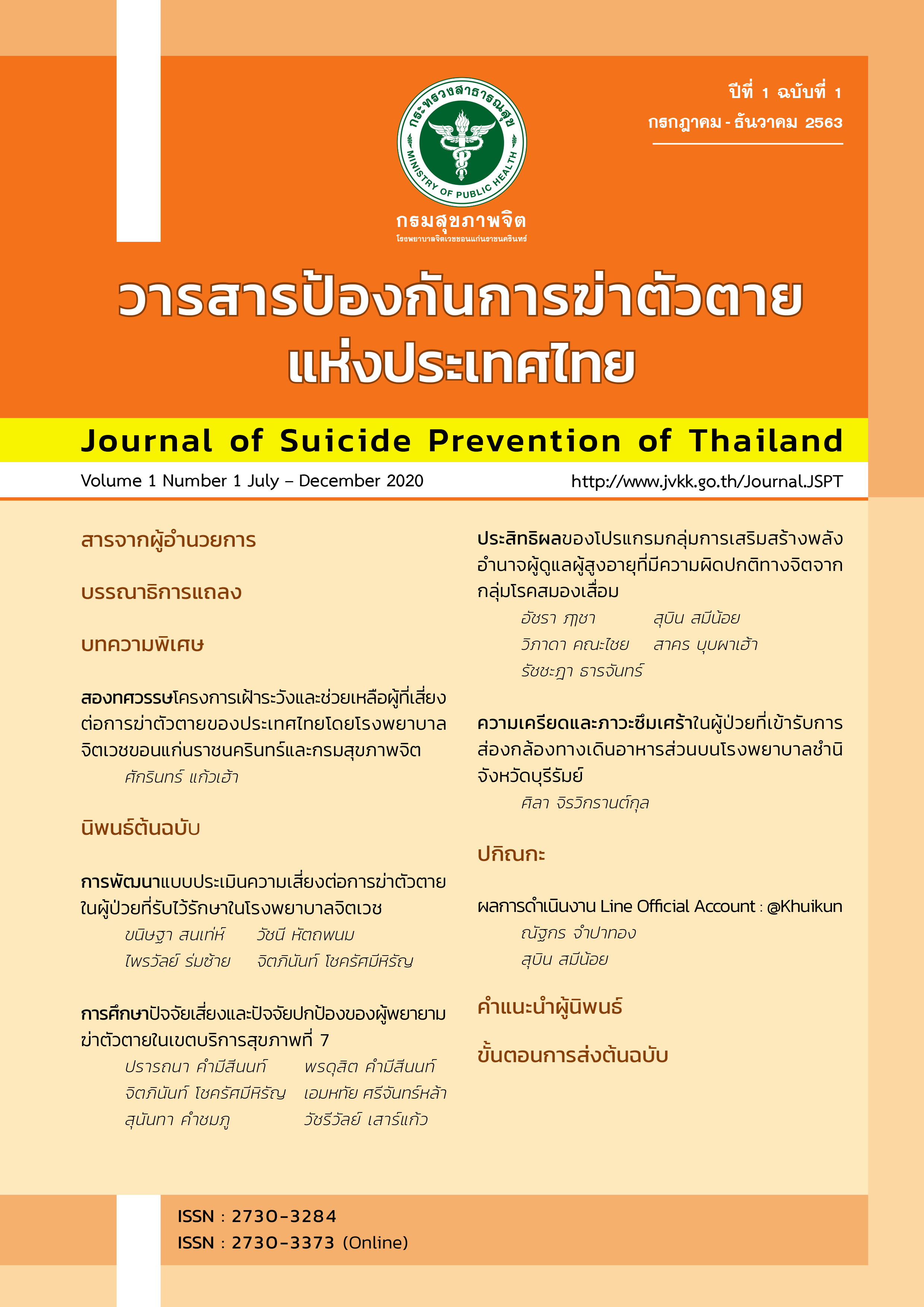
Main Article Content
Abstract
Objective: To study the risk and protective factors of people who attempted suicide.
Materials and methods: This case-control study examined the risk and protective factors of 89 people who attempted suicide (cases) in the 7th Health District of Thailand and 267 general people (control). Data were collected using a researcher-developed structured interview guide and survey form with a reliability of 0.88. Data were analyzed with descriptive statistics, logistic regression, and odds ratios using Stata, version 10, setting a significance alpha level at 0.05.
Results: Risk factors associated with attempted suicide were marital status (divorced or widowed) (OR = 7.77; 95% CI = 1.18 - 51.22), history of physical abuse by a parent or caregiver (OR = 11.44; 95% CI = 1.67 - 78.17), and conflict with a family member or a neighbor during the past 3 months (OR = 19.14; 95% CI = 3.78 - 96.94). Protective factors associated with a suicide attempt were having problem-solving skills (OR = 0.02;95%. CI = 0.00 - 0.16) and supportive people during difficult situations (OR = 0.04; 95% CI = 0.00 - 0.48).
Conclusion: Prevention of suicide requires health care professionals to increase their awareness and pay greater attention to promoting problem solving skills. Health care professionals need to discover the suicidal person’s social support system and psychological resources to enhance the protective factors to avoid further attempts. These strategies can be applied to help people who attempt suicide to problem solve more effectively.
Article Details
References
WorldHealth Organization Preventing suicide : a resource for general physicians. Department of Mental Health. Geneva: World Health Organization;2000.
มาโนช หล่อตระกูล. การฆ่าตัวตาย : การรักษาและป้องกัน.กรุงเทพฯ: บียอนด์เอนเทอร์ไพรซ์; 2553.
Hawton, K., Van Heeringen, K. Suicide. The Lancet, 2009, 373, 1372-1381.
อภิชัย มงคล, ทวี ตั้งเสรี, สุพิน พิมพ์เสน, ปัตพงษ์เกษสมบูรณ์, และนุศราพรเกษสมบูรณ์. รายงานผลการศึกษาเรื่องระบาดวิทยาของพฤติกรรมการทำร้ายตนเองและการฆ่าตัวตายปี พ.ศ. 2545. ขอนแก่น: คอมฟอร์ม (ขอนแก่น) จำกัด; 2546.
อภิชัย มงคล และคณะ.รายงานการประเมินผลเรื่อง โครงการป้องกันช่วยเหลือผู้มีภาวะซึมเศร้าและผู้ที่เสี่ยงต่อการฆ่าตาย พ.ศ. 2552. นนทบุรี: กรมสุขภาพจิต กระทรวงสาธารณสุข, 2553.
หวาน ศรีเรือนทองและคณะ.ความเสี่ยงการฆ่าตัวตายของคนไทย:การสำรวจระดับชาติ.วารสารสมาคมจิตแพทย์แห่งประเทศไทย 2554; 56(4): 413-424.
กรมสุขภาพจิต. ระบาดวิทยาของปัญหาสุขภาพจิตและโรคทางจิตเวช.นนทบุรี. สำนักพัฒนาสุขภาพจิต, 2548.
Varcarolis, E.M. Foundation of psychiatric mental health nursing. A clinical approach. Philadelphia saunders, 2002.
Shives RL. Basic concept of psychiatric-mental health nursing. 6thed. Philadelphia: Lippincott Williams &Wilkins; 2005.
Valfre, M. M. Foundations of mental health care (3th ed.) Philadelphia: Mosby.2005.
Stuart ,W.G., &Laraia, L.M. Principle and practice of psychiatric nursing (8th ed). St.Louis: Mossby, 2005.
Boyd, A. M. Psychiatric nursing contempolary practice (2nd ed.). Philadelphia : Lippincott Williums& Wilkins. 2005.
New Zealand Guidelines Group (NZGG) and Ministry of Health. 2003. BEST PRACTICEEVIDENCE-BASEDGUIDELINETHE ASSESSMENT ANDMANAGEMENT OFPEOPLE AT RISKOF SUICIDE.Review Date: 2008 from https://www.health.govt.nz/system/files/documents/publications/suicide_guideline.pdf
อนุพงศ์ คำมา.ปัจจัยที่เกี่ยวข้องกับการฆ่าตัวตายสำเร็จ : กรณีศึกษาจังหวัดสุโขทัย.วารสารสมาคมจิตแพทย์แห่งประเทศไทย 2556 ; 58 (1) : 3-6.
กรมสุขภาพจิต.รายงานประจำปี กรมสุขภาพจิต ปีงบประมาณ 2554. กองแผนงาน กรมสุขภาพจิต กระทรวงสาธารณสุข นนทบุรี. 2554.
สุวนีย์ เกี่ยวกิ่งแก้ว. การพยาบาลจิตเวช. พิษณุโลก: รัตนสุวรรณการพิมพ์.; 2545.
ศุภรัตน์ เอกอัศวิน. การพยายามฆ่าตัวตายซ้ำในวัยรุ่นที่แผนกผู้ป่วยนอกโรงพยาบาลจิตเวช. วารสารสุขภาพจิตแห่งประเทศไทย 2547; 12(1): 40-49.
พรศิลป์ อุปนันท์. ปัจจัยที่กระตุ้นให้เกิดการฆ่าตัวตายของผู้รับบริการในโรงพยาบาลแม่จัน จังหวัดเชียงราย. วารสารสวนปรุง2552; 25(2): 27-37.
สมภพ เรืองตระกูล.การฆ่าตัวตาย : การประเมินและการรักษา.พิมพ์ครั้ง 1.คณะแพทยศาสตร์ศิริราชพยาบาล มหาวิทยาลัยมหิดล.2551.
Lester, D. Domestic integration and the Taiwanese homicide and suicide rate. Chinese Journal of Mental Health, 1995, 8(3), 21-25.
Mastekaasa, A. ‘Marital status and subjective well-being: A changing relationship’, Social Indicators Research. 1993, (29), 249–276.
Stack, S. The Impact of Divorce on Suicide in Norway, 1951-1980. Journal of Marriage and Family 1989, 51 (1), 229-238.
Dube SR, Anda RF, Felitti VJ, Chapman DP, Williamson DF, Giles WH. Childhood abuse, Hawton, K., Van Heeringen, K. Suicide. The Lancet, 2009, 373, 1372-1381.
Greydanus DE, BacopoulouF,Tsalamanios E. Suicide in adolescents: aworldwidepreventabletragedy. Keio J Med 2009; 58: 95-102.
วิภาพร เสตะจันทร์. ระบาดวิทยาการทำร้ายตนเองและการฆ่าตัวตายของประชาชนจังหวัดบุรีรัมย์.วารสารโรงพยาบาลจิตเวชนครราชสีมาราชนครินทร์ 2553 ; 11(ตุลาคม 2553 – กันยายน 2554) : 51-59
วินิทรา นวลลออ. ความชุกโรคซึมเศร้าในกลุ่มผู้ป่วยที่พยายามฆ่าตัวตายหรือทำร้ายตนเองที่มาตรวจรักษาในโรงพยาบาลธรรมศาสตร์เฉลิมพระเกียรติ. 2550; 52(1),19-28.
ชาติชัย มหาเจริญสิริ. การศึกษาผู้ป่วยฆ่าตัวตายที่รับการรักษาที่โรงพยาบาลโคกสำโรง. วารสารวิจัยระบบสาธารณสุข 2551, 2(1),816-822.
ศักดา ขำคม.แบบแผนการดำเนินชีวิตของผู้ที่ไม่พยายามฆ่าตัวตายซ้ำอีก: กรณีศึกษาภาคตะวันออกเฉียงเหนือของประเทศไทย. วิทยานิพนธ์ศิลปะศาสตร์ดุษฎีบัณฑิต สาขาวิชาพัฒนศาสตร: บัณฑิตวิทยาลัย มหาวิทยาลัยขอนแก่น; 2552.
Donald,M., Dower,J., Correa-Velez,I., &Jones,M. (2006). Risk and protective factors for medically serioussuicide attempts: a comparison of hospital-based with population-based samples of young adults. Australian and New Zealand Journal of Psychiatry, 40(1), 87-96.
