
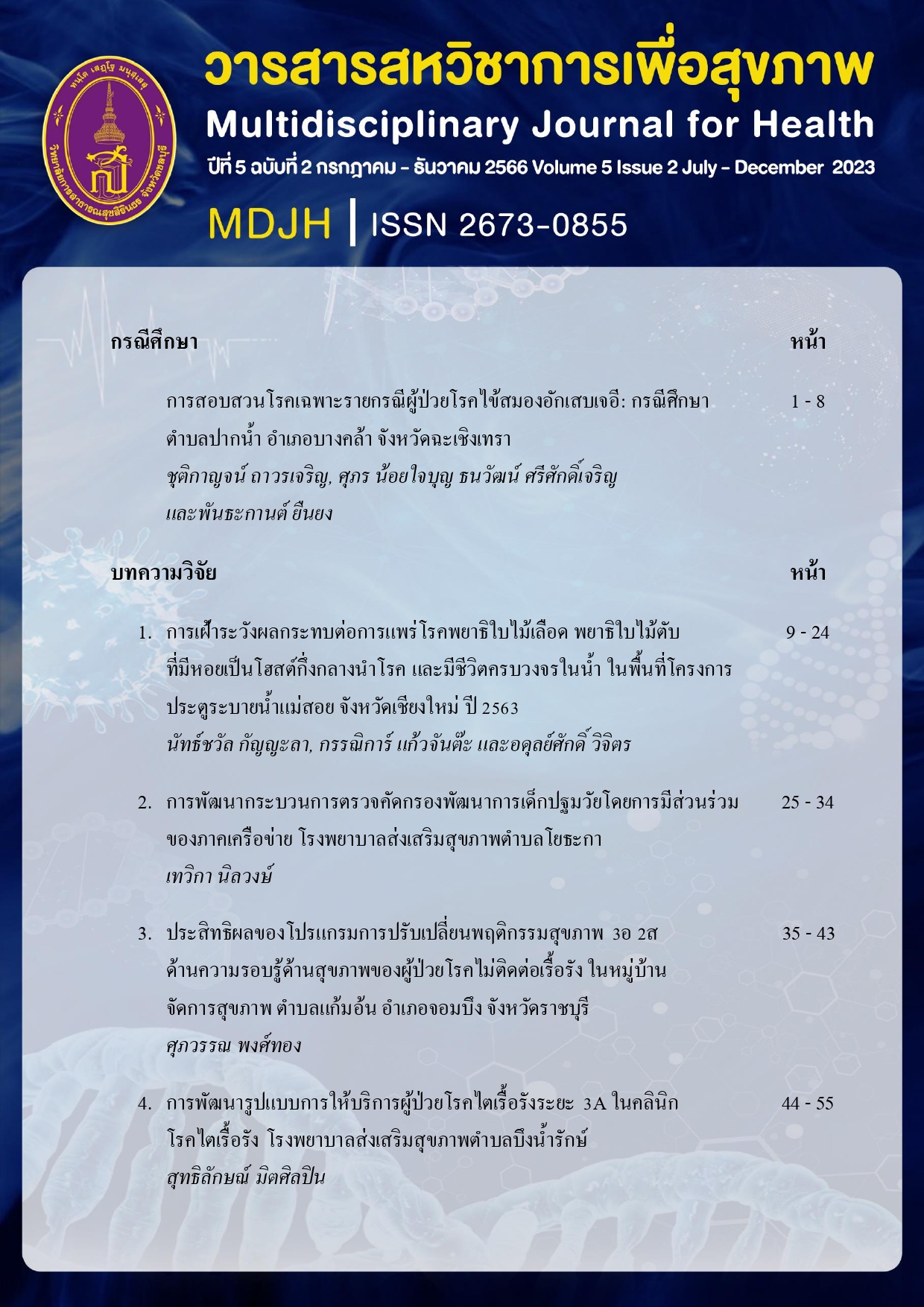
Case Investigation of Japanese encephalitis (JE) in Pak-nam sub-district, Bang-khla district, Chachoengsao province
Keywords:
Case investigation, Japanese Encephalitis (JE), ChachoengsaoAbstract
On August 11, 2023, Bang-khla Hospital received a report of one confirmed case of Japanese Encephalitis (JE) from the Chachoengsao Epidemiology Center for Infectious Diseases. The patient was identified and treated at Chulalongkorn Hospital. The disease investigation team of Bang-khla Hospital subsequently conducted field investigation from August 11 to 17, 2023 with the following objectives: 1) to confirm the disease diagnosis 2) to study the epidemiological characteristics of the disease in terms of individual, time, and location 3) to identify the sources of disease, methods of transmission method, and contacts, and 4) to find measures for disease prevention and. This study was a descriptive epidemiological investigation using specific JE investigation form. Data were collected by patients' treatment reports and parents’ interview.
The results indicated that the patient was 3-year and 7-month-old Thai male. The patient has never been vaccinated against JE and developed symptoms on July 9, 2023. These symptoms included fever, no cough, no runny nose, nausea, vomiting (twice), diarrhea and reduced food intake. The patient received treatment at a clinic in Phanom Sarakham District. On July 11, 2023, the patient exhibited fever, restlessness, lethargy, and speechlessness. Thus, prompting treatment at Phanom Sarakham Hospital. The patient was subsequently transferred to Buddhasothorn Hospital and Chulalongkorn Hospital for further treatment. Laboratory results showed anti-JE IgM at 65 units (normal range 0-39 units), anti-dengue IgM at 6 units (normal range 0-39 units), and anti-dengue IgG at 9 units (normal range 0-99 units). The environmental survey revealed that there was mosquito net in the windows, but no net in the doors and no bed netting at patient’s house. There was a significant amount of household waste in the surrounding area. The house was in a rice field with waterlogged soil for cultivating. Recommendations for disease prevention in this case include proactive immunization targeting children residing in the area, monitoring vaccination status, and advocating for the destruction of mosquito breeding grounds. Additionally, environmental management should be consistently and regularly carried out to maintain cleanliness of the community.
References
ศูนย์สมองและประสาท โรงพยาบาลเพชรเวช. มีไข้สูง ปวดศีรษะ สัญญาณอันตรายของโรคไข้สมองอักเสบ [อินเทอร์เน็ต]. 2563 [เข้าถึงเมื่อ14 ส.ค.2566] เข้าถึงได้จาก www.petcharavejhospital.com/th/ Article/article_detail/Encephalitis_JE.
วินัย รัตนสุวรรณ.โรคไข้สมองอักเสบ [อินเทอร์เน็ต]. 2553 [เข้าถึงเมื่อ18 ส.ค.2566] เข้าถึงได้จาก https://www.si.mahidol.ac.th/th/department/preventive/article_detail.asp?id=2
โรงพยาบาลพิษณุเวช. การรับวัคซีนสำหรับลูกน้อย [อินเทอร์เน็ต]. 2566 [เข้าถึงเมื่อ 18 ส.ค.2566] เข้าถึงได้จาก https://www.pitsanuvej.com/articles/vaccine-table
สำนักงานป้องกันควบคุมโรคที่ 9 นครราชสีมา. รายงานประจำปี สถานการณ์โรคที่เฝ้าระวังทางระบาดวิทยา. นครราชสีมา: สำนักงานป้องกันควบคุมโรค; 2565
กลุ่มงานควบคุมโรคติดต่อ สสจ.ฉะเชิงเทรา.รายงานผู้ป่วยโรคไข้สมองอักเสบ จังหวัดฉะเชิงเทรา ปี 2565. ฉะเชิงเทรา : สำนักงานสาธารณสุขจังหวัด; 2565
กองระบาดวิทยา. นิยามโรคและแนวทางการรายงานโรคติดต่ออันตราย และโรคติดต่อที่ต้องเฝ้าระวังในประเทศไทย. นนทบุรี. แคนนา กราฟฟิค; 2563
กองโรคติดต่อทั่วไป กรมควบคุมโรค. กำหนดการให้วัคซีน ตามแผนงานสร้างเสริมภูมิคุ้มกันโรคของกระทรวงสาธารณสุข.นนทบุรี; 2566
Downloads
Published
Issue
Section
License
Copyright (c) 2023 Multidisciplinary for Health Journal

This work is licensed under a Creative Commons Attribution-NonCommercial-NoDerivatives 4.0 International License.


