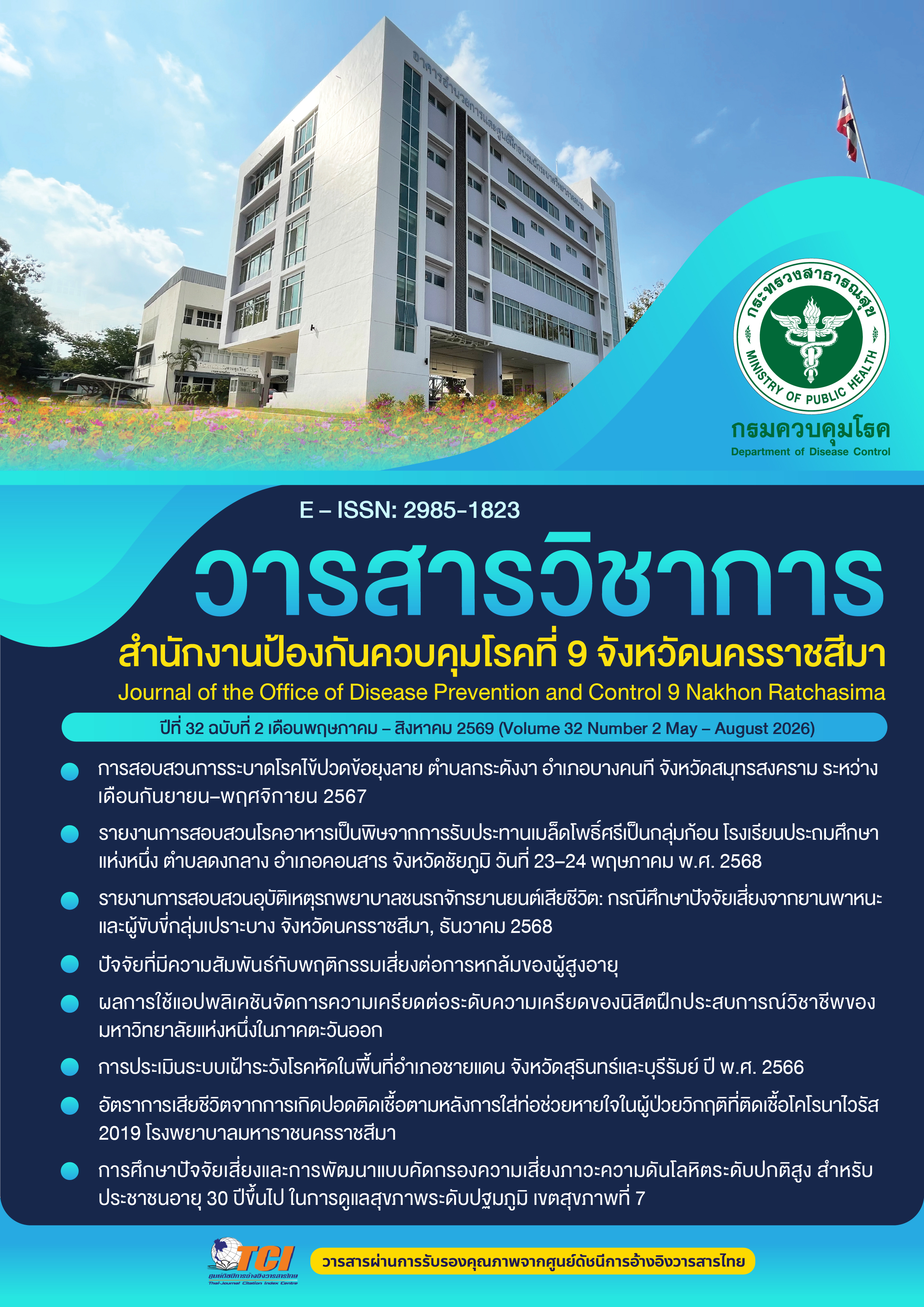
การศึกษาปัจจัยเสี่ยงและการพัฒนาแบบคัดกรองความเสี่ยงภาวะความดันโลหิตระดับปกติสูง สำหรับประชาชนอายุ 30 ปีขึ้นไป ในการดูแลสุขภาพระดับปฐมภูมิ เขตสุขภาพที่ 7
คำสำคัญ:
ปัจจัยเสี่ยง, การพัฒนาแบบการคัดกรอง, ภาวะความดันโลหิตระดับปกติสูง, เขตสุขภาพที่ 7บทคัดย่อ
การศึกษานี้มีวัตถุประสงค์เพื่อศึกษาปัจจัยเสี่ยงและพัฒนาแบบคัดกรองความเสี่ยงภาวะความดันโลหิตระดับปกติสูง (ค่าความดันโลหิตตัวบน (SBP) ตั้งแต่ 130 มิลลิเมตรปรอท และ/หรือ ค่าความดันโลหิตตัวล่าง (DBP) ตั้งแต่ 85 มิลลิเมตรปรอท) สำหรับดูแลสุขภาพระดับปฐมภูมิพื้นที่เขตสุขภาพที่ 7 เป็นการศึกษาเชิงวิเคราะห์แบบภาคตัดขวาง ดำเนินการระหว่างเดือนมกราคม–กรกฎาคม 2565 กลุ่มตัวอย่างคือ ประชาชนอายุ 30 ปีขึ้นไปในพื้นที่เขตสุขภาพที่ 7 จำนวน 7,141 คน คัดเลือกประชากรจากเกณฑ์คัดเข้าใน 4 ตำบลของ 4 จังหวัดเป้าหมาย เก็บรวบรวมข้อมูลโดยอาสาสมัครสาธารณสุขประจำหมู่บ้าน (อสม.) ผ่านแบบสัมภาษณ์ปัจจัยเสี่ยง ประกอบด้วย 2 ส่วน ได้แก่ ส่วนที่ 1 ข้อมูลทั่วไปและภาวะสุขภาพ และส่วนที่ 2 พฤติกรรมสุขภาพ วิเคราะห์ข้อมูลด้วยสถิติเชิงพรรณนา วิเคราะห์ปัจจัยที่มีความสัมพันธ์กับภาวะความดันโลหิตระดับปกติสูงด้วยค่า crude odds Ratio (OR) และ adjusted odds ratio (AOR) ประเมินประสิทธิภาพแบบคัดกรองด้วยพื้นที่ใต้เส้นโค้ง receiver operating characteristic (ROC) curve หรือ area under the curve (AUC) รวมทั้งค่าความไว ค่าความจำเพาะ ค่าพยากรณ์ผลบวก ค่าพยากรณ์ผลลบ และความถูกต้อง ผลการศึกษาพบความชุกของภาวะความดันโลหิตระดับปกติสูง ร้อยละ 34.5 ส่วนใหญ่อยู่ในช่วงอายุ 35–59 ปี (ร้อยละ 52.6) โดยพบว่า เพศ อายุ ดัชนีมวลกาย ภาวะอ้วนลงพุง โรคเบาหวาน มีญาติสายตรงเป็นโรคความดันโลหิตสูง การดื่มแอลกอฮอล์ และการดื่มเครื่องดื่มที่มีไขมันสูง มีความสัมพันธ์กับภาวะความดันโลหิตระดับปกติสูงอย่างมีนัยสำคัญทางสถิติ (p < 0.05) สำหรับแบบคัดกรองพบว่า เมื่อกำหนดจุดตัด ตั้งแต่ 7 คะแนนขึ้นไป มีพื้นที่ใต้เส้นโค้ง (AUC) เท่ากับ 0.632 (จำแนกได้ระดับต่ำ) มีค่าความไว ร้อยละ 75.0 (95%CI: 73.2–76.7) (พอใช้สำหรับการคัดกรองเบื้องต้น) ค่าความจำเพาะ ร้อยละ 43.0 (95%CI: 41.5–44.4) (จำแนกได้ค่อนข้างต่ำ) ค่าพยากรณ์ผลบวก ร้อยละ 40.9 ค่าพยากรณ์ผลลบ ร้อยละ 76.6 และความถูกต้องโดยรวม ร้อยละ 54.0 แบบคัดกรองนี้สามารถนำไปพัฒนาต่อเป็นแบบคัดกรองตนเองหรือแบบคัดกรองในระบบบริการสุขภาพปฐมภูมิ โดยพิจารณาขยายเกณฑ์อายุเริ่มต้นเป็น 30 ปี และกำหนดจุดตัดตั้งแต่ 6 คะแนนขึ้นไปสำหรับกลุ่มอายุ 30–34 ปี ตั้งแต่ 7 คะแนนขึ้นไปสำหรับกลุ่มอายุ 35–59 ปี และตั้งแต่ 10 คะแนนขึ้นไปสำหรับกลุ่มอายุ 60 ปีขึ้นไป
เอกสารอ้างอิง
World Health Organization. The top 10 causes of death [Internet]. Geneva: WHO; 2020 [cited 2024 Jun 9]. Available from: https://www.who.int/news-room/fact-sheets/detail/the-top-10-causes-of-death
World Stroke Organization. Global Stroke Fact Sheet 2019 [Internet]. 2019 [cited 2022 Oct 4]. Available from: https://www.world-stroke.org/assets/downloads/WSO_Fact-sheet_15.01.2020. pdf
Ministry of Public Health (Thailand). Health Data Center: hypertension report [Internet]. [cited 2024 May 17]. Available from: https://hdc.moph.go.th/center/public/standard-report-detail/e0d72f9ec9848a10b70f5872bb6830e8
Aekplakorn W, Puckcharern H, Satheannoppakao W. Thai National Health Examination Survey VI (2019–2020). Nonthaburi: Faculty of Medicine Ramathibodi Hospital, Mahidol University; 2021.
Ministry of Public Health (Thailand). Public health statistics A.D. 2022 [Internet]. [cited 2024 May 17]. Available from: https://spd.moph.go.th/public-health-statistics/
Department of Disease Control (Thailand). Indicators for monitoring and evaluating quality of services in non-communicable disease management [Internet]. [cited 2024 Jun 8]. Available from:https://ddc.moph.go.th/uploads/publish/1186620211006043036.pdfhttps://ddc.moph.go.th/uploads/publish/1186620211006043036.pdf
Thai Hypertension Society. Guidelines for hypertension management in general practice 2019 [Internet]. [cited 2024 Jun 8]. Available from: https://www.thaihypertension.org/files/442.HT% 20guideline%202019.with%20watermark.pdf
Ishikawa Y, Ishikawa J, Ishikawa S, Kario K, Kajii E. Progression from prehypertension to hypertension and risk of cardiovascular disease. J Epidemiol 2017;27(1):8–13.
Zhang Y, Moran AE. Trends in the prevalence, awareness, treatment, and control of hypertension among young adults in the United States, 1999–2014. Hypertension 2017;70(4):736 –42. https://www.thaihypertension.org/files/442.HT%20guideline%202019.with%20watermark.pdf
Yoon SS, Fryar CD, Carroll MD. Hypertension prevalence and control among adults: United States, 2011–2014. NCHS Data Brief 2015;(220):1–8.
Sullivan LM, Massaro JM, D’Agostino RB Sr. Presentation of multivariate data for clinical use: the Framingham Study risk score functions. Stat Med 2004;23(10):1631–60.
Sathish T, Kannan S, Sarma PS, Razum O, Thrift AG, Thankappan KR. A risk score to predict hypertension in primary care settings in rural India. Asia Pac J Public Health 2016;28(1 Suppl):26S–31S.
Echouffo-Tcheugui JB, Batty GD, Kivimaki M, Kengne AP. Risk models to predict hypertension: a systematic review. PLoS One 2013;8(7):e67370.
Thawornchaisit P, De Looze F, Reid CM, Seubsman SA, Sleigh AC. Health risk factors and the incidence of hypertension: 4-year prospective findings from a national cohort of 60,569 Thai Open University students. BMJ Open 2013;3(6):e002826.
Forouzanfar MH, Liu P, Roth GA, Ng M, Biryukov S, Marczak L, et al. Global burden of hypertension and systolic blood pressure of at least 110 to 115 mm Hg, 1990–2015. JAMA 2017;317(2):165–82.
Nawi AM, Mohammad Z, Jetly K, Abd Razak MA, Ramli NS, Wan Ibadullah WAH, et al. The prevalence and risk factors of hypertension among the urban population in Southeast Asian countries: a systematic review and meta-analysis. Int J Hypertens 2021;2021:6657003.
Suwannapong T, Punnarat O, Boonchoo C. Risk factors for hypertension among rural Thais. Southeast Asian J Trop Med Public Health 2011;42(1):208–17.
Li C, Shang S. Relationship between sleep and hypertension: findings from the NHANES (2007–2014). Int J Environ Res Public Health 2021;18(15):7867.
Bursac Z, Gauss CH, Williams DK, Hosmer DW. Purposeful selection of variables in logistic regression. Source Code Biol Med 2008;3:17.
Hosmer DW Jr, Lemeshow S, Sturdivant RX. Applied logistic regression. 3rd ed. Hoboken (NJ): John Wiley & Sons; 2013.
Filippini T, Malavolti M, Whelton PK, Vinceti M. Sodium intake and risk of hypertension: a systematic review and dose-response meta-analysis of observational cohort studies. Curr Hypertens Rep 2022;24(5):133–44.
Wang Q, Song X, Du S, Du W, Su C, Zhang J, et al. Waist circumference trajectories in relation to blood pressure and the risk of hypertension in Chinese adults. Nutrients 2022;14(24):5260.
Ranasinghe P, Cooray DN, Jayawardena R, Katulanda P. The influence of family history of hypertension on disease prevalence and associated metabolic risk factors among Sri Lankan adults. BMC Public Health 2015;15:576.
Jayalath VH, de Souza RJ, Ha V, Mirrahimi A, Blanco-Mejia S, Di Buono M, et al. Sugar-sweetened beverage consumption and incident hypertension: a systematic review and meta-analysis of prospective cohorts. Am J Clin Nutr 2015;102(4):914–21
ดาวน์โหลด
เผยแพร่แล้ว
รูปแบบการอ้างอิง
ฉบับ
ประเภทบทความ
สัญญาอนุญาต
ลิขสิทธิ์ (c) 2026 สำนักงานป้องกันควบคุมโรคที่ 9 จังหวัดนครราชสีมา

อนุญาตภายใต้เงื่อนไข Creative Commons Attribution-NonCommercial-NoDerivatives 4.0 International License.
บทความที่ได้รับการตีพิมพ์ในวารสารวิชาการสำนักงานป้องกันควบคุมโรคที่ 9 จังหวัดนครราชสีมา ถือว่าเป็นลิขสิทธิ์ ของสำนักงานป้องกันควบคุมโรคที่ 9 จังหวัดนครราชสีมา