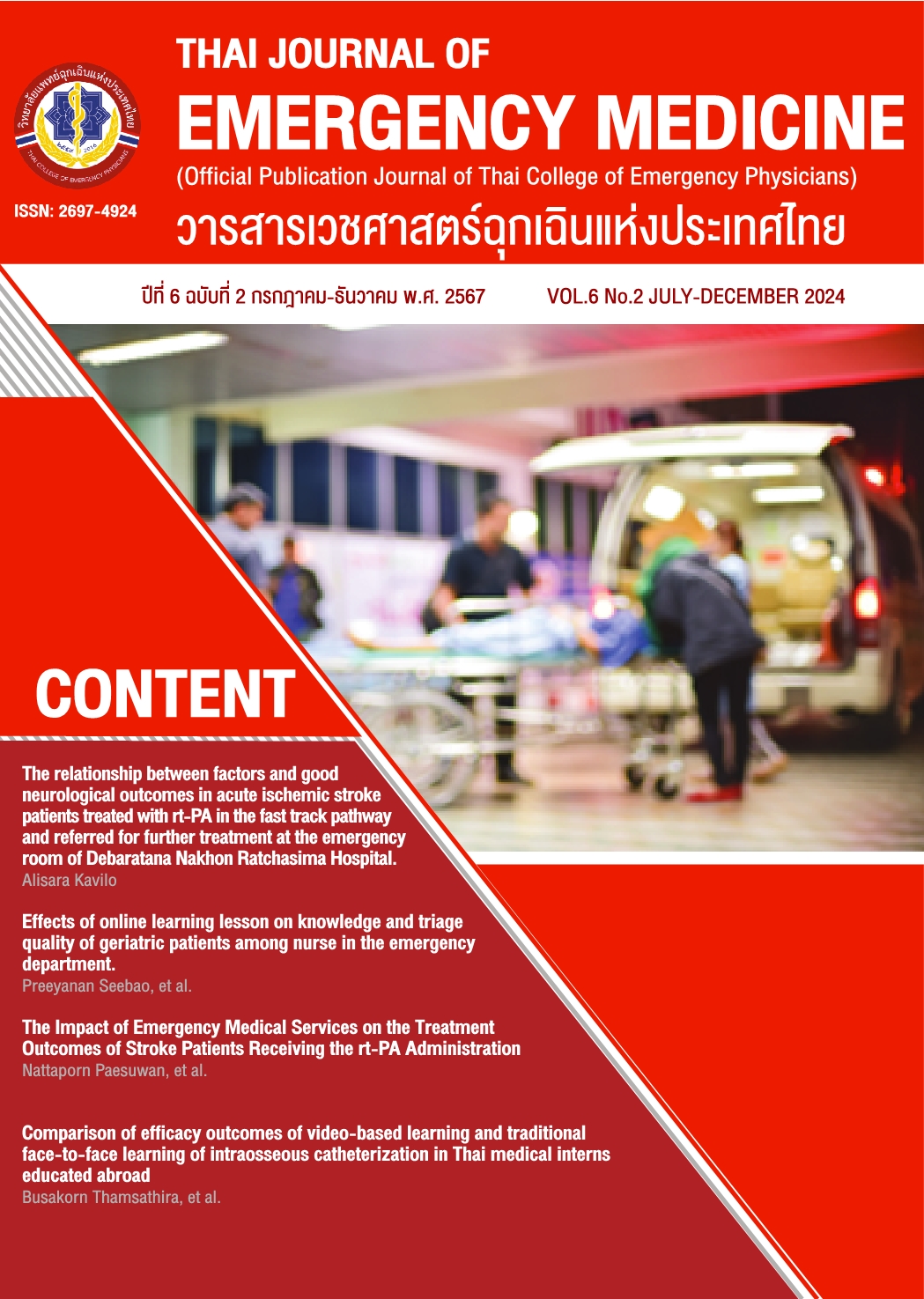
The Impact of Emergency Medical Services on the Treatment Outcomes of Stroke Patients Receiving the rt-PA Administration
Keywords:
Emergency Medical Services, Ischemic stroke, Recombinant tissue plasminogen activator (rt-PA)Abstract
Introduction
Emergency Medical Services (EMS) aim to provide timely and effective treatment to patients. Research has shown that acute ischemic stroke patients who EMS transfers often experience shorter reperfusion times and better clinical outcomes. This study aims to investigate these effects in our specific setting.
Objective
To evaluate the impact of Emergency Medical Services (EMS) on the clinical outcomes of ischemic stroke patients who receive rt-PA
Methods
This is a retrospective study that collects data from medical records between January 1, 2016, and December 31, 2023. It compares clinical outcomes and survival rates between stroke patients who were transferred by Emergency Medical Services (EMS group) and those who were not (non-EMS group). Data analysis will be conducted using multiple logistic regression, with a significance level set at <0.05
Results
This study included 214 patients, with a majority being men (52.8%) and a mean age of 62.1 years (standard deviation 13.8 years). Of these, 52 were in the EMS group, while 162 were in the non-EMS group. Patients in the EMS group were more likely to achieve a door-to-needle time of less than 45 and 60 minutes, with odds ratios of 3.91 and 2.73, respectively. However, survival rates and improvements in other clinical outcomes were not significantly different between the two groups.
Conclusion
EMS improves door-to-needle time for stroke patients receiving rt-PA but does not significantly impact other clinical outcomes
References
Tsao CW, Aday AW, Almarzooq ZI, Anderson CAM, Arora P, Avery CL, et al. American heart association council on epidemiology and prevention statistics committee and stroke statistics subcommittee. Heart Disease and Stroke Statistics-2023 Update: A Report From the American Heart Association. Circulation 2023;147(8):e93-e621. doi: 10.1161/CIR.0000000000001123.
Powers WJ, Rabinstein AA, Ackerson T, Adeoye OM, Bambakidis NC, Becker K, et al. Guidelines for the early management of patients with acute ischemic stroke: 2019 update to the 2018 guidelines for the early management of acute ischemic stroke: a guideline for healthcare professionals from the American Heart Association/American stroke association. Stroke 2019;50(12):e344-e418. doi:10.1161/STR.0000000000000211.
Xirasagar S, Wu Y, Heidari K, Zhou J, Tsai MH, Hardin JW, et al. Does emergency medical services transportation mitigate post-stroke discharge disability? a prospective observational study. J Gen Intern Med 2020;35(11):3173-80. doi:10.1007/s11606- 020-06114-4.
Chen H, Wang J, Pan X, Zhang M. Effects of emergency medical services on timely treatment and outcome in stroke patients with intravenous thrombolysis among the severity of neurologic deficits: A retrospective observational study. Medicine (Baltimore) 2023;102(36):e35053. doi: 10.1097/ MD.0000000000035053.
Odom E, Nakajima Y, Vellano K, Al-Araji R, Coleman King S, Zhang Z, et al. Trends in EMS-attended out-of-hospital cardiac arrest survival, United States 2015-2019. Resuscitation 2022;179:88-93. doi: 10.1016/j.resuscitation.2022.08.003.
Van DB, Song KJ, Shin SD, Ro YS, Jeong J, Bao HL, et al. Association between Scene Time Interval and Survival in EMS-Treated Major Trauma Admitted to the Intensive Care Unit: A Multinational, Multicenter Observational Study. Prehosp Emerg Care 2022;26(4):600-7. doi:10.1080/10903127.2021.1992053.
Rafie S, Mofrad-Booshehri N, Shalil-Ahmadi D, Maraghi E. The effect of prehospital notification by Emergency Medical Services on outcomes in patients receiving recombinant tissue-type plasminogen activator (r-tPA). Curr J Neurol 2022;21(2):133-35. doi:10.18502/cjn.v21i2.10497.
Zhang S, Zhang J, Zhang M, Zhong G, Chen Z, Lin L, et al. Prehospital Notification Procedure Improves Stroke Outcome by Shortening Onset to Needle Time in Chinese Urban Area. Aging Dis 2018;9(3):426-34. doi: 10.14336/ AD.2017.0601.
Nielsen VM, DeJoie-Stanton C, Song G, Christie A, Guo J, Zachrison KS. The Association between Presentation by EMS and EMS Prenotification with Receipt of Intravenous Tissue-Type Plasminogen Activator in a State Implementing Stroke Systems of Care. Prehosp Emerg Care 2020;24(3):319-25. doi:10.1080/10903127.2019.1662862.
Patel MD, Rose KM, O’Brien EC, Rosamond WD. Prehospital notification by emergency medical services reduces delays in stroke evaluation: findings from the North Carolina stroke care collaborative. Stroke 2011;42(8):2263-8. doi: 10.1161/STROKEAHA.110.605857.
Gu HQ, Rao ZZ, Yang X, Wang CJ, Zhao XQ, Wang YL, et al. Chinese Stroke Center Alliance Investigators. Use of Emergency Medical Services and Timely Treatment Among Ischemic Stroke. Stroke 2019;50(4):1013-6. doi: 10.1161/STROKEAHA.118.024232.
Ding K, Chen H, Wang Y, Liu H, Zhang W, Wu Y. Emergency medical service utilization and timely treatment among acute ischemic stroke patients in Beijing from 2018 to 2021. Eur J Emerg Med 2023;30(2):125-31. doi: 10.1097/MEJ.0000000000001004.
Ekundayo OJ, Saver JL, Fonarow GC, Schwamm LH, Xian Y, Zhao X, et al. Patterns of emergency medical services use and its association with timely stroke treatment: findings from Get With the Guidelines-Stroke. Circ Cardiovasc Qual Outcomes 2013;6(3):262-9. doi: 10.1161/CIRCOUTCOMES.113.000089.
National Institute for Emergency Medicine[internet].2023. [cited Mar 4, 2024]. Available from: https://ws.niems.go.th/ITEMS_DWH/
Jantasri S, Tiamkao S, Sawanyawisuth K. A 2-point difference of NIHSS as a predictor of acute ischemic stroke outcome at 3 months after thrombolytic therapy. Clin Neurol Neurosurg 2020;198:106206. doi: 10.1016/j.clineuro.2020.106206.
ElHabr AK, Katz JM, Wang J, Bastani M, Martinez G, Gribko M, et al. Predicting 90-day modified rankin scale score with discharge information in acute ischaemic stroke patients following treatment. BMJ Neurol Open 2021;3(1):e000177. doi: 10.1136/bmjno-2021-000177.
Brandler ES, Sharma M, McCullough F, Ben-Eli D, Kaufman B, Khandelwal P, et al. Prehospital stroke identification: factors associated with diagnostic accuracy. J Stroke Cerebrovasc Dis 2015;24(9):2161-6. doi: 10.1016/j.jstrokecerebrovasdis.2015.06.004.
Bae HJ, Kim DH, Yoo NT, Choi JH, Huh JT, Cha JK, et al. Prehospital notification from the emergency medical service reduces the transfer and intra-hospital processing times for acute stroke patients. J Clin Neurol 2010;6(3):138-42. doi:10.3988/jcn.2010.6.3.138.
Phongphuttha W, Tiamkao S. Outcome of stroke fast-track patients arrival by emergency medical services. J Med Assoc Thai 2021;104(suppl 1):S88-93.
Inyu S. Outcome of using EMS versus nonEMS in acute ischemic stroke patients received rt-PA in Emergency Department, Nopparatrajathanee Hospital. [internet]. 2023 [cited Aug 28, 2024]. Available from: https://nrh.nopparat.go.th/research/public/view/pdf/66_6.pdf.
Fonarow GC, Smith EE, Saver JL, Reeves MJ, Hernandez AF, Peterson ED, et al; Improving door-to-needle times in acute ischemic stroke: the design and rationale for the American Heart Association/American Stroke Association’s Target: Stroke initiative. Stroke 2011;42(10):2983-9. doi: 10.1161/STROKEAHA.111.621342.
Tran D, Zhu Z, Shafie M, Abcede H, Stradling D, Yu W. Three easily-implementable changes reduce median door-to-needle time for intravenous thrombolysis by 23 minutes. BMC Neurol 2019;19(1):300. doi: 10.1186/s12883-019-1527-8.
Downloads
Published
How to Cite
Issue
Section
Categories
License
Copyright (c) 2025 Thai Collage of Emergency Physicians

This work is licensed under a Creative Commons Attribution-NonCommercial-NoDerivatives 4.0 International License.
บทความที่ได้รับตีพิมพ์ในวารสารเวชศาสตร์ฉุกเฉินแห่งประเทศไทย ถือเป็นเป็นลิขสิทธิ์ของ วิทยาลัยแพทย์เวชศาสตร์ฉุกเฉินแห่งประเทศไทย
กรณีที่บทความได้รับการตีพิมพ์ในวารสารเวชศาสตร์ฉุกเฉินแห่งประเทศไทยแล้ว จะตีพิมพ์ในรูปแบบอิเล็กทรอนิกส์ ไม่มีสำเนาการพิมพ์ภายหลังหนังสือเผยแพร่เรียบร้อยแล้ว ผู้นิพนธ์ไม่สามารถนำบทความดังกล่าวไปนำเสนอหรือตีพิมพ์ในรูปแบบใดๆ ที่อื่นได้ หากมิได้รับคำอนุญาตจากวารสารเวชศาสตร์ฉุกเฉินแห่งประเทศไทย