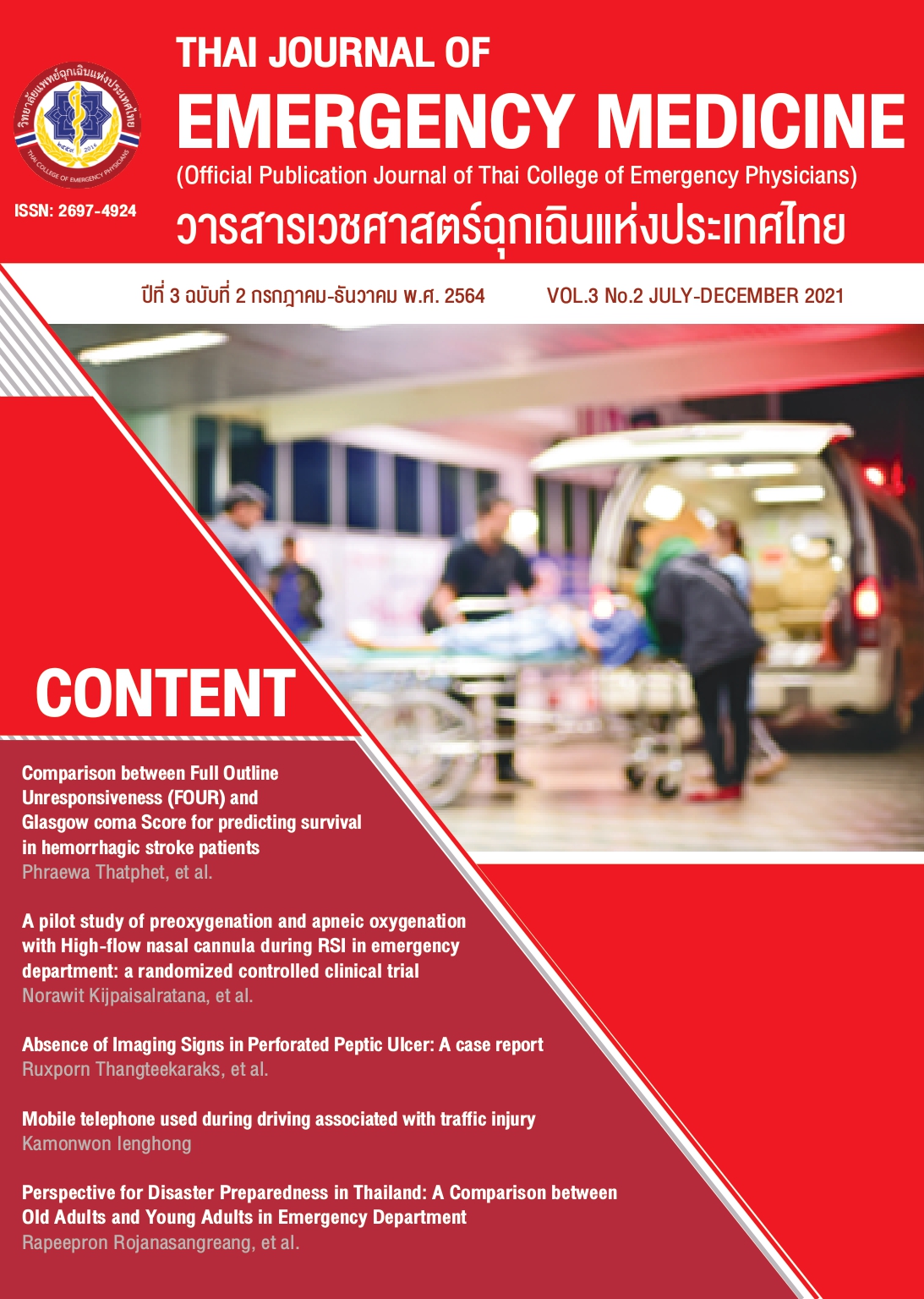
การวิจัยนำร่องการช่วยหายใจด้วยการใช้ High-flow nasal cannula ระหว่างการใส่ท่อช่วยหายใจด้วยยา นำสลบอย่างรวดเร็วในผู้ป่วยในห้องฉุกเฉิน : งานวิจัยแบบสุ่มและมีกลุ่มควบคุม
คำสำคัญ:
Rapid sequence intubation, apneic oxygenation, high flow nasal cannula, desaturationบทคัดย่อ
ที่มาและเหตุผล : ความเข้มข้นของออกชิเจนในเลือดต่ำ เป็นภาวะแทรกซ้อนที่พบได้ในการใส่ท่อช่วยหายใจด้วยวิธีการใส่ท่อช่วยหายใจแบบรวดเร็วโดยการใช้ยานำสลบและยาหย่อนกล้ามเนื้อ (rapid sequence intubation) ซึ่งในปัจจุบันได้มีการใช้วิธีการให้ออกซิเจนขณะที่ผู้ป่วยหยุดหายใจ (apneic oxygenation) เพื่อช่วยลดภาวะแทรกซ้อนนี้ ผู้วิจัยจึงพิจารณานำออกชิเจนอัตราการไหลสูง (high flow nasal cannula) มาทำการศึกษา นอกจากนี้ยังไม่เคยมีการเก็บข้อมูลโดยใช้วิชีวิจัยแบบสุ่มและทำในผู้ป่วยที่ได้รับการใส่ท่อช่วยหายใจในห้องฉุกเฉินมาก่อน
วัตถุประสงค์ : จุดประสงค์ของงานวิจัยชิ้นนี้เพื่อที่จะตอบคำถามหลักของงานวิจัยคือ การเปรียบเทียบอุบัติการณ์ของการเกิดภาวะออกซิเจนในเลือดต่ำระหว่างการใส่ท่อช่วยหายใจในผู้ป่วยที่มีภาวะทางเดินหายใจล้มเหลวเฉียบพลัน
วิธีวิจัย : งานวิจัยแบบสุ่มและมีกลุ่มควบคุม โดยมีผู้เข้าร่วมวิจัยคือผู้ป่วยที่มีข้อบ่งชี้ในการใส่ท่อช่วยหายใจจากภาวะทางเดินหายใจล้มเหลวเฉียบพลันที่มารับการรักษาในห้องฉุกเฉินโรงพยาบาลจุฬาลงกรณ์สภากาชาดไทยและทำการสุ่มกลุ่มผู้เข้าร่วมวิจัยเป็นทั้งหมด 3 กลุ่ม ซึ่งผู้ป่วยทุกกลุ่มมีการใส่ท่อช่วยหายใจและใช้ยานำสลบ โดยกลุ่มควบคุมไม่มีการช่วย apneic oxygenation ขณะที่อีก 2 กลุ่มที่เหลือมีการใช้วิธีการใส่ท่อช่วยหายใจแบบรวดเร็วโดยการใช้ยานำสลบและยาหย่อนกล้ามเนื้อและการช่วย apneic oxygenation ด้วย nasal cannula flow 15 litre per minute (LPM) หรือ high flow nasal cannula flow 60 LPM
ผลการศึกษา : งานวิจัยนำร่องชิ้นนี้มีผู้เข้าร่วมวิจัยทั้งหมด 27 คน ซึ่งจากผลการศึกษาไม่พบอุบัติการณ์การเกิดภาวะออกซิเจนในเลือดต่ำขณะใส่ท่อช่วยหายใจในกลุ่มที่ใช้ high flow nasal cannula ขณะที่พบว่าเกิดภาวะออกชิเจนในเลือดต่ำในกลุ่มที่ใส่ท่อช่วยหายใจแบบปกติ และกลุ่มที่ใช้ nasal cannula 15LPM ในการช่วย apneic oxygenation (22.2 และ 28.6 เปอร์เซ็นต์ามลำดับ) แต่ไม่พบว่ามีความสัมพันธ์กันอย่างมีนัยสำคัญทางสถิติระหว่างวิธีการใส่ท่อช่วยหายใจและอุบัติการณ์การเกิดภาวะออกซิเจนในเลือดต่ำเมื่อทำการเปรียบเทียบกันระหว่างกลุ่มที่ใช้ nasal cannula 15LPM กับกลุ่มที่ใส่ท่อช่วยหายใจแบบปกติ (28.69 กับ 22.29, p = 0.771) หรือกลุ่มที่ใช้ high fow nasal cannula กับกลุ่มที่ใส่ท่อช่วยหายใจแบบปกติ (0% กับ 22.2%, P = 0.099) และกลุ่มที่ใช้ high flow nasal cannula เทียบกับ nasal cannula 15LPM (28.6% กับ 0%, p = 0.06)
สรุป : การใช้ high flow nasal cannula ในการช่วย apneic oxygenation ระหว่างใส่ท่อช่วยหายใจโดยใช้ยานำสลบอย่างรวดเร็ว มีแนวโน้มที่จะช่วยลดอุบัติการณ์การเกิดภาวะความเข้มข้นขอออกซิเจนในเลือดต่ำได้แต่ไม่พบความแตกต่างกันอย่างมีนัยยะสำคัญทางสถิติ
เอกสารอ้างอิง
Gebremedhn EG, Mesele D, Aemero D, Alemu E. The incidence of oxygen desaturation during rapid sequence induction and intubation. World J Emerg Med 2014;5:279-85.
Griesdale DE, Bosma TL, Kurth T, Isac G, Chittock DR. Complications of endotracheal intubation in the critically ill. Intensive Care Med 2008;34:1835-42.
Jaber S, Amraoui J, Lefrant JY, Arich C, Cohendy R, Landreau L, et al. Clinical practice and risk factors for immediate complications of endotracheal intubation in the intensive care unit: a prospective, multiple-center study. Crit Care Med 2006;34:2355-61.
Sakles JC, Chiu S, Mosier J, Walker C, Stolz U. The importance of first pass success when performing orotracheal intubation in the emergency department. Acad Emerg Med 2013;20:71-8.
Hypes C, Sakles J, Joshi R, Greenberg J, Natt B, Malo J, et al. Failure to achieve first attempt success at intubation using video laryngoscopy is associated with increased complications. Intern Emerg Med 2016.
Simpson GD, Ross MJ, McKeown DW, Ray DC. Tracheal intubation in the critically ill: a multi-centre national study of practice and complications. Br J Anaesth 2012;108:792-9.
Marsch SC, Steiner L, Bucher E, Pargger H, Schumann M, Aebi T, et al. Succinylcholine versus rocuronium for rapid sequence intubation in intensive care: a prospective, randomized controlled trial. Crit Care 2011;15:R199.
Taha SK, El-Khatib MF, Baraka AS, Haidar YA, Abdallah FW, Zbeidy RA, et al. Effect of suxamethonium vs rocuronium on onset of oxygen desaturation during apnoea following rapid sequence induction. Anaesthesia 2010;65:358-61.
Tang L, Li S, Huang S, Ma H, Wang Z. Desaturation following rapid sequence induction using succinylcholine vs. rocuronium in overweight patients. Acta Anaesthesiol Scand 2011;55:203-8.
Nishimura M. High-flow nasal cannula oxygen therapy in adults. J Intensive Care 2015;3:15.
Roca O, Hernandez G, Diaz-Lobato S, Carratala JM, Gutierrez RM, Masclans JR. Current evidence for the effectiveness of heated and humidified high flow nasal cannula supportive therapy in adult patients with respiratory failure. Crit Care 2016;20:109.
Riyapan S, Lubin J. Apneic Oxygenation May Not Prevent Severe Hypoxemia During Rapid Sequence Intubation: A Retrospective Helicopter Emergency Medical Service Study. Air Med J 2016;35:365-8.
Wimalasena Y, Burns B, Reid C, Ware S, Habig K. Apneic oxygenation was associated with decreased desaturation rates during rapid sequence intubation by an Australian helicopter emergency medicine service. Ann Emerg Med 2015;65:371-6.
Sakles JC, Mosier JM, Patanwala AE, Arcaris B, Dicken JM. First Pass Success Without Hypoxemia Is Increased With the Use of Apneic Oxygenation During Rapid Sequence Intubation in the Emergency Department. Acad Emerg Med 2016;23:703-10.
Sakles JC, Mosier JM, Patanwala AE, Dicken JM. Apneic oxygenation is associated with a reduction in the incidence of hypoxemia during the RSI of patients with intracranial hemorrhage in the emergency department. Intern Emerg Med 2016;11:983-92.
Semler MW, Janz DR, Lentz RJ, Matthews DT, Norman BC, Assad TR, et al. Randomized Trial of Apneic Oxygenation during Endotracheal Intubation of the Critically Ill. Am J Respir Crit Care Med 2016;193:273-80.
Kim TH, Hwang SO, Cha YS, Kim OH, Lee KH, Kim H, et al. The utility of noninvasive nasal positive pressure ventilators for optimizing oxygenation during rapid sequence intubation. Am J Emerg Med 2016;34:1627-30.
Vourc'h M, Asfar P, Volteau C, Bachoumas K, Clavieras N, Egreteau PY, et al. High-flow nasal cannula oxygen during endotracheal intubation in hypoxemic patients: a randomized controlled clinical trial. Intensive Care Med 2015;41:1538-48.
Miguel-Montanes R, Hajage D, Messika J, Bertrand F, Gaudry S, Rafat C, et al. Use of highflow nasal cannula oxygen therapy to prevent desaturation during tracheal intubation of intensive care patients with mild-to-moderate hypoxemia. Crit Care Med 2015;43:574-83.
Jaber S, Monnin M, Girard M, Conseil M, Cisse M, Carr J, et al. Apnoeic oxygenation via high-flow nasal cannula oxygen combined with non-invasive ventilation preoxygenation for intubation in hypoxaemic patients in the intensive care unit: the single-centre, blinded, randomised controlled OPTINIV trial. Intensive Care Med 2016;42:1877-87.
Simon M, Wachs C, Braune S, de Heer G, Frings D, Kluge S. High-Flow Nasal Cannula Versus Bag-Valve-Mask for Preoxygenation Before Intubation in Subjects With Hypoxemic Respiratory Failure. Respir Care 2016;61:1160-7.
ดาวน์โหลด
เผยแพร่แล้ว
รูปแบบการอ้างอิง
ฉบับ
ประเภทบทความ
หมวดหมู่
สัญญาอนุญาต
ลิขสิทธิ์ (c) 2022 วิทยาลัยแพทย์เวชศาสตร์ฉุกเฉินแห่งประเทศไทย

อนุญาตภายใต้เงื่อนไข Creative Commons Attribution-NonCommercial-NoDerivatives 4.0 International License.
บทความที่ได้รับตีพิมพ์ในวารสารเวชศาสตร์ฉุกเฉินแห่งประเทศไทย ถือเป็นเป็นลิขสิทธิ์ของ วิทยาลัยแพทย์เวชศาสตร์ฉุกเฉินแห่งประเทศไทย
กรณีที่บทความได้รับการตีพิมพ์ในวารสารเวชศาสตร์ฉุกเฉินแห่งประเทศไทยแล้ว จะตีพิมพ์ในรูปแบบอิเล็กทรอนิกส์ ไม่มีสำเนาการพิมพ์ภายหลังหนังสือเผยแพร่เรียบร้อยแล้ว ผู้นิพนธ์ไม่สามารถนำบทความดังกล่าวไปนำเสนอหรือตีพิมพ์ในรูปแบบใดๆ ที่อื่นได้ หากมิได้รับคำอนุญาตจากวารสารเวชศาสตร์ฉุกเฉินแห่งประเทศไทย