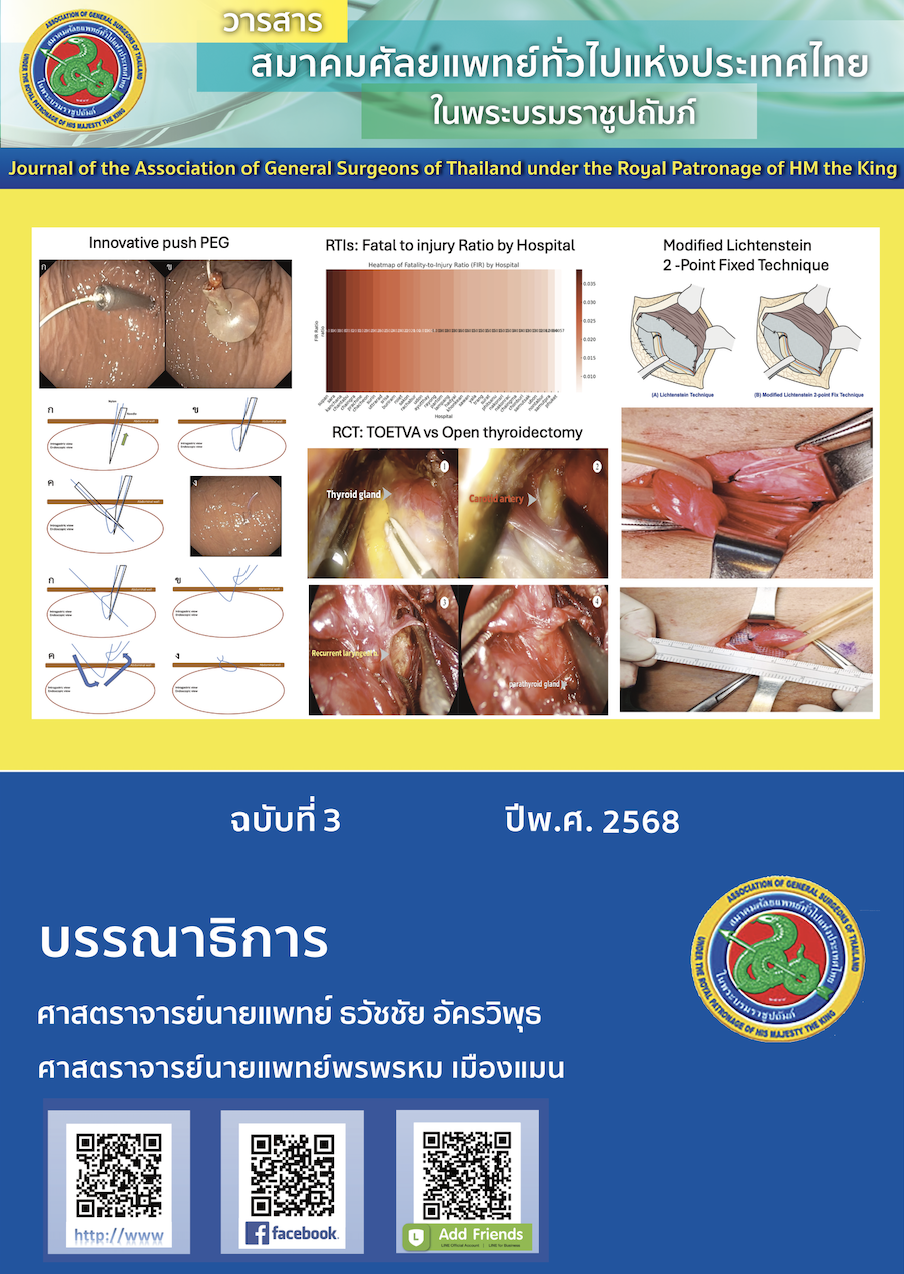
Outcome of Open Inguinal Hernia Repair: Modified Lichtenstein 2-Point Fixed Technique
Keywords:
inguinal hernia, Lichtenstein, chronic inguinal pain, CPIPAbstract
Inguinal hernia is a common surgical condition. The Lichtenstein technique has been shown to have a very low recurrence rate; however, postoperative complications, particularly chronic inguinal pain, are still observed. This study modified the Lichtenstein technique to reduce such adverse effects while maintaining the low recurrence rate. Patient data were retrospectively reviewed from those who underwent open hernioplasty using the Modified Lichtenstein 2-Point Fix Technique between January 2014 and December 2022 at Maharaj Nakhon Si Thammarat Hospital. Data were obtained from the hospital’s hos XP database, and follow-up was conducted via telephone. A total of 668 patients underwent the procedure, comprising 649 males and 19 females, with a mean age of 57.4 ± 16.84 years (range, 12–91 years). The mean operative time was 30.65 ± 13.38 minutes (range, 10–120 minutes). Follow-up information was successfully obtained from 245 patients at least two years after surgery. No recurrence of inguinal hernia was observed in the follow-up group, and 37 patients (15.10%) reported chronic pain. The results suggest that the Modified Lichtenstein 2-Point Fix Technique is a time-efficient procedure with no recurrence and an acceptable rate of postoperative discomfort. This modified approach may serve as a suitable and effective option for general surgeons, particularly in resource-limited settings.
References
Lichtenstein IL, Shulman AG, Amid PK, Montllor MM. The Tension-Free Hernioplasty. Am J Surg 1989; 157: 188–93.
Rutkow IM, Robbins AW. Demographic, classificatory, and socioeconomic aspects of hernia repair in the United States. Surg Clin North Am. 1993; 73(3): 413–26.
Amid PK. Lichtenstein Tension-Free Hernioplasty: Its Inception, Evolution, and Principles. Hernia 2004; 8(1): 1–7.
Simons MP, Aufenacker T, Bay-Nielsen M, et al. European Hernia Society guidelines on the treatment of inguinal hernia in adult patients. Hernia. 2009; 13(4): 343-403.
HerniaSurge Group. International guidelines for groin hernia management. Hernia. 2018; 22(1): 1-165.
Köckerling F, Bittner R, Kofler M, Mayer F, Adolf D, Kuthe A, Weyhe D. Lichtenstein Versus Total Extraperitoneal Patch Plasty Versus Transabdominal Patch Plasty Technique for Primary Unilateral Inguinal Hernia Repair: A Registry-based, Propensity Score-matched Comparison of 57,906 Patients. Ann Surg 2019; 269(2): 351–7. doi: 10.1097/SLA.0000000000002541. PMID: 28953552.
Nateson AK, Basavanayak SN, Sudarsansrikanth. Study of the Lichtenstein’s Hernioplasty and Its Post-Operative Complications for Different Types of Inguinal Hernia. Int Surg J 2019; 6(7): 2514–18.
Mohamed Firdoze S, Mahadevi G, Srinivasan G. To Compare Postoperative Complications between the Two Different Methods of Inguinal Hernia Repair: Lichtenstein Hernioplasty and Three-Stitch Hernioplasty. Int J Acad Med and Pharm 2024; 6(1): 1618–22.
Stabilini C, van Veenendaal N, Aasvang E, Agresta F, Aufenacker T, Berrevoet F, et al. Update of the international HerniaSurge guidelines for groin hernia management. BJS Open. 2023;7(5):zrad080. doi:10.1093/bjsopen/zrad080
Ferzli GS, Massad A, Albert P. Extraperitoneal Endoscopic Inguinal Hernia Repair. J Laparoendosc Surg 1992; 2: 281-6.
Ferzli G, Iskandar M. Laparoscopic totally extra-peritoneal (TEP) inguinal hernia repair. ALES 2019; 4: 9pp.
Rivas JF, Molina APR, Carmona JM. Transabdominal preperitoneal (TAPP) inguinal hernia repair: how we do it. ALES 2021; 6: 6pp.
Patchayappan M, Narayanasamy SN, Duraisamy N. Three Stitch Hernioplasty: A Novel Technique for Beginners. Avicenna J Med 2015; 5(4): 106–9.
Kapur N, Kumar N. Incidence of Chronic Pain after Single Stitch Mesh Fixation in Open Inguinal Hernia Repair: An Observational Prospective Study, A Case Series. Int J Surg Open 2017; 8: 32–5. https://doi.org/10.1016/j.ijso.2017.07.002
Seker D, Oztuna D, Kulacoglu H, Genc Y, Akcil M. Mesh Size in Lichtenstein Repair: A Systematic Review and Meta-Analysis to Determine the Importance of Mesh Size. Hernia 2012; 17(2): 167–75.
Lin H, Zhuang Z, Ma T, Sun X, Huang X, Li Y. A meta-analysis of randomized control trials assessing mesh fixation with glue versus suture in lichtenstein inguinal hernia repair. Medicine 2008; 97(14): 9pp.
van der Linden W, Warg A, Nordin P. National Register Study of Operating Time and Outcome in Hernia Repair. Arch Surg 2011; 146(10): 1198–203. doi: 10.1001/archsurg.2011.268. PMID: 22006880.
Pornchai S, Suvikapakornkul R, Lertsithichai P. Reoperation Rates after Inguinal Herniorrhaphy: A 10-year Review at a Tertiary Care Hospital. Thai J Surg 2011; 32(1): 13 – 20. available from: https://he02.tci-thaijo.org/index.php/ThaiJSurg/article/view/249030
Saber A, Hokkam EN, Ellabban GM. Laparoscopic transabdominal preperitoneal approach for recurrent inguinal hernia: A randomized trial. J Minim Access Surg 2015; 11(2): 123-8. doi: 10.4103/0972-9941.153809. PMID: 25883452; PMCID: PMC4392485.
Roos M, Bakker WJ, Schouten N, Voorbrood C, Clevers GJ, Verleisdonk EJ, et al. Higher recurrence rate after endoscopic totally extraperitoneal (TEP) inguinal hernia repair with Ultrapro lightweight mesh. Ann Surg 2018; 268(2): 241–6. https://doi.org/10.1097/sla.0000000000002649
Riemenschneider KA, Lund H, Pommergaard HC. No evidence for fixation of mesh in laparoscopic transabdominal preperitoneal (TAPP) inguinal hernia repair: a systematic review and meta-analysis of randomized controlled trials. Surg Endosc 2023; 37: 8291–300. https://doi.org/10.1007/s00464-023-10237-0
Sakorafas GH, Halikias I, Nissotakis C, Kotsifopoulos N, Stavrou A, Antonopoulos C, Kassaras GA. Open tension free repair of inguinal hernias; the Lichtenstein technique. BMC Surg 2001; 1: 3. doi: 10.1186/1471-2482-1-3.
Eklund A, Montgomery A, Bergkvist L, Rudberg C. Chronic pain 5 years after randomized comparison of laparoscopic and Lichtenstein inguinal hernia repair. BJS 2010; 97(4): 600–8. https://doi.org/10.1002/bjs.6904
Jeroukhimov I, Dykman D, Hershkovitz Y, Poluksht N, Nesterenko V, Yehuda AB, Stephansky A, Zmora O. Chronic pain following totally extra-peritoneal inguinal hernia repair: a randomized clinical trial comparing glue and absorbable tackers. Langenbecks Arch Surg 2023; 408(1): 190. doi: 10.1007/s00423-023-02932-2.
Hamada T, Adachi T, Matsushima H, Moriuchi H, Iwata T, Eguchi S. Evaluation of chronic pain after transabdominal preperitoneal hernia repair. Int Surg J 2018; 5(3): 778–83. https://doi.org/10.18203/2349-2902.isj20180797
Le TN, Ali MA, Svetla Gadzhanova, Lim R, Bala I, Bogale KN, et al. Hernia repair prevalence by age and gender among the Australian adult population from 2017 to 2021. Critical Public Health 2024; 34(1): 1–11.
Iyer A, Kumar SS, Rama M, Podder S, Huang LC, Tannouri S, et al. Do female patients experience worse outcomes than male patients after inguinal hernia repair? An analysis of the Abdominal Core Health Quality Collaborative database. Surgery. 2025; 185: 109491.
Boonnithi N, Kongkham K. A Prospective Clinical Trial Comparing Darn vs Bassini vs Lichtenstein Inguinal Herniorrhaphy. Thai J Surg 2010; 31(4): 125 – 9.
Patchayappan M, Narayanasamy SN, Duraisamy N. Three Stitch Hernioplasty: A Novel Technique for Beginners. Avicenna J Med 2015; 5(4): 106-9. doi: 10.4103/2231-0770.166891. PMID: 26629464; PMCID: PMC4637946.
Meyer A, Bonnet L, Bourbon M, Blanc P. Totally extraperitoneal (TEP) endoscopic inguinal hernia repair with TAP (transversus abdominis plane) block as a day-case: a prospective cohort study. J Visc Surg 2015; 152(3): 155-9. doi: 10.1016/j.jviscsurg.2014.12.005. Epub 2015 Jan 6. PMID: 25575582.
Ahmad S, Aslam R, Iftikhar M, Alam M. Early Outcomes of Laparoscopic Transabdominal Preperitoneal (TAPP) Repair. Cureus 2023; 15(2): 6pp. doi: 10.7759/cureus.35567.