
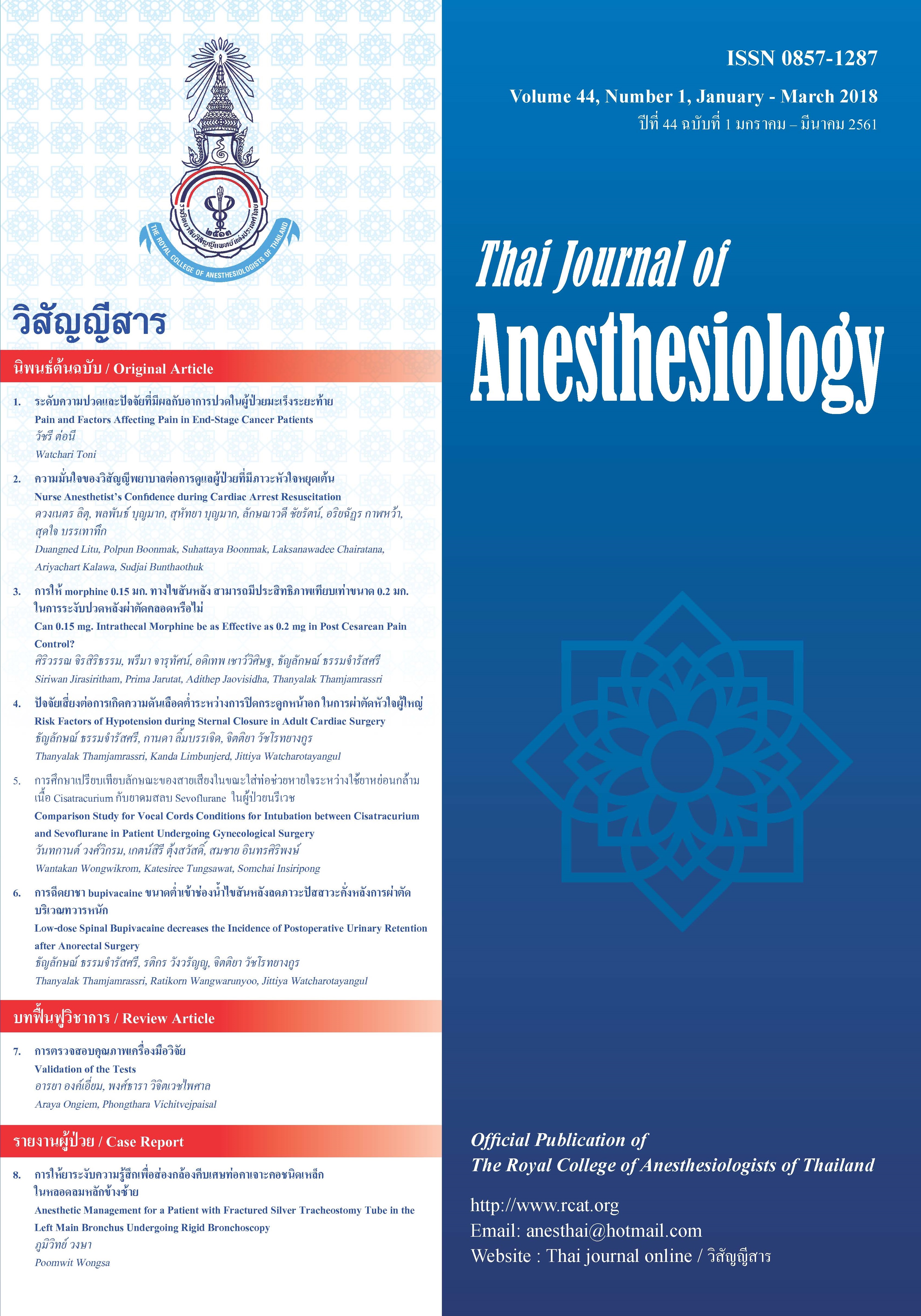
Can 0.15 mg. Intrathecal Morphine be as Effective as 0.2 mg in Post Cesarean Pain Control?
Keywords:
intrathecal morphine , cesarean section, post cesarean pain controlAbstract
Background: 0.2 mg. intrathecal morphine for post cesarean section provides good analgesia. However, side effects increase with higher dosage.
Objective: To compare the effectiveness and side effects of 0.15 mg. and 0.2 mg. intrathecal morphine.
Method: A prospective randomized study of term parturients undergoing cesarean section was done. Patients were randomized into 2 groups: group I (study group) and group II (control group) received 0.15 or 0.2 mg intrathecal morphine with 10 mg heavy bupivacaine for spinal anesthesia respectively. Tramadol was used as a rescue drug postoperatively upon request. The amount of tramadol used in the first 24 hours was compared as the primary endpoint. Other common side effects such as nausea, vomiting, pruritus, pain score and satisfaction score were also recorded.
Results: Data from 128 patients was analyzed. There was no difference in the amount of tramadol use, number of patients who require rescue drug, time to first dose of tramadol and percentage of patients with moderate to severe pain score between the two groups. There was a trend of less severity and episode of nausea and vomiting (20.63% vs 34.92%; p=0.09) and higher satisfaction score (4-5 vs 3-5; p=0.08) in the 0.15 group. Incidences of pruritus were not different between the two groups.
Conclusion: The dose of 0.15 mg. intrathecal morphine provides adequate post cesarean analgesia, with a trend toward less nausea, vomiting and higher satisfaction score.
References
2. Girgin NK, Gurbet A, Turker G, Aksu H, Gulhan N. Intrathecal morphine in anesthesia for cesarean delivery: dose-response relationship for combinations of low-dose intrathecal morphine and spinal bupivacaine. J Clin Anesth 2008;
20(3):180-5.
3. Rodanant O, Sirichotewithayakorn P, Sriprajittichai P, Charuluxananan S. Optimal dose of intrathecal morphine in gynecological patients. J Med Assoc Thai 2003;86 Suppl 2:S331-7.
4. Wong JY, Carvalho B, Riley ET. Intrathecal morphine 100 and 200 ug. for post-cesarean delivery analgesia: a trade-off between analgesic efficacy and side effects. Int J Obstet Anesth 2013;22:36-41.
Downloads
Published
How to Cite
Issue
Section
License
Copyright
Copyright of all articles published in the Thai Journal of Anesthesiology is held by the Thai Journal of Anesthesiology, the Royal College of Anesthesiologists of Thailand. Submission of a manuscript constitutes the authors' agreement that, upon acceptance for publication, copyright of the work is transferred to the Journal. The content and any opinions expressed in published articles are the sole responsibility of the authors and do not necessarily reflect the views of the editorial board or the Royal College of Anesthesiologists of Thailand.
Licensing
All articles are published open access under the Creative Commons Attribution-NonCommercial-NoDerivatives 4.0 International License (CC BY-NC-ND 4.0). Under this license, anyone may copy and redistribute published articles in any medium or format for non-commercial purposes, provided that appropriate credit is given to the authors and to the Thai Journal of Anesthesiology as the original source of publication, a link to the license is included, and the material is not modified in any way. Requests for commercial use or for adaptation of published material should be directed to the editorial office.
Authors' Rights
Although copyright is held by the Journal, authors retain the right to reuse their own published material in their future scholarly works, theses and dissertations, teaching, and academic presentations, and to deposit the final published version (PDF) in institutional or subject repositories or on personal and institutional websites, without embargo, provided that the Thai Journal of Anesthesiology is clearly acknowledged as the original place of publication.