
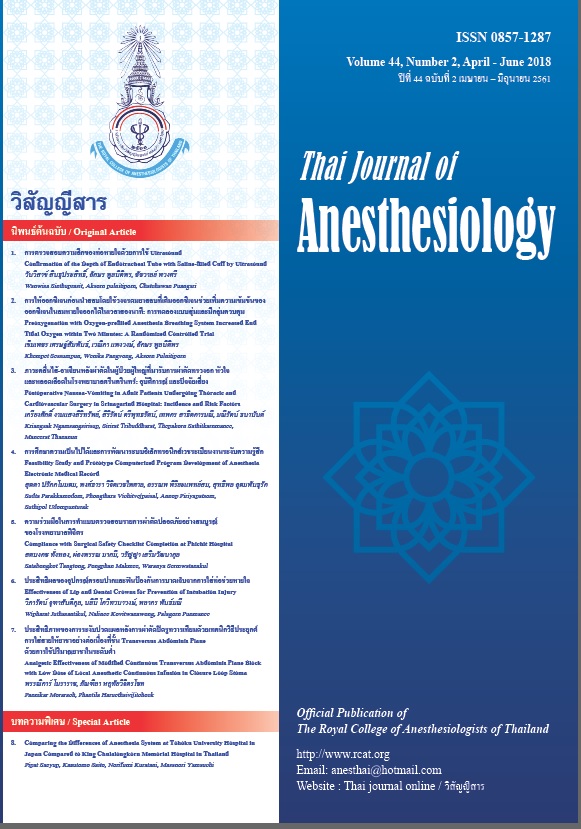
Compliance with Surgical Safety Checklist Completion at Phichit Hospital
Keywords:
Compliance, Completion, Surgical Safety ChecklistAbstract
Introduction: The Surgical Safety Checklist (SSC) was developed by the WHO to help operating teams reduce the occurrence of patient harm. Therefore, the aim of this study was to evaluate compliance of checklist completion and its barrier for implementation.
Method: A descriptive cross-sectional study was conducted among 630 patients undergoing elective and
emergency surgery at Phichit Hospital during March 1-30, 2017. The SSC data were collected from medical records after surgery includes sign-in, time-out, sign-out, involved health care disciplines, completeness rate of SSC and its barrier for implementation.
Result: The compliance of using surgical safety checklist was 630 cases (100%), the completeness of
checklist was only 3.17 %, (4% in elective cases and 1.6% in emergency cases). A small number of surgeons participated in this activities (13.8%). Forty four percent of health care team reported that time was a main barrier.
Conclusion: The surgical safety checklist was used in every cases but completeness remained poor because of time constraint.
References
2.
Reason J. Human error models and management. BMJ 2000; 320(7237): 768-70.
3.
WHO Surgical Safety Checklist Implementation [Internet]. 2009 [cited 2017 Mar 26]; Available from: http://www.who.int/patientsafety/topics/safe-surgery/checklist_implementation/
en/.
4.
Haynes AB, Weiser TG, William RB, et al. A surgical safety checklist to reduce morbidity and mortality in a global population. N Engl J 2009;360(5): 491-99.
5.
Bergs J, Hellings J, Simons PAM, et al. Surgical safety checklists an update. Acta Chirurgica Belgica 2014; 114(4): 219-24.
6.
Fourcade A, Blache JL, Grenier C, et al. Barriers to staff adoption of a surgical safety checklist. BMJ qual saf 2012; 21(3):191-7.
7.
Kasatpibal N, Senaratana W, Chitreecheur J, et al. Implementation of the World Health Organization surgical safety checklist at a university hospital in Thailand. Surg infect 2012; 13(1): 50-6.
Downloads
Published
How to Cite
Issue
Section
License
Copyright
Copyright of all articles published in the Thai Journal of Anesthesiology is held by the Thai Journal of Anesthesiology, the Royal College of Anesthesiologists of Thailand. Submission of a manuscript constitutes the authors' agreement that, upon acceptance for publication, copyright of the work is transferred to the Journal. The content and any opinions expressed in published articles are the sole responsibility of the authors and do not necessarily reflect the views of the editorial board or the Royal College of Anesthesiologists of Thailand.
Licensing
All articles are published open access under the Creative Commons Attribution-NonCommercial-NoDerivatives 4.0 International License (CC BY-NC-ND 4.0). Under this license, anyone may copy and redistribute published articles in any medium or format for non-commercial purposes, provided that appropriate credit is given to the authors and to the Thai Journal of Anesthesiology as the original source of publication, a link to the license is included, and the material is not modified in any way. Requests for commercial use or for adaptation of published material should be directed to the editorial office.
Authors' Rights
Although copyright is held by the Journal, authors retain the right to reuse their own published material in their future scholarly works, theses and dissertations, teaching, and academic presentations, and to deposit the final published version (PDF) in institutional or subject repositories or on personal and institutional websites, without embargo, provided that the Thai Journal of Anesthesiology is clearly acknowledged as the original place of publication.