
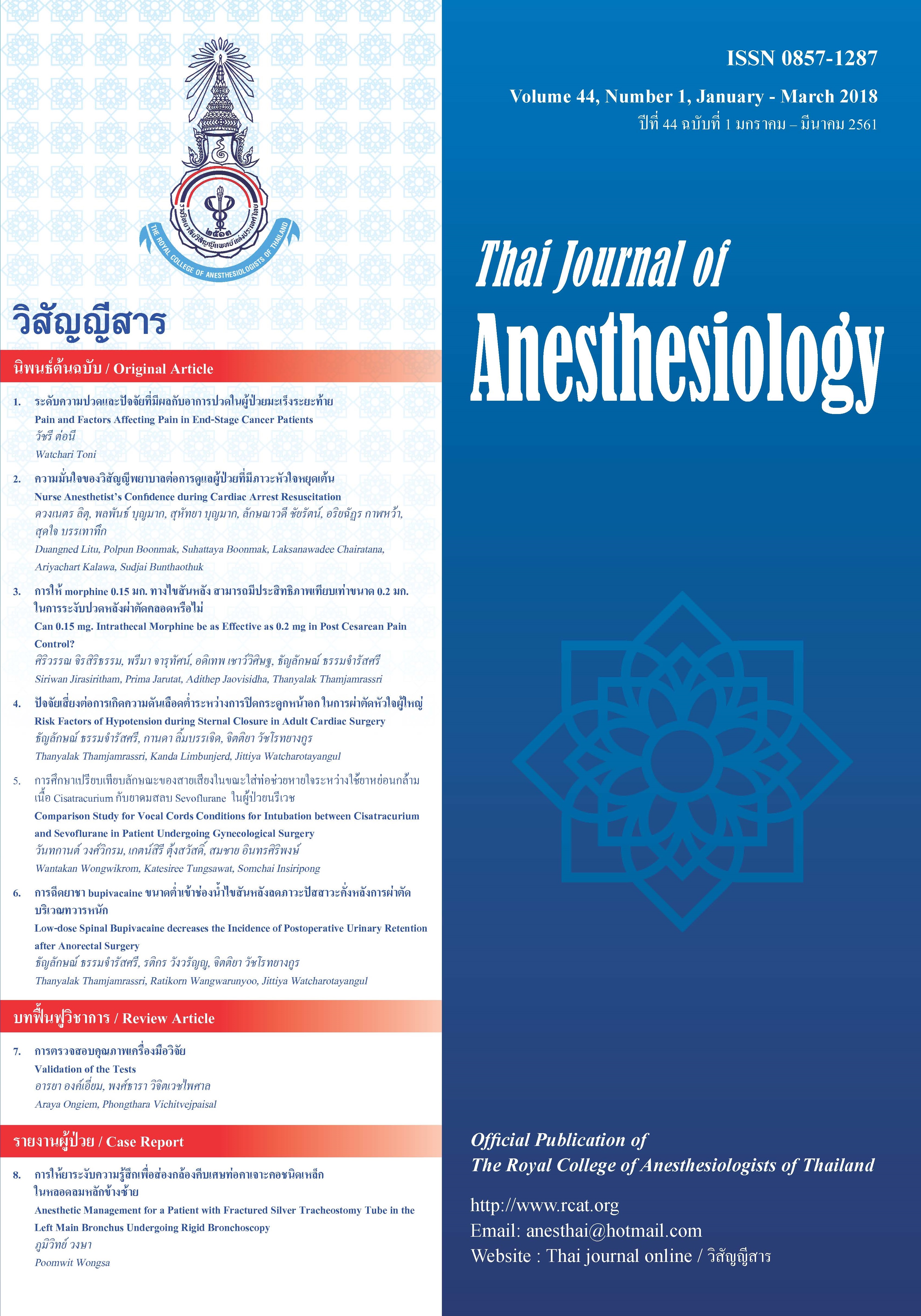
Risk Factors of Hypotension during Sternal Closure in Adult Cardiac Surgery
Keywords:
cardiac surgery, hypotension, sternal closureAbstract
Background: Hemodynamics and cardiac function are
major concerns during cardiac surgery. Many factors
including sternal closure can cause hypotension.
Objective: To find incidence and risk factors of hypotension
during sternal closure in cardiac surgery
Methods: A prospective cohort study was done at
Ramathibodi hospital. During March to December 2014,
adult patients underwent cardiac surgery were enrolled
into our study. Blood pressure before sternal retractor
removal, after sternal retractor removal, during sternal
wiring and after sternal closure were recorded. Decreasing
of systolic blood pressure more than 10%, bolus dose of
vasopressor needed or increasing inotropic infusion rate
was defined as hypotension.
Results: Eighty five of 120 patients were defined as
hypotension and mostly occurred in stage of sternal
wiring. None of the risk factors was statistical significant
parameter related to the hypotension either from crude or
logistic regression analysis.
Conclusion: Hypotension is a common complication
during sternal closure but we could not find its related
risk factors.
References
effects of chest closure in adult patients undergoing cardiac
surgery. J Cardiothorac Vasc Anesth 2001;15(5):589-92.
2. Jögi P, Werner O. Hemodynamic effects of sternum closure
after open-heart surgery in infants and children. Scand J
Thorac Cardiovasc Surg 1985;19(3):217-20.
3. Anderson CA, Filsoufi F, Aklog L, Farivar RS, Byrne JG,
Adams DH. Liberal use of delayed sternal closure for
postcardiotomy hemodynamic instability. Ann Thorac Surg
2002;73(5):1484-8.
4. Boeken U, Assmann A, Mehdiani A, Akhyari P, Lichtenberg
A. Open chest management after cardiac operations:
outcome and timing of delayed sternal closure. Eur J
Cardiothorac Surg 2011;40(5):1146-50.
5. Emre Özker, Bülent Sarita, Can Vuran, Uygar Yörüker, Halim
Ulugöl, Riza Türköz. Delayed Sternal Closure After
Pediatric Cardiac Operations; Single Center Experience:
a Retrospective Study. J Cardiothorac Surg 2012;7:102.
Downloads
Published
How to Cite
Issue
Section
License
Copyright
Copyright of all articles published in the Thai Journal of Anesthesiology is held by the Thai Journal of Anesthesiology, the Royal College of Anesthesiologists of Thailand. Submission of a manuscript constitutes the authors' agreement that, upon acceptance for publication, copyright of the work is transferred to the Journal. The content and any opinions expressed in published articles are the sole responsibility of the authors and do not necessarily reflect the views of the editorial board or the Royal College of Anesthesiologists of Thailand.
Licensing
All articles are published open access under the Creative Commons Attribution-NonCommercial-NoDerivatives 4.0 International License (CC BY-NC-ND 4.0). Under this license, anyone may copy and redistribute published articles in any medium or format for non-commercial purposes, provided that appropriate credit is given to the authors and to the Thai Journal of Anesthesiology as the original source of publication, a link to the license is included, and the material is not modified in any way. Requests for commercial use or for adaptation of published material should be directed to the editorial office.
Authors' Rights
Although copyright is held by the Journal, authors retain the right to reuse their own published material in their future scholarly works, theses and dissertations, teaching, and academic presentations, and to deposit the final published version (PDF) in institutional or subject repositories or on personal and institutional websites, without embargo, provided that the Thai Journal of Anesthesiology is clearly acknowledged as the original place of publication.