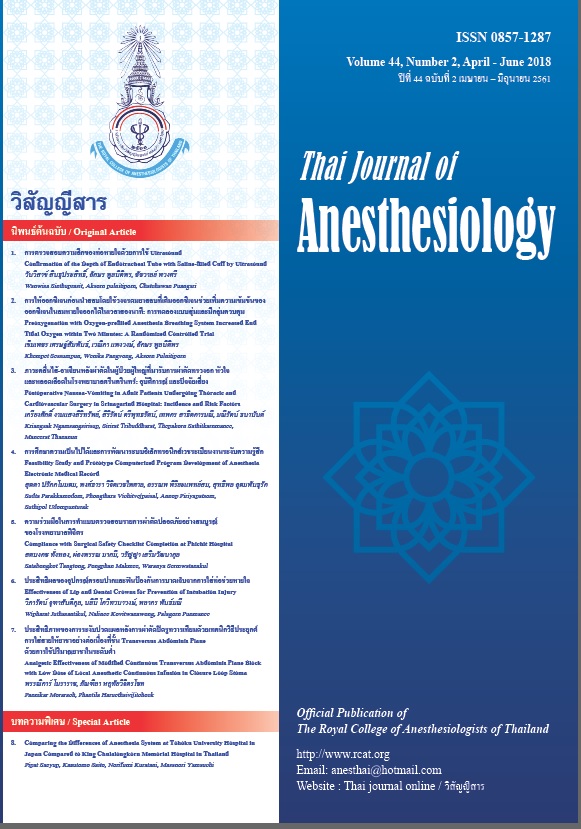
Effectiveness of Lip and Dental Crowns for Prevention of Intubation Injury
Keywords:
injury from intubation, lip and dental crownsAbstract
Complications from intubation in patients undergoing
surgery with anesthesia are lip and dental injuries that can
have an effect on chew and beauty.
Objectives: To evaluate the effectiveness of silicone lip
and dental crowns and user satisfaction.
Methods: Descriptive research of 227 patients, who
underwent elective surgery and general anesthesia, ASA
class I-III, aged 18-75 years. Patient-care records and user
satisfaction survey were used to collect data. The content
validity of the survey was approved by 3 experts, which
CVI value of the survey was 0.75. Data were analyzed by
descriptive statistics (frequency and percentage).
Results: A hundred and fifty patients (66.1%) reported
instruments had good to the oral cavity while seventy-seven
patients (33.9%) reported the intruments has poor adhesion.
Two hundred and twenty- two cases (97.8%) has no
complications from intubation. Five cases reported slight
upper lip trauma (2.2%) but no injury to teeth was found.
Overall satisfaction with silicone lip and dental crowns
were high, with an average score of 3.68 (SD 0.77). The
lightweight instruments and easy to use were reached
the highest of satisfaction with a mean score of 4.05 Conclusion: Silicone lip and dental crowns can prevent
trauma from intubation without any allergic reaction in
patients. The instruments has good adhesion to the oral
cavity. The incidence of complications (upper lip trauma)
from intubation was low. No dental injuries were found.
Downloads
Published
How to Cite
Issue
Section
License
Copyright
Copyright of all articles published in the Thai Journal of Anesthesiology is held by the Thai Journal of Anesthesiology, the Royal College of Anesthesiologists of Thailand. Submission of a manuscript constitutes the authors' agreement that, upon acceptance for publication, copyright of the work is transferred to the Journal. The content and any opinions expressed in published articles are the sole responsibility of the authors and do not necessarily reflect the views of the editorial board or the Royal College of Anesthesiologists of Thailand.
Licensing
All articles are published open access under the Creative Commons Attribution-NonCommercial-NoDerivatives 4.0 International License (CC BY-NC-ND 4.0). Under this license, anyone may copy and redistribute published articles in any medium or format for non-commercial purposes, provided that appropriate credit is given to the authors and to the Thai Journal of Anesthesiology as the original source of publication, a link to the license is included, and the material is not modified in any way. Requests for commercial use or for adaptation of published material should be directed to the editorial office.
Authors' Rights
Although copyright is held by the Journal, authors retain the right to reuse their own published material in their future scholarly works, theses and dissertations, teaching, and academic presentations, and to deposit the final published version (PDF) in institutional or subject repositories or on personal and institutional websites, without embargo, provided that the Thai Journal of Anesthesiology is clearly acknowledged as the original place of publication.