
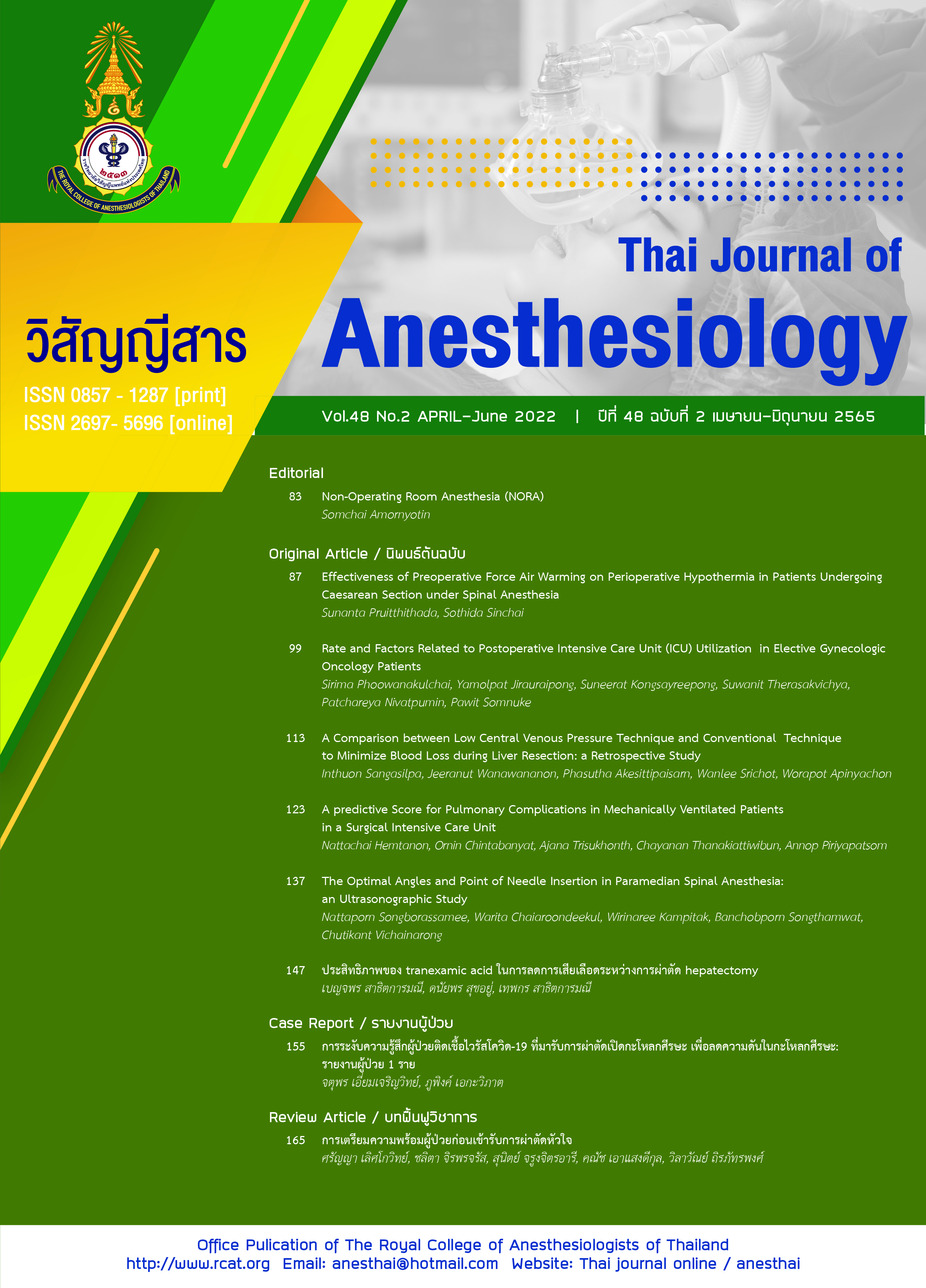
Anesthetic Management of Patient with COVID-19 Undergoing Decompressive Craniectomy: a Case Report
Keywords:
COVID-19, decompressive craniec- tomy, middle cerebral artery infarctionAbstract
This report describes a case of a COVID-19 patient who presented with middle cerebral artery infarction. The patient developed cerebral edema and brain herniation. This report aims to share clinical experience in the perioperative management of a 71-year-old patient undergoing decompressive craniectomy. Infection control is essential during the perioperative period, especially in the moment of airway management. Risk factors for cerebrovascular complications for COVID-19 patients were shown as elderly, severe COVID-19 disease, and hypercoagulable state. Finally, the anesthetic management of a patient with COVID-19 for decompressive craniectomy has been discussed.
References
กรมการแพทย์. แนวปฏิบัติการทำหัตถการและการผ่าตัดใน สถานการณ์การระบาดของ COVID-19 [Internet]. 7 พฤษภาคม 2563 [สืบค้นเมื่อ 1 ธันวาคม 2564]. สืบค้นจาก:https://covid19.dms.go.th/backend/Content/Content_File/Covid_Health/Attach/25630514135316M_%E0%B8%9B%E0%B8%A3%E0%B8%
B0%E0%B8%81%E0%B8%B2%E0%B8%A8%20OR%20COVID%20(update).pdf
ราชวิทยาลัยวิสัญญีแพทย์แห่งประเทศไทย. แนวทางปฏิบัติการดูแลผู้ป่วยที่ติดเชื้อ หรือสงสัยว่าติดเชื้อ COVID-19 ในการระงับความรู้สึก [Internet]. 15 มีนาคม 2563 [สืบค้นเมื่อ 1 ธันวาคม 2564]. สืบค้นจาก: http://www.anesthai.org/public/images/content/15032563%20แนวทางแนวทางปฏิบัติการดูแลผู้ป่วย%20COVID-19%20ฉบับ%2015%20มี.ค.2563.pdf
American Society of Anesthesiologists. The use of personal protective equipment by anesthesia professionals during the COVID-19 pandemic. [Internet]. 2020 [cited 2 December 2020] Available from: https://www.asahq.org/about-asa/newsroom/news-releases/2020/06/revised-the-use-of-personal-protective-equipment-by-anesthesia-professionals-during-the-covid-19-pandemic
Flexman AM, Abcejo AS, Avitsian R, et al. Neuroanesthesia practice during the COVID-19 pandemic: recommendations from Society for Neuroscience in Anesthesiology and Critical Care (SNACC). J Neurosurg Anesthesiol. 2020;32:202-9.
Simonds AK, Hanak A, Chatwin M, et al. Evaluation of droplet dispersion during non-invasive ventilation, oxygen therapy, nebuliser treatment and chest physiotherapy in clinical practice: implications for management of pandemic influenza and other airborne infections. Health Technol Assess. 2010;14:131-72.
Chen X, Liu Y, Gong Y, et al. Perioperative management of patients infected with the novel coronavirus: recommendation from the Joint Task Force of the Chinese Society of Anesthesiology and the Chinese Association of Anesthesiologists. Anesthesiology. 2020;132:1307-16.
Mao L, Jin H, Wang M, et al. Neurologic manifestations of hospitalized patients with coronavirus disease 2019 in Wuhan, China. JAMA Neurol. 2020;77:683-90.
Li Y, Li M, Wang M, et al. Acute cerebrovascular disease following COVID-19: a single center,
retrospective, observational study. Stroke Vasc Neurol. 2020;5:279-84.
Kihira S, Schefflein J, Mahmoudi K, et al. Association of coronavirus disease (COVID-19) with large vessel occlusion strokes: a case-control study. Am J Roentgenol. 2021;216:150-6.
Warner JJ, Harrington RA, Sacco RL, Elkind MSV. Guidelines for the early management of patients with acute ischemic stroke: 2019 update to the 2018 guidelines for the early management of acute ischemic stroke. Stroke. 2019;50:3331-2.
Shah A, Almenawer S, Hawryluk G. Timing of decompressive craniectomy for ischemic stroke and traumatic brain injury: a review. Front Neurol. 2019;10:11.
Souper N, Jiménez C, Maldonado F. Anesthetic management of a patient with ongoing thrombolytic therapy during decompressive craniectomy: a case report. A A Pract. 2018;11:304-8.
Sáez-Alegre M, García-Feijoo P, Millán P, et al. Case report: decompressive craniectomy for COVID-19 malignant cerebral artery infarction. Is surgery a good option? Front Neurol. 2021;12:632036.
Liang JW, Reynolds AS, Reilly K, et al. COVID-19 and decompressive hemicraniectomy for acute ischemic stroke. Stroke. 2020;51:e215-8.
Rahimifar M, Tator CH, Shanlin RJ, Sole MJ. Effect of blood transfusion, dopamine, or normal saline on neurogenic shock secondary to acutely raised intracranial pressure. J Neurosurg. 1989;70:932-41.
Raja AS, Greenberg JO, Qaseem A, Denberg TD, Fitterman N, Schuur JD. Clinical guidelines committee of the American College of Physicians. Evaluation of patients with suspected acute pulmonary embolism: best practice advice from the clinical guidelines committee of the American College of Physicians. Ann Intern Med. 2015;163:701-11.
Velavan TP, Meyer CG. Mild versus severe COVID-19: laboratory markers. Int J Infect Dis. 2020;95:304-7.
Cuker A, Tseng EK, Nieuwlaat R, et al. American Society of Hematology 2021 guidelines on the use of anticoagulation for thromboprophylaxis in patients with COVID-19. Blood Adv. 2021;5:872-88.
Dessie ZG, Zewotir T. Mortality-related risk factors of COVID-19: a systematic review and meta-analysis of 42 studies and 423,117 patients. BMC Infect Dis. 2021;21:855.
Downloads
Published
How to Cite
Issue
Section
License

This work is licensed under a Creative Commons Attribution-NonCommercial-NoDerivatives 4.0 International License.
Copyright
Copyright of all articles published in the Thai Journal of Anesthesiology is held by the Thai Journal of Anesthesiology, the Royal College of Anesthesiologists of Thailand. Submission of a manuscript constitutes the authors' agreement that, upon acceptance for publication, copyright of the work is transferred to the Journal. The content and any opinions expressed in published articles are the sole responsibility of the authors and do not necessarily reflect the views of the editorial board or the Royal College of Anesthesiologists of Thailand.
Licensing
All articles are published open access under the Creative Commons Attribution-NonCommercial-NoDerivatives 4.0 International License (CC BY-NC-ND 4.0). Under this license, anyone may copy and redistribute published articles in any medium or format for non-commercial purposes, provided that appropriate credit is given to the authors and to the Thai Journal of Anesthesiology as the original source of publication, a link to the license is included, and the material is not modified in any way. Requests for commercial use or for adaptation of published material should be directed to the editorial office.
Authors' Rights
Although copyright is held by the Journal, authors retain the right to reuse their own published material in their future scholarly works, theses and dissertations, teaching, and academic presentations, and to deposit the final published version (PDF) in institutional or subject repositories or on personal and institutional websites, without embargo, provided that the Thai Journal of Anesthesiology is clearly acknowledged as the original place of publication.