
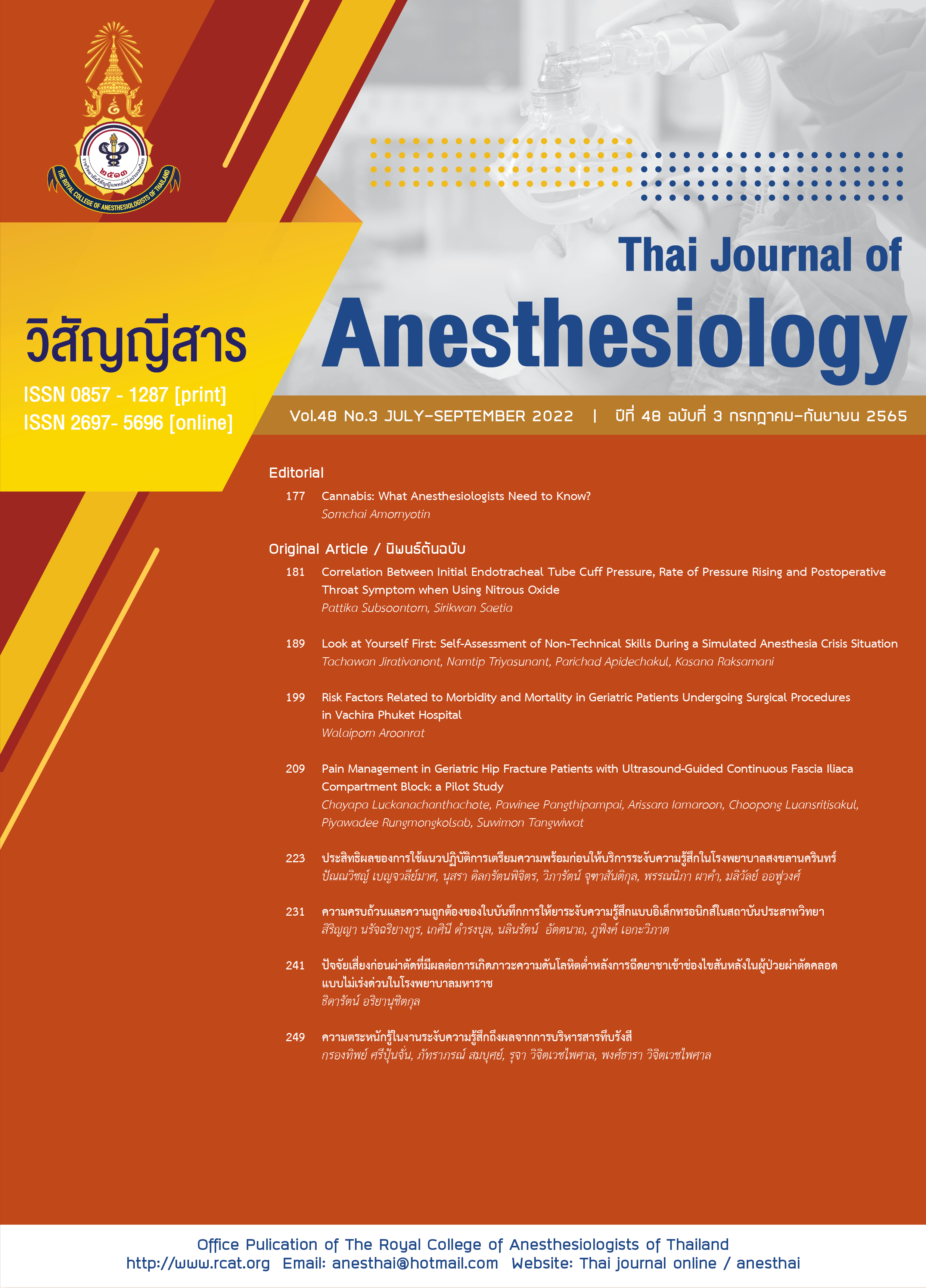
Cannabis: What Anesthesiologists Need to Know?
Abstract
Cannabis is categorized as an abuse drug that is not able to be studied, and has now been legalized in Thailand. The physiology and pharmacology of cannabis in humans are also difficult to study. The most famous of cannabinoids are THC (delta-9-tetrahydrocannabinol) and CBD (cannabidiol).1 THC is the most potent psychoactive product. It is mainly found in the flowering buds of the cannabis plant. The half-life of THC in the human body is 5-13 days. The effects of cannabis are difficult to expect because they depend on both THC concentration and the route of delivery. CBD is not psychoactive, and is a product marketed for antianxiety and chronic pain problems. To date, anesthesiologists need to understand the pharmacodynamics and pharmacokinetics of the use of cannabis and its chemical compounds. Inhaled cannabinoids are rapidly distributed within seconds to minutes after an inhaled dose. The effects of orally ingested cannabinoids may be delayed up to 1-2 hours
References
Amornyotin S. Cannabis and endocannabinoid system. J Addict Med Ther Sci. 2021;7:004-6.
Jouanjus E, Raymond V, Lapeyre-Mestre M, Wolff V. What is the current knowledge about the cardiovascular risk for users of cannabis-based products? A systematic review. Curr Atheroscler Rep. 2017;19:26.
Hitchcock LN, Tracy BL, Bryan AD, Hutchison KE, Bidwell LC. Acute effects of cannabis concentrate on motor control and speed: smartphone-based mobile assessment. Front Psychiatry. 2020;11:623672.
Chetty K, Lavoie A, Deghani P. A literature review of cannabis and myocardial infarction-what clinicians may not be aware of. CJC Open. 2020;3:12-21.
Huson H, Granados T, Rasko Y. Surgical considerations of marijuana use in elective procedures. Heliyon. 2018;4:e00779..
Beaulieu P, Boulanger A, Desroches J, Clark AJ. Medical cannabis: considerations for the anesthesiologist and pain physician. Can J Anesth. 2016;63:608-24.
Flisberg P, Paech MJ, Shah T, Ledowski T, Kurowski I, Parsons R. Induction dose of propofol in patients using cannabis. Eur J Anaesthesiol. 2009;26:192-5.
Ibera C, Shalom B, Saifi F, Shruder J, Davidson E. Effects of cannabis extract premedication on anesthetic depth. Harefuah. 2018;157:162-6.
Beaulieu P. Anesthetic-implications of recreational drug use. Can J Anesth. 2017;64:1236-64.
Echeverria-Villalobos M, Todeschini AB, Stoicea N,
Fiorda-Diaz J, Weaver T, Bergese SD. Perioperative care of cannabis users: a comprehensive review of pharmacological and anesthetic considerations. J Clin Anesth. 2019;57:41-9.
McAfee J, Boehnke KF, Moser SM, Brummett CM, Waljee JF, Bonar EE. Perioperative cannabis use: a longitudinal study of associated clinical characteristics and surgical outcomes. Reg Anesth Pain Med. 2021;46:137-44.
Downloads
Published
How to Cite
Issue
Section
License

This work is licensed under a Creative Commons Attribution-NonCommercial-NoDerivatives 4.0 International License.
Copyright
Copyright of all articles published in the Thai Journal of Anesthesiology is held by the Thai Journal of Anesthesiology, the Royal College of Anesthesiologists of Thailand. Submission of a manuscript constitutes the authors' agreement that, upon acceptance for publication, copyright of the work is transferred to the Journal. The content and any opinions expressed in published articles are the sole responsibility of the authors and do not necessarily reflect the views of the editorial board or the Royal College of Anesthesiologists of Thailand.
Licensing
All articles are published open access under the Creative Commons Attribution-NonCommercial-NoDerivatives 4.0 International License (CC BY-NC-ND 4.0). Under this license, anyone may copy and redistribute published articles in any medium or format for non-commercial purposes, provided that appropriate credit is given to the authors and to the Thai Journal of Anesthesiology as the original source of publication, a link to the license is included, and the material is not modified in any way. Requests for commercial use or for adaptation of published material should be directed to the editorial office.
Authors' Rights
Although copyright is held by the Journal, authors retain the right to reuse their own published material in their future scholarly works, theses and dissertations, teaching, and academic presentations, and to deposit the final published version (PDF) in institutional or subject repositories or on personal and institutional websites, without embargo, provided that the Thai Journal of Anesthesiology is clearly acknowledged as the original place of publication.