
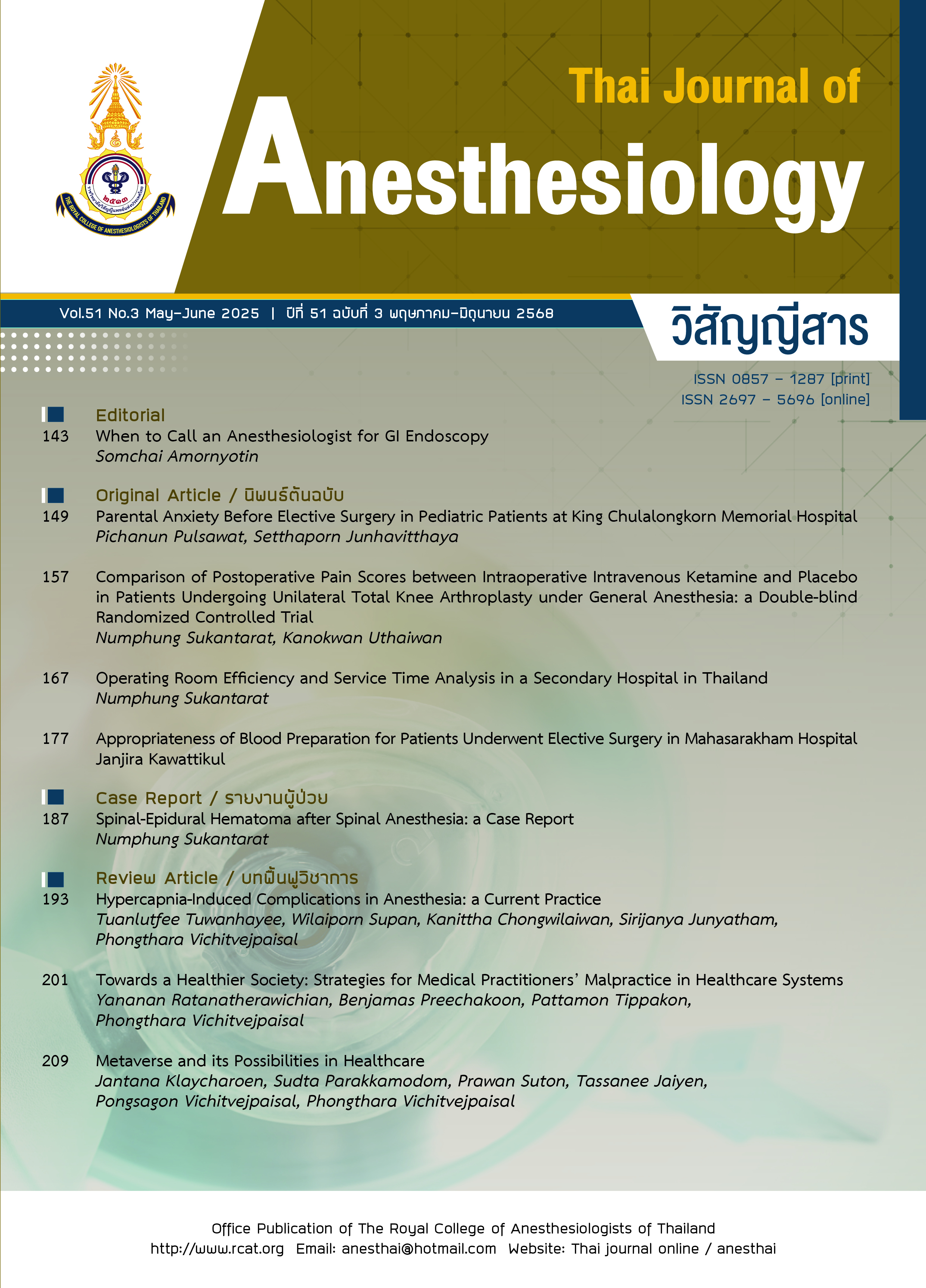
Comparison of Postoperative Pain Scores between Intraoperative Intravenous Ketamine and Placebo in Patients Undergoing Unilateral Total Knee Arthroplasty under General Anesthesia: a Double-blind Randomized Controlled Trial
Keywords:
intravenous ketamine, total knee arthroplasty, postoperative pain, general anesthesiaAbstract
Background: Multimodal analgesia with intra-operative intravenous ketamine for acute postoperative pain control has been reported to be effective. Research on subanesthetic ketamine for total knee arthroplasty (TKA) under general anesthesia (GA) is limited. We hypothesize that intraoperative intravenous ketamine may help reduce postoperative pain and opioid consumption in patients undergoing unilateral TKA with GA . Methods: This study was a prospective, single-center, double-blind randomized controlled trial. The 100 patients who underwent TKA under GA were randomly divided into two groups. One group received intraoperative intravenous ketamine, administered as a bolus dose of 0.5 mg/kg followed by a continuous infusion at 0.25 mg/kg/h until the end of surgery, while the control group received a placebo. The primary outcome measure was postoperative pain. The secondary outcomes included morphine consumption, the timing of intravenous analgesia requests, the length of hospital stay, and complications. Results: There were no significant differences between the two groups in terms of postoperative numerical rating scale scores for resting and movement pain at 24 h postoperative morphine consumption, the duration of intravenous analgesic requests, the length of hospital stay, and complications. Conclusion: Intraoperative intravenous ketamine in patients undergoing TKA under GA did not reduce 24-h postoperative pain scores at rest or during movement, nor did it decrease morphine consumption. Additionally, it did not shorten the length of hospital stay, delay the timing of the first analgesic request, or affect complication rates.
References
Heidari B. Knee osteoarthritis prevalence, risk factors, pathogenesis and features: part I. Caspian J Intern Med. 2011;2:205-12.
Woraphot Wichan M. Comparison of simultaneous bilateral with unilateral total knee arthroplasty in thabo crown prince hospital. Thai J Orthopaedic Surg. 2018;42:16-23.
Bagsby D, Pierson JL. Functional outcomes of simultaneous bilateral versus unilateral total knee arthroplasty. Orthopedics. 2015;38:e43-7.
Gan TJ. Poorly controlled postoperative pain: prevalence, consequences, and prevention. J Pain Res. 2017;10:2287-98.
Li JW, Ma YS, Xiao LK. Postoperative pain management in total knee arthroplasty. Orthop Surg. 2019;11:755-61.
Orhurhu VJ, Roberts JS, Ly N, Cohen SP. Ketamine in acute and chronic pain management. StatPearls. Treasure Island (FL): StatPearls Publishing Copyright © 2024, StatPearls Publishing LLC.; 2024.
Bell RF, Kalso EA. Ketamine for pain management. Pain Rep. 2018;3:e674.
Riccardi A, Guarino M, Serra S, et al. Narrative review: low-dose ketamine for pain management. J Clin Med. 2023;12:3256.
Puntillo F, Giglio M, Varrassi G. The routes of administration for acute postoperative pain medication. Pain Ther. 2021;10:909-25.
Lavand'homme PM, Kehlet H, Rawal N, Joshi GP. Pain management after total knee arthroplasty: PROcedure SPEcific Postoperative Pain ManagemenT recommendations. Eur J Anaesthesiol. 2022;39:743-57.
Sinatra R. Causes and consequences of inadequate management of acute pain. Pain Med. 2010;11:1859-71.
Cengiz P, Gokcinar D, Karabeyoglu I, Topcu H, Cicek GS, Gogus N. Intraoperative low-dose ketamine infusion reduces acute postoperative pain following total knee replacement surgery: a prospective, randomized double-blind placebo-controlled trial. J Coll Physicians Surg Pak. 2014;24:299-303.
Jain S, Nazir N, Mustafi SM. Preemptive low-dose intravenous ketamine in the management of acute and chronic postoperative pain following laparoscopic cholecystectomy: a prospective randomized control study. Med Gas Res. 2022;12:141-5.
Ates I, Aydin ME, Celik EC, Gozeler MS, Ahiskalioglu A. Perioperative intravenous low-dose ketamine infusion to minimize pain for septorhinoplasty: a prospective, randomized, double-blind study. Ear Nose Throat J. 2021;100:254-9.
Brinck EC, Tiippana E, Heesen M, et al. Perioperative intravenous ketamine for acute postoperative pain in adults. Cochrane Database Syst Rev. 2018;12:Cd012033.
Jouguelet-Lacoste J, La Colla L, Schilling D, Chelly JE. The use of intravenous infusion or single dose of low-dose ketamine for postoperative analgesia: a review of the current literature. Pain Med. 2015;16:383-403.
Xu B, Wang Y, Zeng C, et al. Analgesic efficacy and safety of ketamine after total knee or hip arthroplasty: a meta-analysis of randomised placebo-controlled studies. BMJ Open. 2019;9:e028337.
Wang P, Yang Z, Shan S, Cao Z, Wang Z. Analgesic effect of perioperative ketamine for total hip arthroplasties and total knee arthroplasties: a PRISMA-compliant meta-analysis. Medicine. 2020;99:e22809.
Li Z, Chen Y. Ketamine reduces pain and opioid consumption after total knee arthroplasty: a meta-analysis of randomized controlled studies. Int J Surg. 2019;70:70-83.
Mion G, Villevieille T. Ketamine pharmacology: an update (pharmacodynamics and molecular aspects, recent findings). CNS Neurosci Ther. 2013;19:370-80.
Vadivelu N, Schermer E, Kodumudi V, Belani K, Urman RD, Kaye AD. Role of ketamine for analgesia in adults and children. J Anaesthesiol Clin Pharmacol. 2016;32:298-306.
Doghiem MA, Aboalia D. Multimodal analgesia after total knee arthroplasty role of peripheral nerve blocks and small dose ketamine. Alexandria J Anaesth Intensive Care. 2005;8:4-11.
Bendtsen TF, Moriggl B, Chan V, Børglum J. The optimal analgesic block for total knee arthroplasty. Reg Anesth Pain Med. 2016;41:711-9.
Soehnlen NT, Erb ED, Kiskaddon EM, Green U, Froehle A, Krishnamurthy A. Multimodal pain management with adductor canal block decreases opioid consumption following total knee arthroplasty. Fed Pract. 2021;38:598-605.
Tan TL, Longenecker AS, Rhee JH, et al. Intraoperative ketamine in total knee arthroplasty does not decrease pain and narcotic consumption: a prospective randomized controlled trial. J Arthroplasty. 2019;34:1640-5.
Perrin SB, Purcell AN. Intraoperative ketamine may influence persistent pain following knee arthroplasty under combined general and spinal anaesthesia: a pilot study. Anaesth Intensive Care. 2009;37:248-53.
Adam F, Chauvin M, Du Manoir B, Langlois M,
Sessler DI, Fletcher D. Small-dose ketamine infusion improves postoperative analgesia and rehabilitation after total knee arthroplasty. Anesth Analg. 2005;100:475-80.
Downloads
Published
How to Cite
Issue
Section
License

This work is licensed under a Creative Commons Attribution-NonCommercial-NoDerivatives 4.0 International License.
Copyright
Copyright of all articles published in the Thai Journal of Anesthesiology is held by the Thai Journal of Anesthesiology, the Royal College of Anesthesiologists of Thailand. Submission of a manuscript constitutes the authors' agreement that, upon acceptance for publication, copyright of the work is transferred to the Journal. The content and any opinions expressed in published articles are the sole responsibility of the authors and do not necessarily reflect the views of the editorial board or the Royal College of Anesthesiologists of Thailand.
Licensing
All articles are published open access under the Creative Commons Attribution-NonCommercial-NoDerivatives 4.0 International License (CC BY-NC-ND 4.0). Under this license, anyone may copy and redistribute published articles in any medium or format for non-commercial purposes, provided that appropriate credit is given to the authors and to the Thai Journal of Anesthesiology as the original source of publication, a link to the license is included, and the material is not modified in any way. Requests for commercial use or for adaptation of published material should be directed to the editorial office.
Authors' Rights
Although copyright is held by the Journal, authors retain the right to reuse their own published material in their future scholarly works, theses and dissertations, teaching, and academic presentations, and to deposit the final published version (PDF) in institutional or subject repositories or on personal and institutional websites, without embargo, provided that the Thai Journal of Anesthesiology is clearly acknowledged as the original place of publication.