
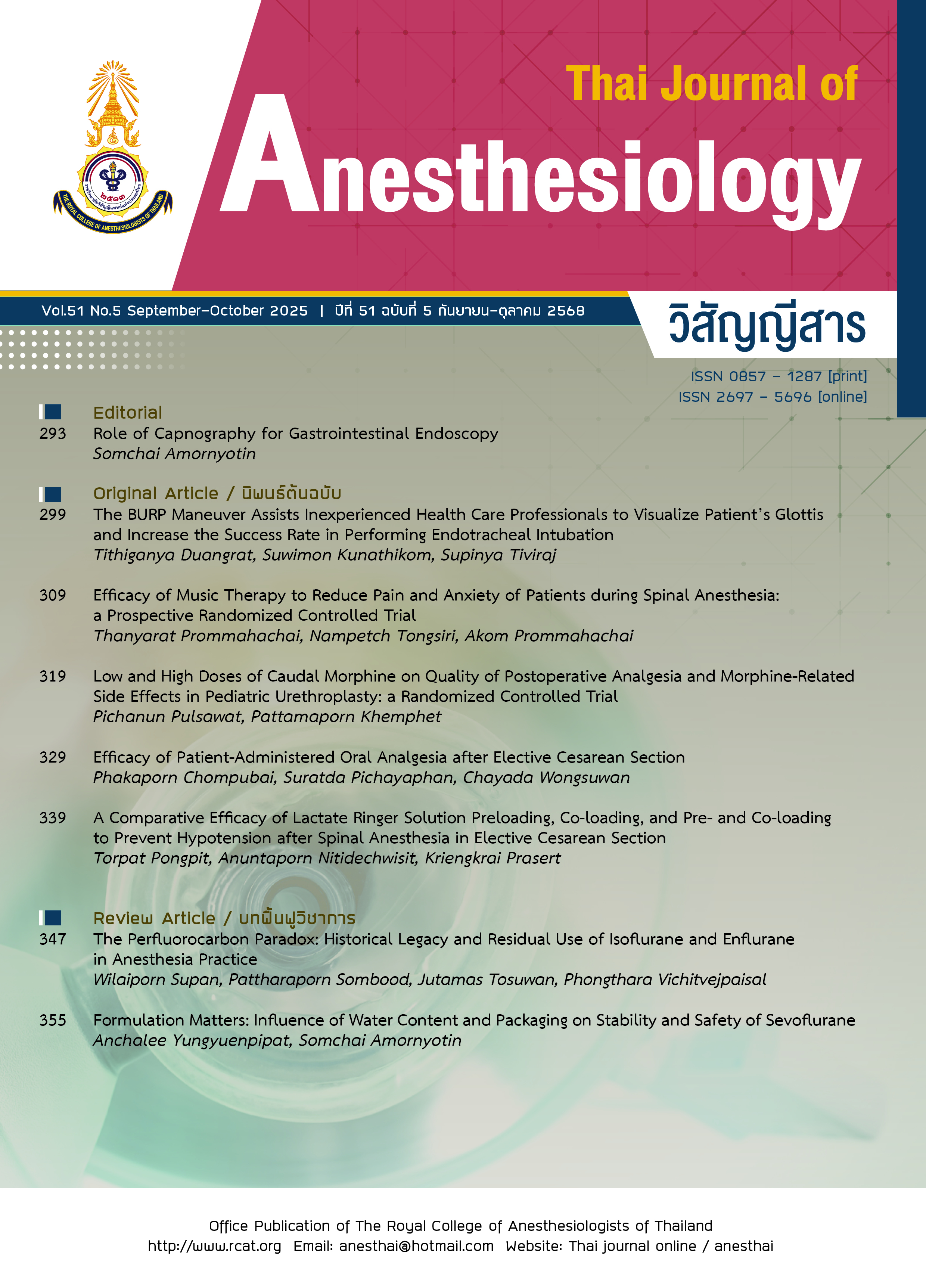
A Comparative Efficacy of Lactate Ringer Solution Preloading, Co-loading, and Pre- and Co-loading to Prevent Hypotension after Spinal Anesthesia in Elective Cesarean Section
Keywords:
caesarean section, co-load, crystalloid, preload, spinal anesthesiaAbstract
Background: Hypotension after spinal anesthesia is a most frequent complication around 60-70% in maternal undergoing caesarean section. Practical way to overcome or prevent hypotension due to spinal anesthesia is administering intravenous fluid boluses. This study aimed to compare the effectiveness of lactate ringer solution preloading, co-loading and preloading with co-loading (pre & co-load) against the incidence of hypotension after spinal anesthesia in elective caesarean section. Methods: This research is randomized clinical control trial. The number of subjects who participated in this study were total 147 subjects 49 subjects per group. Maternal subjects aged over 18 years who planed undergo elective cesarean section with spinal anesthesia and there were no contraindications for spinal anesthesia were enrolled. Participants were randomized into three groups, preload co-load and pre & co-load group. Systolic blood pressures, diastolic blood pressures, mean arterial pressure, and pulse rate are measured in basal conditions and every 1 to 15 min after spinal anesthesia and every 5 min until surgery were completed. Comparing incidence of post spinal anesthesia hypotension, maternal clinical complications, proportion of received vasopressors with exact probability test, comparing blood pressure level, heart rates, amount of vasopressors, duration of surgery, amount of intravenous fluid, neonatal status and birth weight was determined by ANOVA. Comparison incidence of hypotension after spinal anesthesia among three groups by Hazard ratio with COX-regression analysis. Results: There was no difference in ages, gestational ages, BMI and pre-operative blood pressure among three groups. Incidence rate of post-spinal block hypotension was 10.5, 12.0 and 6.3/100 person-hours in preload, co-load and pre & co-load respectively. Hazard ratios were 0.61 (0.42, 0.90) and 0.48 (0.32, 0.71) for pre & co-load group when comparative group was preload and co-load respectively. Conclusion: Lactate Ringer solution pre & co-load was significantly better in reducing incidence of hypotension after spinal anesthesia in elective cesarean section compared with the preload and co-load groups. Considering for pre & co-load for first line of lactate ringer intravenous administration in maternal elective cesarean section.
References
The New York School of Regional Anesthesia (NYSORA) continuing medical education. New York. [cited 2019 Feb 24] Spinal anesthesia. Available from: https://www.nysora.com /techniques /neuraxial-and-perineuraxial-techniques/spinal-anesthesia/.
Šklebar I, Bujas T, Habek D. Spinal anaesthesia-induced hypotension in obstetrics: prevention and therapy. Acta Clin Croat. 2019;58(Suppl1):90-5.
Van De Velde M. Spinal anesthesia in the obstetric patient: prevention and treatment of hypotension. Acta Anaesthesiol Belg. 2006;57:383-6.
Mercier FJ, Augè M, Hoffmann C, Fischer C, Le Gouez A. Maternal hypotension during spinal anesthesia for caesarean delivery. Minerva Anestesiol. 2013;79:62-73.
Loubert C. Fluid and vasopressor management for cesarean delivery under spinal anesthesia: continuing professional development. Can J Anaesth. 2012;59:604-19.
Labor NL. Interrupted Cesareans, “cascading interventions,” and finding a balance of sensible care Harvard Magazine 2012 November - December 22-6.
Lawrence C, Tsen M. Anesthesia for cesarean delivery. In: Chestnut DH, ed. Chestnut’s obstetric anesthesia Fifth edition, 2014:545-93.
Hasanin A, Mokthtar AM, Badawy AA, Fouad R. Post-spinal anesthesia hypotension during cesarean delivery, a review article. Egypt J Anesth. 2017;33:189-93.
Corke BC, Datta S, Ostheimer GW, Weiss JB, Alper MH. Spinal anaesthesia for caesarean section. The influence of hypotension on neonatal outcome. Anaesthesia. 1982;37:658-62.
Tamilselvan P, Fernando R, Bray J, Sodhi M, Columb M. The effects of crystalloid and colloid preload on cardiac output in the parturient undergoing planned cesarean delivery under spinal anesthesia: a randomized trial. Anesth Analg. 2009;109:1916-21.
Madi-Jebara S, Ghosn A, Sleilaty G, et al. Prevention of hypotension after spinal anesthesia for cesarean section 6% hydroxyethyl starch 130/0.4 (Voluven®) versus lactated Ringer’s solution. J Med Liban. 2008;56:203-7.
Oh AY, Hwang JW, Song IA, et al. Influence of the timing of administration of crystalloid on maternal hypotension during spinal anesthesia for cesarean delivery: preload versus coload. BMC Anesthesiol. 2014;14:36.
Afolayan JM, Olofinbiyi BA, Fadare JO. Crystalloid preload plus crystalloid coload for management of hypotension during subarachnoid block for emergency caesarean section. Afr J Anesth Intensive Care. 2015;15:No1.
Fakherpour A, Ghaem H, Fattahi Z, Zaree S. Maternal anesthesia-related risk factors and incidence of spinal anesthesia-induced hypotension in elective cesarean section: a multinomial logistic regression. Indian J Anesth. 2018;62:36-46.
Bishop DG, Cairns C, Grobbelaar M, Rodseth RN. Obstetric spinal hypotension: preoperative risk factors and the development of a preliminary risk score-the PRAM score. S Afr Med J. 2017;107:1127-31.
Chan WS, Irwin MG, Tong WN. Prevention of hypotension during spinal anaesthesia for caesarean section: ephedrine infusion versus fluid preload. Anaesthesia. 1997;52:908-13.
Covino BG, Scott DB, Lambert DH. Handbook of spinal anesthesia and analgesia, Philadelphia: WB Saunders, 1994.
Rao AR, Vijaya G. Mahendra BVVN: comparison of effects of preloading and coloading with ringer lactate in elective caesarean section cases under spinal anaesthesia. IOSR J Dent Med Sci. 2015;14:57-64.
Jacob JJ, Williams A, Verghese M, Afzal L. Crystalloid preload versus crystalloid coload for parturients undergoing cesarean section under spinal anesthesia. J Obst Anaesth Crit Care. 2012;2:10-5.
Downloads
Published
How to Cite
Issue
Section
License

This work is licensed under a Creative Commons Attribution-NonCommercial-NoDerivatives 4.0 International License.
Copyright
Copyright of all articles published in the Thai Journal of Anesthesiology is held by the Thai Journal of Anesthesiology, the Royal College of Anesthesiologists of Thailand. Submission of a manuscript constitutes the authors' agreement that, upon acceptance for publication, copyright of the work is transferred to the Journal. The content and any opinions expressed in published articles are the sole responsibility of the authors and do not necessarily reflect the views of the editorial board or the Royal College of Anesthesiologists of Thailand.
Licensing
All articles are published open access under the Creative Commons Attribution-NonCommercial-NoDerivatives 4.0 International License (CC BY-NC-ND 4.0). Under this license, anyone may copy and redistribute published articles in any medium or format for non-commercial purposes, provided that appropriate credit is given to the authors and to the Thai Journal of Anesthesiology as the original source of publication, a link to the license is included, and the material is not modified in any way. Requests for commercial use or for adaptation of published material should be directed to the editorial office.
Authors' Rights
Although copyright is held by the Journal, authors retain the right to reuse their own published material in their future scholarly works, theses and dissertations, teaching, and academic presentations, and to deposit the final published version (PDF) in institutional or subject repositories or on personal and institutional websites, without embargo, provided that the Thai Journal of Anesthesiology is clearly acknowledged as the original place of publication.