
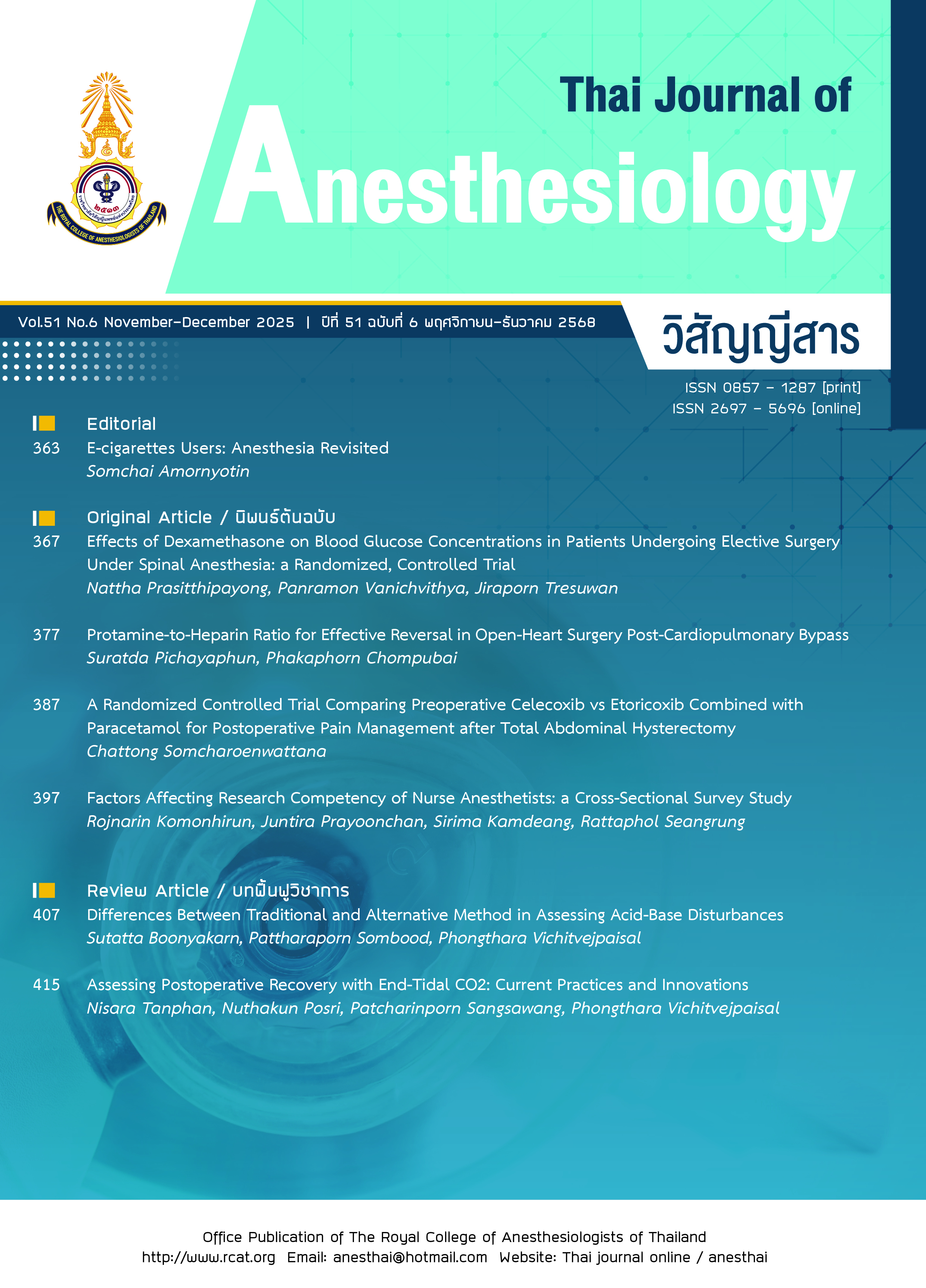
Protamine-to-Heparin Ratio for Effective Reversal in Open-Heart Surgery Post-Cardiopulmonary Bypass
Keywords:
heparin, heparin reversal, open heart surgery, postoperative blood loss, protamineAbstract
Introduction: Heparin is routinely administered to achieve anticoagulation during cardiopulmonary bypass (CPB) in open-heart surgery. Protamine sulfate is used to neutralize heparin; however, inappropriate dosing may result in adverse events such as hypotension and paradoxical bleeding. Determining the optimal protamine-to-heparin (P:H) ratio is therefore essential to ensure effective reversal while minimizing complications. This study aims to identify the effective P:H ratio necessary for adequate heparin reversal. Methods: This retrospective study included adult patients who underwent open-heart surgery with CPB at Lampang Hospital between January 2022 and June 2023. Patients were stratified into three groups based on their P:H ratios: <1, =1, and >1. The P:H ratio was calculated using the initial heparin dose administered prior to the initiation of CPB. The primary outcome was the effective heparin reversal, defined as an activated clotting time (ACT) ≤ 10 sec above baseline or within 80-180 sec five min post-protamine administration. Secondary outcomes included determining the minimum effective P:H ratio that resulted in acceptable postoperative blood loss, and evaluating 8-h postoperative blood loss, blood product transfusion volumes, and 24-h reoperation rates due to bleeding. Results: A total of 539 patients were analyzed. Effective heparin reversal, based on post- protamine ACT values, was achieved across all groups with no significant differences observed. Eight-hours postoperative blood loss, blood transfusions, and 24-h reoperation rates were comparable among three groups, with no statistically significant differences. A P:H ratio of approximately 0.94-0.95 was sufficient to maintain acceptable postoperative blood loss and transfusion requirements, comparable to the median values observed in this study. Conclusion: This study found no significant differences in heparin reversal efficacy or blood loss among groups receiving varying protamine doses. Heparin reversal efficacy was defined as achieving an ACT of ≤10 sec above baseline or within the range of 80-180 sec, measured five min after protamine administration. However, a P:H ratio of 0.94-0.95 may indicate effective heparin neutralization
References
Cartwright B, Mundell N. Anticoagulation for cardiopulmonary bypass: part one. BJA Educ. 2023;23:110-6.
McKinney MC, Riley JB. Evidence-based algorithm for heparin dosing before cardiopulmonary bypass. Part 1: development of the algorithm. J Extra Corpor Technol. 2007;39:238-42.
Nakasuji A, Matsushita S, Inaba H, et al. Evaluation of a new formula for calculating heparin dose for cardiopulmonary bypass patients. Open J Thorac Surg. 2014;4:32-8.
Applefield D, Krishnan S. Protamine. StatPearls. Treasure Island (FL) ineligible companies. StatPearls Publishing Copyright © 2024, StatPearls Publishing LLC.; 2024.
Horrow JC. Protamine: a review of its toxicity. Anesth Analg. 1985;64:348-61.
Boer C, Meesters MI, Veerhoek D, Vonk ABA. Anticoagulant and side-effects of protamine in cardiac surgery: a narrative review. Br J Anaesth. 2018;120:914-27.
Ni Ainle F, Preston RJS, Jenkins PV, et al. Protamine sulfate down-regulates thrombin generation by
inhibiting factor V activation. Blood. 2009;114:
-65.
Hecht P, Besser M, Falter F. Are we able to dose protamine accurately yet? A review of the protamine conundrum. J Extra Corpor Technol. 2020;52:63-70.
Boer C, Meesters MI, Milojevic M, et al. 2017 EACTS/EACTA Guidelines on patient blood management for adult cardiac surgery. J Cardiothorac Vasc Anesth. 2018;32:88-120.
Shore-Lesserson L, Enriquez LJ, Weitzel N. Coagulation monitoring. In: Kapland JA, editor. Kapland’s cardiac anesthesia for cardiac and noncardiac surgery, seventh edition. Philadelphia : Elsevier. 2017;p706-7.
Taneja R, Szoke DJ, Hynes Z, Jones PM. Minimum protamine dose required to neutralize heparin in cardiac surgery: a single-centre, prospective, observational cohort study. Can J Anaesth. 2023;70:219-27.
Suelzu S, Cossu A, Pala G, et al. Impact of different dosage of protamine on heparin reversal during off-pump coronary artery bypass: a clinical study. Heart Lung Vessel. 2015;7:238-45.
Chapter 2: definition, identification, and prediction of CKD progression. Kidney Int Suppl. 2013;3:63-72.
Haas E, Fischer F, Levy F, et al. Identifying optimal heparin management during cardiopulmonary bypass in obese patients: a prospective observational comparative study. Eur J Anaesthesiol. 2016;33:408-16.
Baker MS, Skoyles JR, Shajar FM, Skinner H, Richens D, Mitchell IM. Can lean body mass be used to reduce the dose of heparin and protamine for obese patients undergoing cardiopulmonary bypass? J Extra Corpor Technol. 2005;37:153-6.
Sorodoc V, Asaftei A, Ceasovschih A, et al. Anticoagulation approach in morbid obesity: a comprehensive review on venous thromboembolism management. Front Pharmacol. 2024;15:1457280.
Ganter MT, Dalbert S, Graves K, Klaghofer R, Zollinger A, Hofer CK. Monitoring activated clotting time for combined heparin and aprotinin application: an in vitro evaluation of a new aprotinin-insensitive test using SONOCLOT. Anesth Analg. 2005;101:308-14.
Svenarud P, Øvrum E. Clinical effects of different protamine doses after cardiopulmonary bypass. Asian Cardiovasc Thorac Ann. 2002;10:119-23.
Ottesen S, Stormorken H, Hatteland K. The value of activated coagulation time in monitoring heparin therapy during extracorporeal circulation. Scand J Thorac Cardiovasc Surg. 1984;18:123-8.
Keeler JF, Shah MV, Hansbro SD. Protamine-the need to determine the dose. Comparison of a simple protamine titration method with an empirical dose regimen for reversal of heparinisation following cardiopulmonary bypass. Anaesthesia. 1991;46:925-8.
Lee MH, Riley W, Shann KG. Can the minimum protamine dose to neutralize heparin at the completion of cardiopulmonary bypass be significantly lower than the conventional practice? J Extra Corpor Technol. 2021;53:170-6.
Lee MH, Beck M, Shann K. Protamine dose to neutralize heparin at the completion of cardiopulmonary bypass can be reduced significantly without affecting post-operative bleeding. J Extra Corpor Technol. 2023;55:105-11.
Cuenca JS, Diz PG, Sampedro FG, Zincke JMG, Acuña HR, Fontanillo MMF. Method to calculate the protamine dose necessary for reversal of heparin as a function of activated clotting time in patients undergoing cardiac surgery. J Extra Corpor Technol. 2013;45:235-41.
Yongyukantorn K RP, Karnjanawanichkul O. Optimal dose of protamine for heparin reversal in patients undergoing cardiopulmonary bypass surgery. J Med Assoc Thai. 2018;101:1037-41.
Culliford AT, Gitel SN, Starr N, et al. Lack of correlation between activated clotting time and plasma heparin during cardiopulmonary bypass. Ann Surg. 1981;193:105-11.
Ammar T, Fisher CF, Sarier K, Coller BS. The effects of thrombocytopenia on the activated coagulation time. Anesth Analg. 1996;83:1185-8.
Reiner JS, Coyne KS, Lundergan CF, Ross AM. Bedside monitoring of heparin therapy: comparison of activated clotting time to activated partial thromboplastin time. Cathet Cardiovasc Diagn. 1994;32:49-52.
Downloads
Published
How to Cite
Issue
Section
License

This work is licensed under a Creative Commons Attribution-NonCommercial-NoDerivatives 4.0 International License.
Copyright
Copyright of all articles published in the Thai Journal of Anesthesiology is held by the Thai Journal of Anesthesiology, the Royal College of Anesthesiologists of Thailand. Submission of a manuscript constitutes the authors' agreement that, upon acceptance for publication, copyright of the work is transferred to the Journal. The content and any opinions expressed in published articles are the sole responsibility of the authors and do not necessarily reflect the views of the editorial board or the Royal College of Anesthesiologists of Thailand.
Licensing
All articles are published open access under the Creative Commons Attribution-NonCommercial-NoDerivatives 4.0 International License (CC BY-NC-ND 4.0). Under this license, anyone may copy and redistribute published articles in any medium or format for non-commercial purposes, provided that appropriate credit is given to the authors and to the Thai Journal of Anesthesiology as the original source of publication, a link to the license is included, and the material is not modified in any way. Requests for commercial use or for adaptation of published material should be directed to the editorial office.
Authors' Rights
Although copyright is held by the Journal, authors retain the right to reuse their own published material in their future scholarly works, theses and dissertations, teaching, and academic presentations, and to deposit the final published version (PDF) in institutional or subject repositories or on personal and institutional websites, without embargo, provided that the Thai Journal of Anesthesiology is clearly acknowledged as the original place of publication.