
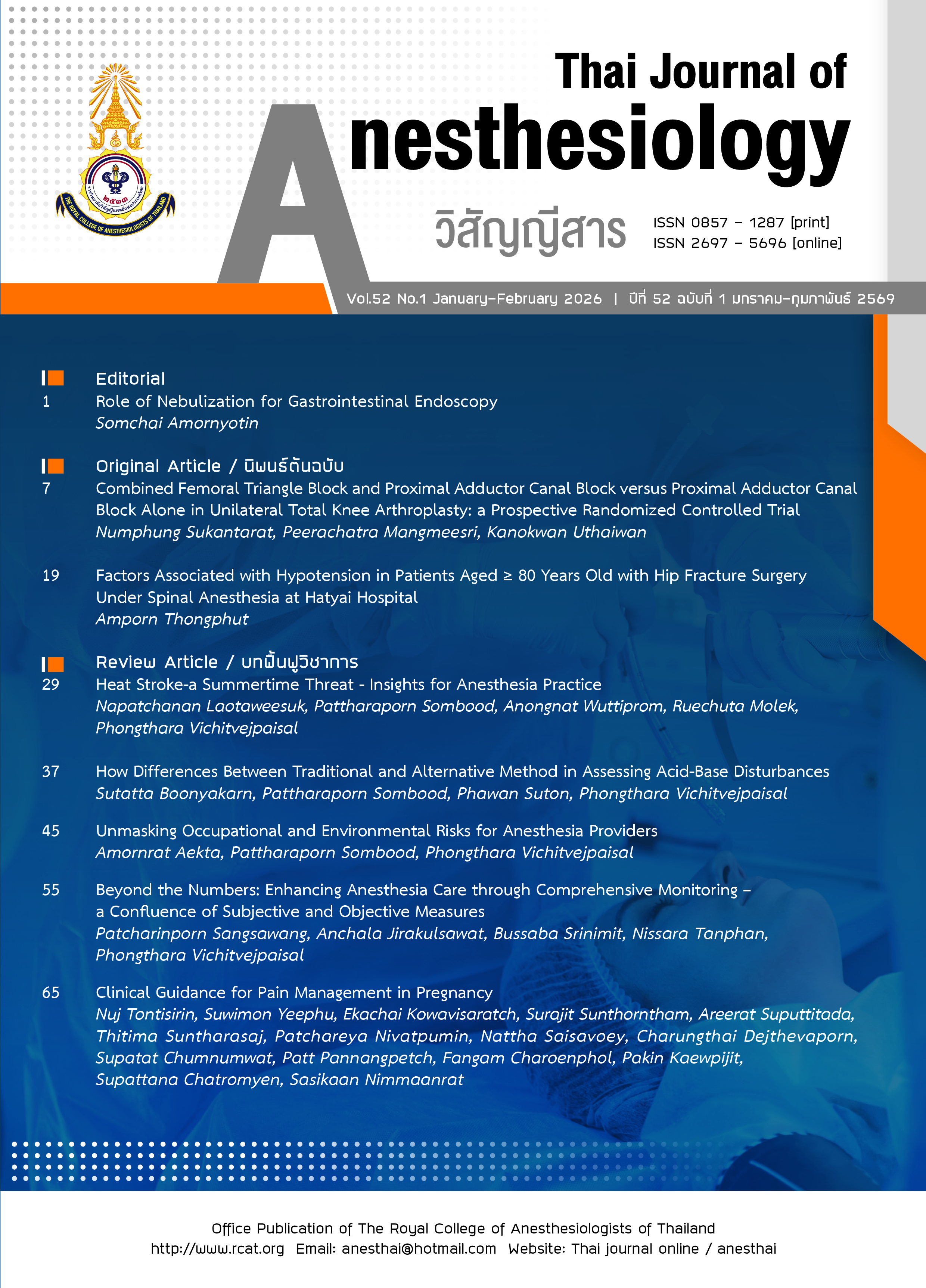
Combined Femoral Triangle Block and Proximal Adductor Canal Block versus Proximal Adductor Canal Block Alone in Unilateral Total Knee Arthroplasty: a Prospective Randomized Controlled Trial
Keywords:
femoral triangle block, postoperative pain, proximal adductor canal block, regional anesthesia, total knee arthroplastyAbstract
Background: Total knee arthroplasty (TKA) frequently results in moderate to severe pain, particularly within the first 24 h following surgery. This pain is associated with delayed rehabilitation and recovery, complications, and prolonged hospitalization. Femoral triangle block (FTB) and proximal adductor canal block (PACB) are multimodal analgesic techniques known to alleviate knee pain. However, their comparative efficacy remains contentious. Methods: In this randomized controlled trial, 60 patients who underwent TKA under spinal anesthesia were randomly divided into two groups. One group received a combination of FTB and PACB, whereas the other group received PACB alone. The primary outcome measure was postoperative pain assessed via the numerical rating scale (NRS). The secondary outcomes included morphine consumption, the timing of intravenous analgesia requests, the length of hospital stay, and complications. Results: Postoperative NRS scores for resting and movement pain at 24 h, the timing of intravenous analgesic requests, the length of hospital stays, and complication rates did not significantly differ between the two groups. However, morphine consumption at 0, 4, 8, 12, 18, and 24 h postoperatively in group CB was significantly lower than in group AB. Conclusion: A combination of FTB and PACB provided broader sensory coverage and significantly reduced 24-h cumulative morphine consumption compared with PACB alone after unilateral TKA, without increasing complications. Although the clinical benefit was modest, this approach may be valuable as part of multimodal or ERAS-based analgesia.
References
Organization WH. Osteoarthritis 14 July 2023 [cited 2023 14 July]. Available from: https://www.who.int/news-room/fact-sheets/detail/osteoarthritis.
Li JW, Ma YS, Xiao LK. Postoperative pain management in total knee arthroplasty. Orthop Surg. 2019;11:755-61.
Castrodad IMD, Recai TM, Abraham MM, et al. Rehabilitation protocols following total knee arthroplasty: a review of study designs and outcome measures. Ann Transl Med. 2019;7(Suppl7):S255.
Benyamin R, Trescot AM, Datta S, et al. Opioid complications and side effects. Pain Physician. 2008;11(Suppl):S105-20.
Joshi G, Gandhi K, Shah N, Gadsden J, Corman SL. Peripheral nerve blocks in the management of postoperative pain: challenges and opportunities. J Clin Anesth. 2016;35:524-9.
Chinachoti T, Makarasara W. Incidence of delayed recovery from femoral nerve block in total knee arthroplasty. J Med Assoc Thai. 2016;99:584-8.
Leung P, Dickerson DM, Denduluri SK, et al. Postoperative continuous adductor canal block for total knee arthroplasty improves pain and functional recovery: a randomized controlled clinical trial. J Clin Anesth. 2018;49:46-52.
Bendtsen TF, Moriggl B, Chan V, Børglum J. The optimal analgesic block for total knee arthroplasty. Reg Anesth Pain Med. 2016;41:711-9.
Runge C, Moriggl B, Børglum J, Bendtsen TF. The spread of ultrasound-guided injectate from the adductor canal to the genicular branch of the posterior obturator nerve and the popliteal plexus: a cadaveric study. Reg Anesth Pain Med. 2017;42:725-30.
Jaremko I, Lukaševič K, Tarasevičius Š, Zeniauskas L, Macas A, Gelmanas A. Comparison of 2 peripheral nerve blocks techniques for functional recovery and postoperative pain management after total knee arthroplasty: a prospective, double-blinded, randomized trial. Med Sci Monit. 2021;27:e932848.
Kukreja P, Feinstein J, Kalagara HK, et al. A summary of the anatomy and current regional anesthesia practices for postoperative pain management in total knee arthroplasty. Cureus. 2018;10:e2755.
Tran J, Peng PWH, Gofeld M, Chan V, Agur AMR. Anatomical study of the innervation of posterior knee joint capsule: implication for image-guided intervention. Reg Anesth Pain Med. 2019;44:234-8.
Ilfeld BM, Duke KB, Donohue MC. The association between lower extremity continuous peripheral nerve blocks and patient falls after knee and hip arthroplasty. Anesth Analg. 2010;111:1552-4.
Mathew K, Varacallo M. Anatomy, bony pelvis and lower limb: saphenous nerve, artery, and vein. StatPearls. Treasure Island (FL): StatPearls Publishing Copyright © 2024, StatPearls Publishing LLC.; 2024.
Sonawane K, Dixit H, Mistry T, Balavenkatasubramanian J. Anatomical and technical considerations of “Dual Subsartorial Block” (DSB), a novel motor-sparing regional analgesia technique for total knee arthroplasty. Open J Orthop Rheumatol. 2021;6:46-56.
Sonawane K, Dixit H, Mistry T, Balavenkatasubramanian J. Comparing analgesic efficacy of a novel dual subsartorial block using two different volumes in patients undergoing total knee arthroplasty: a prospective, double-blind, monocentric, randomised trial. Cureus. 2021;13:e20488.
Wang D, Yang Y, Li Q, et al. Adductor canal block versus femoral nerve block for total knee arthroplasty: a meta-analysis of randomized controlled trials. Sci Rep. 2017;7:40721.
Hasabo EA, Assar A, Mahmoud MM, et al. Adductor canal block versus femoral nerve block for pain control after total knee arthroplasty: a systematic review and meta-analysis. Medicine. 2022;101:e30110.
Wang CG, Ding YL, Wang YY, Liu JY, Zhang Q. Comparison of adductor canal block and femoral triangle block for total knee arthroplasty. Clin J Pain. 2020;36:558-61.
Song L, Li Y, Xu Z, Geng ZY, Wang DX. Comparison of the ultrasound-guided single-injection femoral triangle block versus adductor canal block for analgesia following total knee arthroplasty: a randomized, double-blind trial. J Anesth. 2020;34:702-11.
de Arzuaga CIS, Miguel M, Biarnés A, et al. Single-injection nerve blocks for total knee arthroplasty: femoral nerve block versus femoral triangle block versus adductor canal block-a randomized controlled double-blinded trial. Arch Orthop Trauma Surg. 2023;143:6763-71.
Andersen HL, Gyrn J, Møller L, Christensen B, Zaric D. Continuous saphenous nerve block as supplement to single-dose local infiltration analgesia for postoperative pain management after total knee arthroplasty. Reg Anesth Pain Med. 2013;38:106-11.
Soehnlen NT, Erb ED, Kiskaddon EM, Green U, Froehle A, Krishnamurthy A. Multimodal pain management with adductor canal block decreases opioid consumption following total knee arthroplasty. Fed Pract. 2021;38:598-605.
Mariano ER, Perlas A. Adductor canal block for total knee arthroplasty: the perfect recipe or just one ingredient? Anesthesiology. 2014;120:530-2.
Lavand’homme PM, Kehlet H, Rawal N, Joshi GP. Pain management after total knee arthroplasty: PROcedure SPEcific Postoperative Pain ManagemenT recommendations. Eur J Anaesthesiol. 2022;39:743-57.
Pehora C, Pearson AM, Kaushal A, Crawford MW, Johnston B. Dexamethasone as an adjuvant to peripheral nerve block. Cochrane Database Syst Rev. 2017;11:Cd011770.
Downloads
Published
How to Cite
Issue
Section
License

This work is licensed under a Creative Commons Attribution-NonCommercial-NoDerivatives 4.0 International License.
Copyright
Copyright of all articles published in the Thai Journal of Anesthesiology is held by the Thai Journal of Anesthesiology, the Royal College of Anesthesiologists of Thailand. Submission of a manuscript constitutes the authors' agreement that, upon acceptance for publication, copyright of the work is transferred to the Journal. The content and any opinions expressed in published articles are the sole responsibility of the authors and do not necessarily reflect the views of the editorial board or the Royal College of Anesthesiologists of Thailand.
Licensing
All articles are published open access under the Creative Commons Attribution-NonCommercial-NoDerivatives 4.0 International License (CC BY-NC-ND 4.0). Under this license, anyone may copy and redistribute published articles in any medium or format for non-commercial purposes, provided that appropriate credit is given to the authors and to the Thai Journal of Anesthesiology as the original source of publication, a link to the license is included, and the material is not modified in any way. Requests for commercial use or for adaptation of published material should be directed to the editorial office.
Authors' Rights
Although copyright is held by the Journal, authors retain the right to reuse their own published material in their future scholarly works, theses and dissertations, teaching, and academic presentations, and to deposit the final published version (PDF) in institutional or subject repositories or on personal and institutional websites, without embargo, provided that the Thai Journal of Anesthesiology is clearly acknowledged as the original place of publication.