
Factors Associated with Hypotension in Patients Aged ≥ 80 Years Old with Hip Fracture Surgery Under Spinal Anesthesia at Hatyai Hospital
Keywords:
elderly, hip fracture, hypotension, spinal anesthesiaAbstract
Introduction: Hip fractures are a common reason for surgery in older individuals. Spinal anesthesia is widely used for these procedures, but it is frequently associated with intraoperative hypotension, which may result in severe complications. This study aims to identify perioperative factors that increase the risk of hypotension following spinal anesthesia in extremely elderly patients undergoing hip fracture surgery. Methods: This prognostic factor research with retrospective observational cohort design included patients aged 80 yr and older who underwent hip fracture surgery under spinal anesthesia at Hatyai hospital between October 2016 and September 2023. Baseline characteristics, as well as surgical and anesthetic factors, were collected from medical records. Pre-spinal risk factors were analyzed using univariable and multivariable logistic regression to determine their association with spinal hypotension. Results: Among the 319 patients analyzed, 201 (63%) developed hypotension after spinal anesthesia. Risk factors identified included age over 85 yr, a BMI of 25 kg/m² or higher, the use of renin-angiotensin-aldosterone system antagonists on the day of surgery, the presence of an intertrochanteric fracture, and a surgery delay of more than 14 days after injury. Conclusion: In extremely elderly patients scheduled for hip fracture surgery under spinal anesthesia, careful consideration should be given to the selection of preoperative antihypertensive medications to mitigate the risk of hypotension. Moreover, minimizing surgical delays is critical to optimizing patient outcomes.
References
Suksrisai B, Linhavong J, Manonom S, Manorangsan S. Prevalence and factors affecting first and recurrent hip fracture in the elderly: a retrospective study from inpatients at Thammasat University Hospital. Thammasat Med J. 2020;20:275-85.
Shoda N, Yasunaga H, Horiguchi H, et al. Risk factors affecting in hospital mortality after hip fracture: retrospective analysis using the Japanese Diagnosis Procedure Combination Database. BMJ Open. 2012;2:e000416.
Dominguez JE, Halaszynski TM. Perioperative regional anesthesia in the elderly. In: Hadzic A, editor. Hadzic’s Textbook of Regional Anesthesia and Acute Pain Management. 2nd ed. New York, NY: McGraw-Hill Education. 2017;p865-80.
Hartmann B, Junger A, Klasen J, et al. The incidence and risk factors for hypotension after spinal anesthesia induction: an analysis with automated data collection. Anesth Analg. 2002;94:1521-9.
Chinachoti T, Saetia S, Chaisiri P, Tritrakarn T. Incidence and risk factors of hypotension and bradycardia during spinal anesthesia. Siriraj Med J. 2006;58:696-701.
Malima ZA, Torborg A, Cronjé L, Biccard BM. Predictors of post-spinal hypotension in elderly patients; a prospective observational study in the Durban Metropole. South Afr J Anaesth Analg. 2019;25:13-7.
Jang WY, Jung JK, Lee DK, Han SB. Intraoperative hypotension is a risk factor for postoperative acute kidney injury after femoral neck fracture surgery: a retrospective study. BMC Musculoskelet Disord. 2019;20:131.
Pereira IDF, Grando MM, Vianna PTG, et al. Retrospective analysis of risk factors and predictors of intraoperative complications in neuraxial blocks at Faculdade de Medicina de Botucatu-UNESP. Rev Bras Anestesiol. 2011;61:568-81,311-8.
Akarapatima R, Wongwiwattananon W, Pakpirom J, Benjhawaleemas P. The risk factors for spinal anesthesia-induced hypotension in patients undergoing hip fracture surgery among the elderly: a retrospective cohort study. Thai J Anesthesiol. 2021;47:85-92.
Tarkkila P, Isola J. A regression model for identifying patients at high risk of hypotension, bradycardia and nausea during spinal anesthesia. Acta Anaesthesiol Scand. 1992;36:554-8.
Hogan QH, Prost R, Kulier A, Taylor ML, Liu S, Mark L. Magnetic resonance imaging of cerebrospinal fluid volume and the influence of body habitus and abdominal pressure. Anesthesiology. 1996;84:1341-9.
Sullivan JT, Grouper S, Walker MT, Parrish TB, McCarthy RJ, Wong CA. Lumbosacral cerebrospinal fluid volume in humans using three-dimensional magnetic resonance imaging. Anesth Analg. 2006;103:1306-10.
Calloway JJ, Memtsoudis SG, Krauser DG, Ma Y, Russell LA, Goodman SM. Hemodynamic effects of angiotensin inhibitors in elderly hypertensives undergoing total knee arthroplasty under regional anesthesia. J Am Soc Hypertens. 2014;8:644-51.
Pang H, Niebur P, Karjalainen N, et al. Hemodynamic influences of angiotensin-converting enzyme inhibitors on patients undergoing total knee arthroplasty with spinal anesthesia. Int J Anesth Res. 2016;4:219-24.
Ling Q, Gu Y, Chen J, et al. Consequences of continuing renin angiotensin aldosterone system antagonists in the preoperative period: a systematic review and meta-analysis. BMC Anesthesiol. 2018;18:26.
Li B, Li J, Wang S, Liu L. Clinical analysis of peri-operative hidden blood loss of elderly patients with intertrochanteric fractures treated by unreamed proximal femoral nail anti-rotation. Sci Rep. 2018;8:3225.
Stacey J, Bush C, DiPasquale T. The hidden blood loss in proximal femur fractures is sizeable and significant. J Clin Orthop Trauma. 2021;16:239-43.
Jitsinthunun T, Supannanont P, Raksakietisak M. Incidence, risk-factors, and outcomes of intraoperative hypotension following spinal anesthesia in hip fracture surgery: a retrospective study from Thailand. Siriraj Med J. 2024;76:395-405.
Carpintero P, Caeiro JR, Carpintero R, Morales A, Silva S, Mesa M. Complications of hip fractures: a review. World J Orthop. 2014;5:402-11.
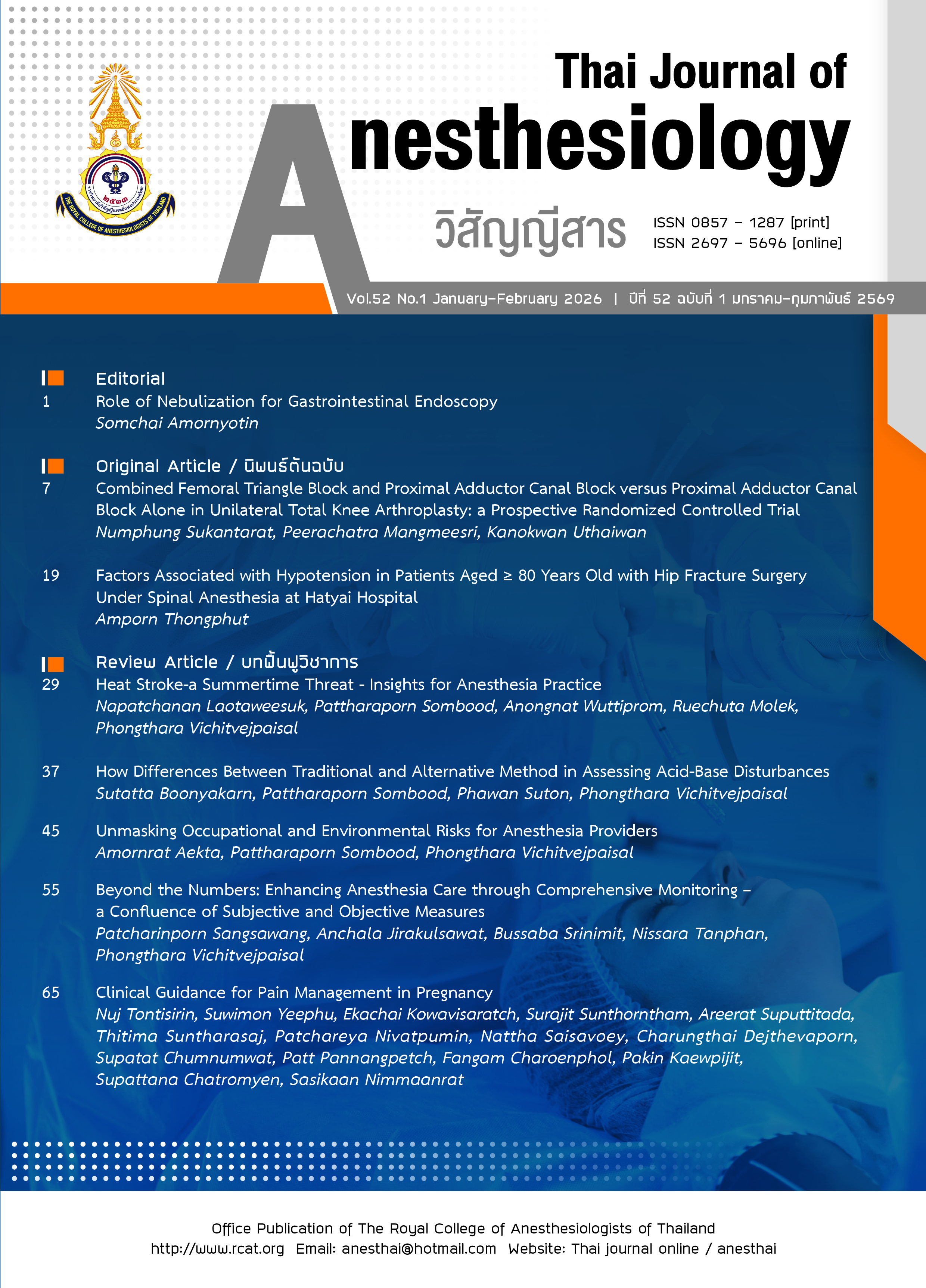
Downloads
Published
How to Cite
Issue
Section
License

This work is licensed under a Creative Commons Attribution-NonCommercial-NoDerivatives 4.0 International License.
Copyright
Copyright of all articles published in the Thai Journal of Anesthesiology is held by the Thai Journal of Anesthesiology, the Royal College of Anesthesiologists of Thailand. Submission of a manuscript constitutes the authors' agreement that, upon acceptance for publication, copyright of the work is transferred to the Journal. The content and any opinions expressed in published articles are the sole responsibility of the authors and do not necessarily reflect the views of the editorial board or the Royal College of Anesthesiologists of Thailand.
Licensing
All articles are published open access under the Creative Commons Attribution-NonCommercial-NoDerivatives 4.0 International License (CC BY-NC-ND 4.0). Under this license, anyone may copy and redistribute published articles in any medium or format for non-commercial purposes, provided that appropriate credit is given to the authors and to the Thai Journal of Anesthesiology as the original source of publication, a link to the license is included, and the material is not modified in any way. Requests for commercial use or for adaptation of published material should be directed to the editorial office.
Authors' Rights
Although copyright is held by the Journal, authors retain the right to reuse their own published material in their future scholarly works, theses and dissertations, teaching, and academic presentations, and to deposit the final published version (PDF) in institutional or subject repositories or on personal and institutional websites, without embargo, provided that the Thai Journal of Anesthesiology is clearly acknowledged as the original place of publication.