
A Survey of Postoperative Pain Management at Postanesthetic Care Unit in Maharaj Nakorn Chiang Mai Hospital
Keywords:
Postoperative pain, PACU, การระงับปวดหลังผ่าตัด, ห้องพักฟื้นAbstract
Background: Compared with children and elderly patients, surveys of early postoperative pain in adults are rarely done. Objectives: To evaluate the effectiveness of postoperative pain management in the PACU and identify the associated factors in patients with moderate to severe pain.
Methods: Retrospective cohort study design was used to collect data from 18 to 60-year-old patients’ anesthetic and PACU records from July to September 2011. The results were analyzed using descriptive statistics and presented as mean + SD and percentage.
Results: 33.89 % of adult patients still had moderate to severe pain at 60th minute in the PACU. In those patients, there was high incidence of general anesthesia, intra-abdominal operation and intermittent intravenous opioid injection for postoperative pain relief.
Conclusion: Early postoperative pain relief in adult was still inadequate. More attention should be provided to patients undergoing intra-abdominal surgery under general anesthesia. Frequent assessment, proper prescription of analgesics and multimodal analgesia should be taken into account. The PACU should develop a proper postoperative pain management guideline.
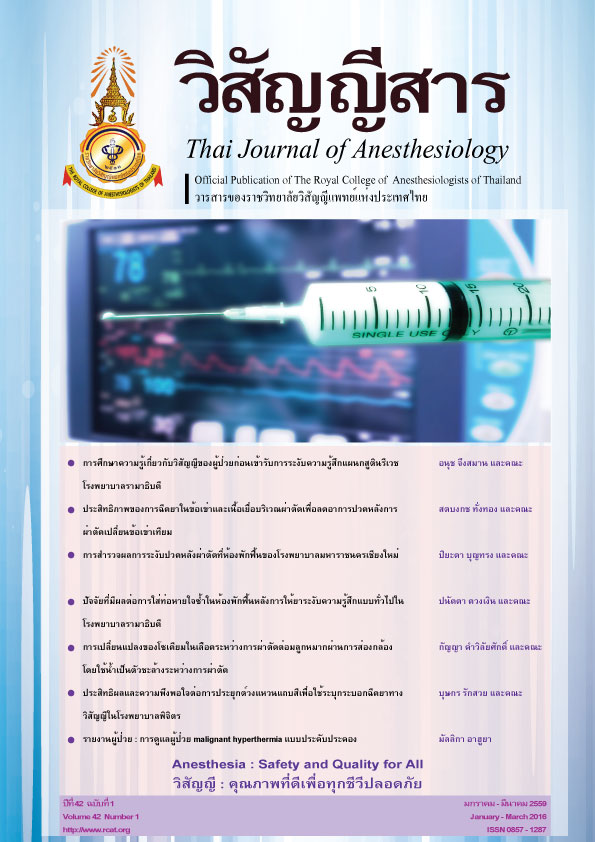
การสำรวจผลการระงับปวดหลังผ่าตัดที่ห้องพักฟื้นของโรงพยาบาลมหาราชนครเชียงใหม่
บทนำ: การศึกษาเรื่องการระงับปวดหลังผ่าตัดในห้องพักฟื้นในกลุ่มผู้ป่วยผู้ใหญ่มีน้อยเมื่อเทียบกับ ผู้ป่วยเด็กและผู้ป่วยสูงอายุ
วัตถุประสงค์: เพื่อประเมินประสิทธิผลของการระงับปวดหลังผ่าตัด และหาปัจจัย ที่เกี่ยวข้องในผู้ป่วยผู้ใหญ่ที่มีอาการปวดปานกลางถึงรุนแรงในห้องพักฟื้น วิธีการศึกษา: เป็นการศึกษาแบบ retrospective cohort โดยเก็บข้อมูลจาก ใบบันทึกการให้ยาระงับความรู้สึกในห้องผ่าตัด และในบันทึกใน ห้องพักฟื้น ในผู้ป่วยที่มีอายุ 18 ถึง 60 ปี ที่มารับการผ่าตัดที่โรงพยาบาลมหาราชนครเชียงใหม่ ในช่วงเดือน กรกฎาคม ถึงเดือนกันยายน พ.ศ. 2554
ผลการศึกษา: พบว่ามีผู้ป่วยร้อยละ 33.89 ยังคงมีอาการปวดแผลผ่าตัด ปานกลางถึงรุนแรง ณ นาทีที่ 60 ในห้องพักฟื้น ปัจจัยที่เกี่ยวข้องได้แก่ การให้ยาระงับความรู้สึกแบบทั่วร่างกาย การผ่าตัดในช่องท้อง และการให้วิธีระงับปวดแบบฉีดยาเข้าหลอดเลือดเป็นครั้งคราว
สรุป: การระงับปวดหลัง ผ่าตัดในห้องพักฟื้นโดยเฉพาะระยะแรกยังคงไม่เพียงพอ ควรมีการใส่ใจในรายที่มารับการผ่าตัดในช่องท้อง ภายใต้การให้ยาระงับความรู้สึกแบบทั่วร่างกาย ควรมีการประเมินความปวดให้ถี่ขึ้น สั่งยาแก้ปวดที่เหมาะสม และควรพิจารณาใช้วิธีการระงับปวดแบบผสมผสานร่วมด้วย และห้องพักฟื้นควรมีแนวปฏิบัติในด้านการระงับ ปวดหลังผ่าตัดที่เหมาะสม
Downloads
How to Cite
Issue
Section
License
Copyright
Copyright of all articles published in the Thai Journal of Anesthesiology is held by the Thai Journal of Anesthesiology, the Royal College of Anesthesiologists of Thailand. Submission of a manuscript constitutes the authors' agreement that, upon acceptance for publication, copyright of the work is transferred to the Journal. The content and any opinions expressed in published articles are the sole responsibility of the authors and do not necessarily reflect the views of the editorial board or the Royal College of Anesthesiologists of Thailand.
Licensing
All articles are published open access under the Creative Commons Attribution-NonCommercial-NoDerivatives 4.0 International License (CC BY-NC-ND 4.0). Under this license, anyone may copy and redistribute published articles in any medium or format for non-commercial purposes, provided that appropriate credit is given to the authors and to the Thai Journal of Anesthesiology as the original source of publication, a link to the license is included, and the material is not modified in any way. Requests for commercial use or for adaptation of published material should be directed to the editorial office.
Authors' Rights
Although copyright is held by the Journal, authors retain the right to reuse their own published material in their future scholarly works, theses and dissertations, teaching, and academic presentations, and to deposit the final published version (PDF) in institutional or subject repositories or on personal and institutional websites, without embargo, provided that the Thai Journal of Anesthesiology is clearly acknowledged as the original place of publication.