
Application of Social Epidemiology: Towards Fundamental Community Health Management
Keywords:
Social Epidemiology, Health inequities, Community Health ManagementAbstract
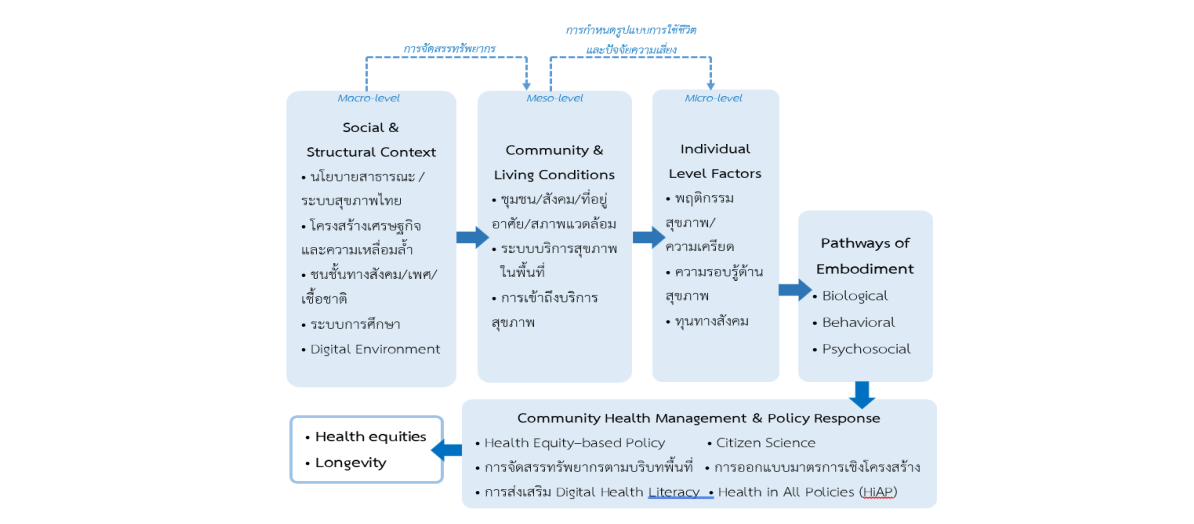
Introduction:Health management in the 21st century has become increasingly complex, as health determinants are no longer limited to biomedical factors but are also influenced by social, economic, cultural, and political structures. Objective: This study was to present a conceptual framework and practical approaches for applying social epidemiology to community health management through a review of academic literature in public health and social sciences. Scope of Study: Integrating key epidemiological and social theories, including Social Capital Theory and Structural Violence, to explain the biological, behavioral, and psychosocial mechanisms linking health determinants in communities. Method: Synthesizing knowledge from empirical research, policy reports, and relevant case studies. Results: Social epidemiology can explain health problems and inequalities through social determinants of health, which affect health according to the eco-social theory. This study develops a framework for grassroots community health management to support the design of health measures and policies aimed at systematically reducing inequality. Conclusion: The developed framework reflects the importance of community health management based on social determinants of community participation, and the enhancement of health literacy, which contributes to reducing health inequalities and developing Thailand's healthcare system.
Downloads
References
Durkheim É. Suicide: A Study in Sociology. 2nd ed. London, England: Routledge; 2005.
Krieger N. Theories for social epidemiology in the 21st century: an ecosocial perspective. Int J Epidemiol.2001;30(4):668-677. doi:10.1093/ije/30.4.668.
Krieger N. Structural racism, health inequities, and the two-edged sword of data: structural problems require structural solutions. Front Public Health. 2021;9:655447. doi:10.3389/fpubh.2021.655447
Marmot M, Allen J, Goldblatt P, Herd E, Morrison J. Build Back Fairer: The COVID-19 Marmot Review. Institute of Health Equity; 2020.
Bambra C, Riordan R, Ford J, Matthews F. The COVID-19 pandemic and health inequalities. J Epidemiol Community Health. 2020;74(11): 964-968. doi:10.1136/jech-2020-214401.
Braveman P, Gruskin S. Defining equity in health. J Epidemiol Community Health. 2003;57(4):254–258. doi:10.1136/jech.57.4.254
Katsiroumpa A, Moisoglou I, Gallos P, et al. Problematic TikTok use and its association with poor sleep. Psychiatry Int. 2025;6:25. doi:10.3390/psychiatryint6010025.
Silvani MI, Werder R, Perret C. The influence of blue light on sleep, performance and cognitive function: a systematic review. Front Physiol. 2022;13:943108. doi:10.3389/fphys.2022.943108.
Harvard Health Publishing. Blue light has a dark side. Harvard Health Publishing. Published July 24, 2024. Accessed September 15, 2025. https://www.health.harvard.edu/staying-healthy/blue-light-has-a-dark-side
World Health Organization. Social determinants of health. https://www.who.int/social_determinants/en/. Published 2025. Accessed September 15, 2025
World Health Organization. A Conceptual Framework for Action on the Social Determinants of Health. Geneva, Switzerland: World Health Organization; 2010. ISBN: 9789241500852. Accessed January 29, 2026. https://www.who.int/publications/i/item/9789241500852
Phelan JC, Link BG, Tehranifar P. Social conditions as fundamental causes of health inequalities: theory, evidence, and policy implications. J Health Soc Behav. 2010;51(1 Suppl):S28-S40. doi:10.1177/0022146510383498
Bambra C, Lynch J, Smith KE. The unequal pandemic: COVID-19 and health inequalities.Policy Press; 2021.
Viswasam N, Rivera J, Comins C, Rao A, Lyons CE, Baral S. The epidemiology of HIV among sex workers around the world. In: Shannon K, Goldenberg SM, eds. Sex Work, Health, and Human Rights. Springer; 2021. doi:10.1007/978-3-030-64171-9_2
Lim SWE, Chong JHS, Chee JY, et al. Impact of a Community-Based Health Intervention on Health Knowledge, Lifestyle Goals, Dietary Practices, and Physical Activity in Older Adults: A Multisite Cohort Study. Healthcare (Basel). 2024;12(24):2588. Published 2024 Dec 23. doi:10.3390/healthcare12242588
สายชล คล้อยเอี่ยม, กมลวรรณ สุขประเสริฐ, ภารุจีร์ เจริญเผ่า, ฐานิตา คุณารักษ์, ดวงพร ไข่ขวัญ และว่าที่ร้อยตรีมณฑล หวานวาจา. ความสัมพันธ์ระหว่างชุมชนรอบรู้ด้านสุขภาพกับความรอบรู้ด้านสุขภาพของคนในชุมชน. วารสารศูนย์อนามัยที่ 7 ขอนแก่น. 2566;15(3):14–25.
Lim A, Ammatawiyanon L, Khurram H, et al. Spatial occurrence-intensity modeling of dengue incidence in southernmost provinces of Thailand. PLoS Negl Trop Dis. 2025;19(7):e0013347. doi:10.1371/journal.pntd.0013347
Sriklin T, Kajornkasirat S, Puttinaovarat S. Dengue transmission mapping with weatherbased predictive model in three southernmost provinces of Thailand. Sustainability. 2021;13(12):6754. doi:10.3390/su13126754.
Rahman MS, Pientong C, Zafar S, Ekalaksananan T, Paul RE, Haque U, et al. Mapping the spatial distribution of the dengue vector Aedes aegypti and predicting its abundance in northeastern Thailand using a machinelearning approach.One Health.2021;13:100358. doi:10.1016/j.onehlt.2021.100358.
Diez Roux AV. Social epidemiology: past, present, and future. Annu Rev Public Health. 2022;43:79-98. doi:10.1146/annurev-publhealth-060220-042648.
สำานักส่งเสริมสุขภาพ กรมอนามัย กระทรวงสาธารณสุข. การศึกษาสถานการณ์ปัจจัยกำาหนดสุขภาพ และพฤติกรรมสุขภาพที่ส่งผลกระทบต่อครอบครัว ชุมชน.พิมพ์ครั้งที่ 1. กรุงเทพฯ: กรมอนามัย กระทรวงสาธารณสุข; 2566.
Kitphati R, Seangkeao K, Muangyim K, Nak-ai W. Participatory development in community health for the Pgazkoenyau ethnic: a case study in an ethnic community in Thailand. Open Public Health J. 2022;15:1-10. DOI:10.2174/e18749445-v15-e2201040
Wongsanuphat S, Malaikham J, Suriya S, Prommongkhol J, Khampha N, Khempetch T. Enhancing digital disease surveillance in Thailand using information technology, data engineering, data science, and artificial intelligence. Outbreak Surveill Investig Response OSIR J.2025;18(1):52-60. doi:10.59096/osir.v18i1.272056
Srimanee C, Homhuan S, Siriphon A, Boonchieng W, Nethngam S, Kattirat W. Local administrative organization and enhancing healthcare services for senior and dependent people through digital technology: a case study of Wiang Yong Subdistrict Municipality, Muang District, Lamphun Province. Connexion: Journal of Humanities and Social Sciences. 2024;13(2):72-92.retrieved from https://so05.tcithaijo.org/index.php/MFUconnexion/article/view/276088
Pengsakun S, Suebpala W, Jungrak L, et al. Citizen Science-Based Coral Reef Monitoring in Trat Province, Eastern Gulf of Thailand. Ramkhamhaeng International Journal of Science and Technology. 2025;8(2):61-76. https://ph02.tci-thaijo.org/index.php/RIST/ article/view/260618
Downloads
Published
How to Cite
Issue
Section
License
Copyright (c) 2026 Chulabhorn Royal Academy

This work is licensed under a Creative Commons Attribution-NonCommercial-NoDerivatives 4.0 International License.
Copyright and Disclaimer
Articles published in this journal are the copyright of Chulabhorn Royal Academy.
The opinions expressed in each article are those of the individual authors and do not necessarily reflect the views of Chulabhorn Royal Academy or any other faculty members of the Academy. The authors are fully responsible for all content in their respective articles. In the event of any errors or inaccuracies, the responsibility lies solely with the individual authors.


