
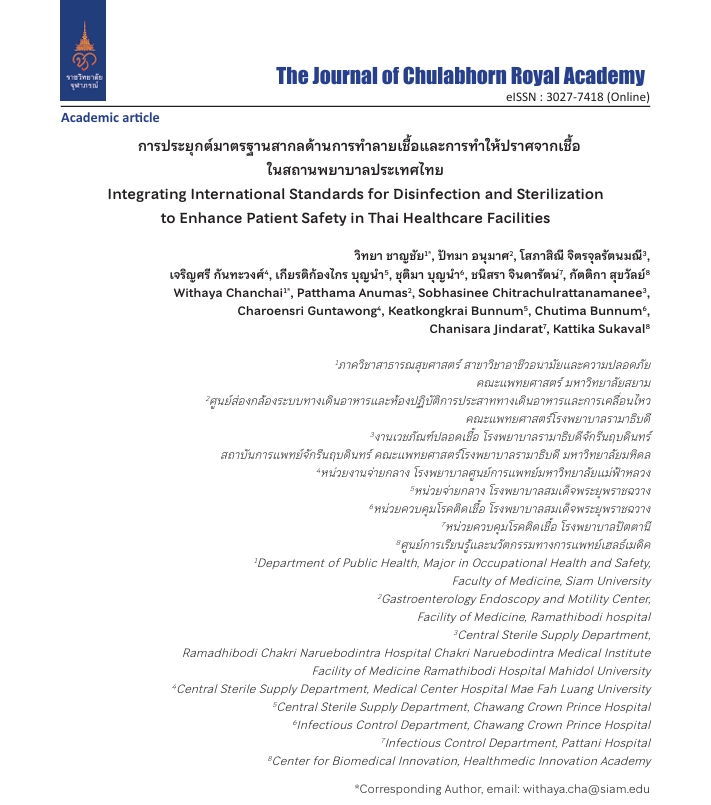
Integrating International Standards for Disinfection and Sterilization to Enhance Patient Safety in Thai Healthcare Facilities
Keywords:
International standards, Disinfection, Sterilization, Medical devices, Infection prevention and controlAbstract
Disinfection and sterilization are essential components of infection prevention and control in healthcare facilities and are directly associated with patient safety, quality of care, and the reduction of healthcare-associated infection risks. This article aims to review and synthesize international standards for disinfection and sterilization and to analyze their application in the context of healthcare facilities in Thailand. The review is based on key conceptual frameworks, including the Spaulding classification, guidelines issued by the Centers for Disease Control and Prevention (CDC), the Food and Drug Administration (FDA), the World Health Organization (WHO), and the Association for the Advancement of Medical Instrumentation (AAMI) standards ST79 and ST91. The article covers the principles of risk classification for medical devices, the selection of appropriate disinfection and sterilization methods based on device intended use, and factors that affect process effectiveness, including pre-cleaning, disinfectant concentration, contact time, temperature, material compatibility, quality assurance, traceability, and occupational safety. It also discusses practical challenges in reprocessing complex medical devices, such as flexible endoscopes and respiratory equipment. The synthesis indicates that the effectiveness of disinfection and sterilization processes depends not only on compliance with international standards but also on the integration of manufacturers’ instructions, device design characteristics, personnel competency, quality assurance systems, and the availability of institutional resources. These considerations are particularly important in Thailand, where healthcare facilities vary substantially in infrastructure and service capacity across different levels of care. In conclusion, the systematic application of international standards for disinfection and sterilization, adapted to the context of Thai healthcare facilities, can strengthen process quality, enhance patient and personnel safety, and reinforce infection prevention and control systems in the long term.
Downloads
References
Cuncannon A, Dosani A, Fast O. Sterile processing in low- and middle-income countries: an integrative review. J Infect Prev. 2021;22(1):28-38. doi:10.1177/1757177420947468
Rowan NJ, Kremer T, McDonnell G. A review of Spaulding's classification system for effective cleaning, disinfection and sterilization of reusable medical devices: Viewed through a modern-day lens that will inform and enable future sustainability. Sci Total Environ. 2023;878:162976. doi:10.1016/j.scitotenv.2023.162976
Kremer T, Rowan NJ, McDonnell G. A proposed cleaning classification system for reusable medical devices to complement the Spaulding classification. J Hosp Infect. 2024;145:88-98. doi:10.1016/j.jhin.2023.11.018
Rutala WA, Boyce JM, Weber DJ. Disinfection, sterilization and antisepsis: An overview. Am J Infect Control. 2023;51(11S):A3-A12. doi:10.1016/j.ajic.2023.01.001
Benowitz I, Moulton-Meissner HA, Epstein L, Arduino MJ. The Centers for Disease Control and Prevention Guidance on Flexible Gastrointestinal Endoscopes: Lessons Learned from Outbreaks, Infection Control. Gastrointest Endosc Clin N Am. 2020;30(4):723-733. doi:10.1016/j.giec.2020.06.009
Day LW, Muthusamy VR, Collins J, et al. Multisociety guideline on reprocessing flexible GI endoscopes and accessories. Gastrointest Endosc. 2021;93(1):11-33.e6. doi:10.1016/j.gie.2020.09.048
Rutala WA, Weber DJ. Reprocessing semicritical items: An overview and an update on the shift from HLD to sterilization for endoscopes. Am J Infect Control. 2023;51(11S):A96-A106. doi:10.1016/j.ajic.2023.01.002
Eberhardt GL, Atwood BI, Smith JD. Point of Use Treatment for Medical Devices: From Bedside to Battlefield. Mil Med. 2024;189(9-10):e1910-e1916. doi:10.1093/milmed/usad499
Huang J, Yi L, Chen Y, Hu J. Factors associated with cleaning quality of reusable medical devices at a single center in China. Heliyon. 2024;10(2):e24194. doi:10.1016/j.heliyon.2024.e24194
Heuvelmans M, Wunderink HF, van der Mei HC, Monkelbaan JF. A narrative review on current duodenoscope reprocessing techniques and novel developments. Antimicrob Resist Infect Control. 2021;10(1):171. doi:10.1186/s13756-021-01037-z
Casini B, Tuvo B, Marciano E, et al. Improving the Reprocessing Quality of Flexible Thermolabile Endoscopes: How to Learn from Mistakes. Int J Environ Res Public Health. 2021;18(5):2482. doi:10.3390/ijerph18052482
Michael FA, Jung M, Reimers M, et al. A New Drying Method of Thermolabile Flexible Endoscope Channels by Laminar and Turbulent Airflow: A Prospective, Randomized-Controlled, Single-Center, Proof-of-Concept Trial. Am J Gastroenterol. 2025;120(5):1027-1035. doi:10.14309/ajg.0000000000003093
Jing W, Mu Y, Cai Y. Central sterile supply department management quality sensitive index constructed by management mode under the guidance of key point control theory and its effect on CSSD management quality: a retrospective study. Ann Palliat Med. 2022;11(6):2050-2060. doi:10.21037/apm-22-594
Zhang W. Role of cleaning quality traceability in hospital sterilization centers. Front Med (Lausanne). 2026;12:1684189. doi:10.3389/fmed.2025.1684189
Yamamoto S, Hachiya Y, Yuasa E, et al. Evaluation of the ceiling levels of ortho-phthalaldehyde exposure among health care workers engaged in endoscope disinfection: A new methodology using video-exposure monitoring. J Occup Health. 2020;62(1):e12139. doi:10.1002/1348-9585.12139
Downloads
Published
How to Cite
Issue
Section
License
Copyright (c) 2026 Chulabhorn Royal Academy

This work is licensed under a Creative Commons Attribution-NonCommercial-NoDerivatives 4.0 International License.
Copyright and Disclaimer
Articles published in this journal are the copyright of Chulabhorn Royal Academy.
The opinions expressed in each article are those of the individual authors and do not necessarily reflect the views of Chulabhorn Royal Academy or any other faculty members of the Academy. The authors are fully responsible for all content in their respective articles. In the event of any errors or inaccuracies, the responsibility lies solely with the individual authors.


