
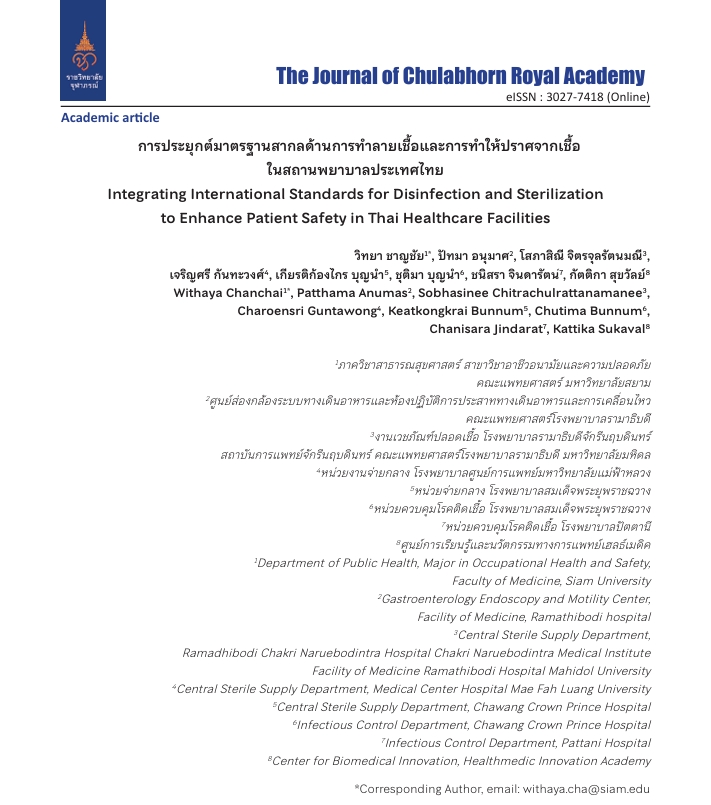
การประยุกต์มาตรฐานสากลด้านการทำลายเชื้อและการทำให้ปราศจากเชื้อ ในสถานพยาบาลประเทศไทย
คำสำคัญ:
การควบคุมการติดเชื้อ, อุปกรณ์ทางการแพทย์, การทำให้ปราศจากเชื้อ, การทำลายเชื้อ, มาตรฐานสากลบทคัดย่อ
การทำลายเชื้อและการทำให้ปราศจากเชื้อเป็นองค์ประกอบสำคัญของระบบป้องกันและควบคุมการติดเชื้อในสถานพยาบาล และมีความสัมพันธ์โดยตรงกับความปลอดภัยของผู้ป่วย คุณภาพบริการ และการลดความเสี่ยงของการติดเชื้อที่สัมพันธ์กับการดูแลสุขภาพ บทความนี้มีวัตถุประสงค์เพื่อทบทวนและสังเคราะห์มาตรฐานสากลด้านการทำลายเชื้อและการทำให้ปราศจากเชื้อ ตลอดจนวิเคราะห์การประยุกต์ใช้ในบริบทของสถานพยาบาลในประเทศไทย โดยอาศัยกรอบแนวคิดสำคัญ ได้แก่ Spaulding classification แนวทางของ Centers for Disease Control and Prevention (CDC), Food and Drug Administration (FDA), World Health Organization (WHO) ตลอดจนมาตรฐาน Association for the Advancement of Medical Instrumentation (AAMI) ST79 และ ST91 เนื้อหาครอบคลุมหลักการจำแนกความเสี่ยงของอุปกรณ์ทางการแพทย์ การเลือกวิธีทำลายเชื้อและการทำให้ปราศจากเชื้อให้เหมาะสมกับลักษณะการใช้งาน ปัจจัยที่มีผลต่อประสิทธิภาพของกระบวนการ เช่น การทำความสะอาดก่อนการประมวลผล ความเข้มข้นของสาร ระยะเวลาสัมผัส อุณหภูมิ ความเข้ากันได้กับวัสดุอุปกรณ์ การควบคุมคุณภาพ การตรวจสอบย้อนกลับ และความปลอดภัยของผู้ปฏิบัติงาน รวมทั้งยกประเด็นท้าทายในอุปกรณ์ที่มีความซับซ้อน เช่น กล้องส่องตรวจชนิดอ่อนงอและอุปกรณ์ช่วยหายใจ การสังเคราะห์พบว่า ประสิทธิผลของกระบวนการขึ้นอยู่กับการบูรณาการมาตรฐานสากลเข้ากับข้อกำหนดของผู้ผลิต ลักษณะโครงสร้างของอุปกรณ์ ศักยภาพบุคลากร ระบบประกันคุณภาพ และความพร้อมด้านทรัพยากรของแต่ละหน่วยบริการ โดยเฉพาะในบริบทของประเทศไทยซึ่งมีความแตกต่างด้านโครงสร้างพื้นฐานและศักยภาพของสถานพยาบาลในแต่ละระดับ สรุปได้ว่า การประยุกต์มาตรฐานสากลด้านการทำลายเชื้อและการทำให้ปราศจากเชื้ออย่างเป็นระบบ และปรับให้เหมาะสมกับบริบทของสถานพยาบาลไทย จะช่วยเสริมสร้างคุณภาพกระบวนการ ความปลอดภัยของผู้ป่วยและบุคลากร และความเข้มแข็งของระบบป้องกันและควบคุมการติดเชื้อในระยะยาว
Downloads
เอกสารอ้างอิง
Cuncannon A, Dosani A, Fast O. Sterile processing in low- and middle-income countries: an integrative review. J Infect Prev. 2021;22(1):28-38. doi:10.1177/1757177420947468
Rowan NJ, Kremer T, McDonnell G. A review of Spaulding's classification system for effective cleaning, disinfection and sterilization of reusable medical devices: Viewed through a modern-day lens that will inform and enable future sustainability. Sci Total Environ. 2023;878:162976. doi:10.1016/j.scitotenv.2023.162976
Kremer T, Rowan NJ, McDonnell G. A proposed cleaning classification system for reusable medical devices to complement the Spaulding classification. J Hosp Infect. 2024;145:88-98. doi:10.1016/j.jhin.2023.11.018
Rutala WA, Boyce JM, Weber DJ. Disinfection, sterilization and antisepsis: An overview. Am J Infect Control. 2023;51(11S):A3-A12. doi:10.1016/j.ajic.2023.01.001
Benowitz I, Moulton-Meissner HA, Epstein L, Arduino MJ. The Centers for Disease Control and Prevention Guidance on Flexible Gastrointestinal Endoscopes: Lessons Learned from Outbreaks, Infection Control. Gastrointest Endosc Clin N Am. 2020;30(4):723-733. doi:10.1016/j.giec.2020.06.009
Day LW, Muthusamy VR, Collins J, et al. Multisociety guideline on reprocessing flexible GI endoscopes and accessories. Gastrointest Endosc. 2021;93(1):11-33.e6. doi:10.1016/j.gie.2020.09.048
Rutala WA, Weber DJ. Reprocessing semicritical items: An overview and an update on the shift from HLD to sterilization for endoscopes. Am J Infect Control. 2023;51(11S):A96-A106. doi:10.1016/j.ajic.2023.01.002
Eberhardt GL, Atwood BI, Smith JD. Point of Use Treatment for Medical Devices: From Bedside to Battlefield. Mil Med. 2024;189(9-10):e1910-e1916. doi:10.1093/milmed/usad499
Huang J, Yi L, Chen Y, Hu J. Factors associated with cleaning quality of reusable medical devices at a single center in China. Heliyon. 2024;10(2):e24194. doi:10.1016/j.heliyon.2024.e24194
Heuvelmans M, Wunderink HF, van der Mei HC, Monkelbaan JF. A narrative review on current duodenoscope reprocessing techniques and novel developments. Antimicrob Resist Infect Control. 2021;10(1):171. doi:10.1186/s13756-021-01037-z
Casini B, Tuvo B, Marciano E, et al. Improving the Reprocessing Quality of Flexible Thermolabile Endoscopes: How to Learn from Mistakes. Int J Environ Res Public Health. 2021;18(5):2482. doi:10.3390/ijerph18052482
Michael FA, Jung M, Reimers M, et al. A New Drying Method of Thermolabile Flexible Endoscope Channels by Laminar and Turbulent Airflow: A Prospective, Randomized-Controlled, Single-Center, Proof-of-Concept Trial. Am J Gastroenterol. 2025;120(5):1027-1035. doi:10.14309/ajg.0000000000003093
Jing W, Mu Y, Cai Y. Central sterile supply department management quality sensitive index constructed by management mode under the guidance of key point control theory and its effect on CSSD management quality: a retrospective study. Ann Palliat Med. 2022;11(6):2050-2060. doi:10.21037/apm-22-594
Zhang W. Role of cleaning quality traceability in hospital sterilization centers. Front Med (Lausanne). 2026;12:1684189. doi:10.3389/fmed.2025.1684189
Yamamoto S, Hachiya Y, Yuasa E, et al. Evaluation of the ceiling levels of ortho-phthalaldehyde exposure among health care workers engaged in endoscope disinfection: A new methodology using video-exposure monitoring. J Occup Health. 2020;62(1):e12139. doi:10.1002/1348-9585.12139
ดาวน์โหลด
เผยแพร่แล้ว
รูปแบบการอ้างอิง
ฉบับ
ประเภทบทความ
สัญญาอนุญาต
ลิขสิทธิ์ (c) 2026 ราชวิทยาลัยจุฬาภรณ์

อนุญาตภายใต้เงื่อนไข Creative Commons Attribution-NonCommercial-NoDerivatives 4.0 International License.
บทความที่ได้รับการตีพิมพ์เป็นลิขสิทธิ์ของราชวิทยาลัยจุฬาภรณ์
ข้อความที่ปรากฏในบทความแต่ละเรื่องในวารสารวิชาการเล่มนี้เป็นความคิดเห็นส่วนตัวของผู้เขียนแต่ละท่านไม่เกี่ยวข้องกับราชวิทยาลัยจุฬาภรณ์ และคณาจารย์ท่านอื่น ในราชวิทยาลัยฯ แต่อย่างใด ความรับผิดชอบองค์ประกอบทั้งหมดของบทความแต่ละเรื่องเป็นของผู้เขียนแต่ละท่าน หากมีความผิดพลาดใด ๆ ผู้เขียนแต่ละท่านจะรับผิดชอบบทความของตนเองแต่ผู้เดียว


