
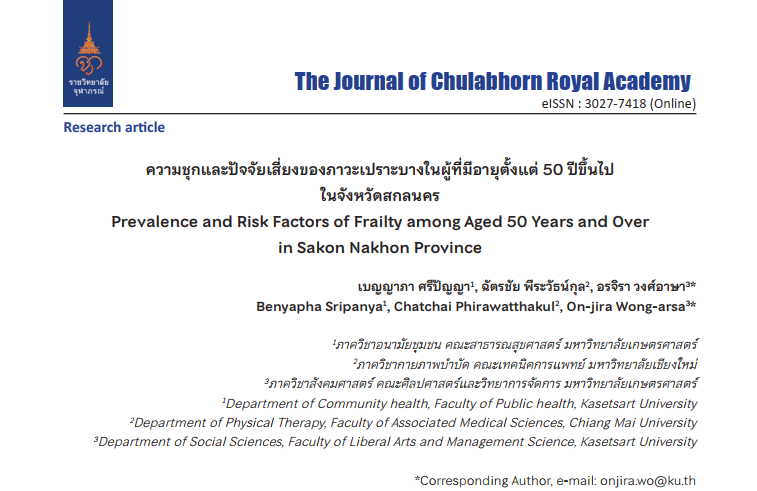
Prevalence and Risk Factors of Frailty among Aged 50 Years and Over in Sakon Nakhon Province
Keywords:
Frailty, Risk factor, Sociodemographic characteristics, Pre-aging, Older adultsAbstract
Abstract
Frailty is a biopsychosocial syndrome characterized by changes in all physiological systems that are age-related conditions and contribute to adverse health outcomes. This cross-sectional analytical study aimed to investigate the prevalence and risk factors of frailty among people aged 50 years and over. Sample groups are 356 people that aged 50 years and over in Sakon Nakhon province. Data were collected using a personal information form, social support questionnaire, Thai Geriatric Depression, Mini-Mental State examination, and the Tilburg Frailty Indicator. Data analysis was performed using Binary Logistic Regression Model showing the Odds Ratio and 95% Confidence Interval.
The results showed that most of the participants were female (72.19%). The average age was 63.92 ± 8.38 years, and 31.18% (95%CI: 26.4, 36.0) were detected as being frail. The factors predicted the development of frailty syndrome, were age (OR = 2.367, 95%CI 1.490 - 3.759, p <0.001), low level education (OR = 4.267, 95%CI 2.339 - 7.784, p <0.001), chronic medical condition (OR = 3.086, 95%CI 1.870 - 5.091, p <0.001), the number so medications used (OR = 2.026, 95%CI 2.281 - 3.202, p = 0.003), the history of fall during the last six mouth (OR = 2.153, 95%CI 1.356 - 3.418, p = 0.001), insufficiency of income (OR = 1.649, 95%CI 1.007 - 2.701, p = 0.047) low level of social support (OR = 1.632, 95%CI 1.039 - 2.564, p = 0.034), and cognitive impairment (OR = 1.888, 95%CI 1.194 - 2.986, p = 0.007).
This study indicates demographic factors. Health status, economic, and psychosocial conditions are all risk factors for frailty and lead to frailty among people in pre-aging and elderly age. Therefore, monitoring and managing these risk factors is important to reduce adverse health outcomes in the future.
Downloads
References
Xue QL. The frailty syndrome: definition and natural history. Clin Geriatr Med. 2011;27(1):1-15. doi:10.1016/j.cger.2010.08.009
Cohen CI, Benyaminov R, Rahman M, Ngu D, Reinhardt M. Frailty: A Multidimensional Biopsychosocial Syndrome. Med Clin North Am. 2023;107(1):183-197. doi:10.1016/j.mcna.2022.04.006
Fried L, Walston J. Frailty and failure to thrive. In: Hazzard WR, Blass JP, Ettinger WH Jr, Halter JB, Ouslander JG. Principles of geriatric medicine and gerontology, fourth edition. NY: Mc Graw Hill; 1998: 1387–1402.
Loecker C, Schmaderer M, Zimmerman L. Frailty in Young and Middle-Aged Adults: An Integrative Review. J Frailty Aging. 2021;10(4):327-333. doi:10.14283/jfa.2021.14
O'Caoimh R, Sezgin D, O'Donovan MR, Molloy DW, Clegg A, Rockwood K, Liew A. Prevalence of frailty in 62 countries across the world: a systematic review and meta-analysis of population-level studies. Age Ageing. 2021;50(1):96-104. doi:10.1093/ageing/afaa219
Morkphrom E, Srinonprasert V, Sura-amonrattana U, et al. Severity of frailty using modified Thai frailty index, social factors, and prediction of mortality among community-dwelling older adults in a middle-income country. Front Med (Lausanne). 2022;9:1060990. Published 2022 Dec 9. doi:10.3389/fmed.2022.1060990
ชนัดดา อนุพัฒน์, วิราพรรณ วิโจน์รัตน์, ดวงรัตน์ วัฒนกิจไกรเลิศ และศริยามน ติรพัฒน์. ปัจจัยที่มีอิทธิพลต่อภาวะเปราะบางในผู้สูงอายุ. วารสารวิจัยทางวิทยาศาสตร์สุขภาพ. 2563;14(1):43-54.
Kwak D, Thompson LV. Frailty: Past, present, and future?. Sports Med Health Sci. 2020;3(1):1-10. Published 2020 Nov 30. doi:10.1016/j.smhs.2020.11.005
Feng Z, Lugtenberg M, Franse C, et al. Risk factors and protective factors associated with incident or increase of frailty among community-dwelling older adults: A systematic review of longitudinal studies. PLoS One. 2017;12(6):e0178383. Published 2017 Jun 15. doi:10.1371/journal.pone.0178383
Ye B, Gao J, Fu H. Associations between lifestyle, physical and social environments and frailty among Chinese older people: a multilevel analysis. BMC Geriatr. 2018;18(1):314. Published 2018 Dec 14. doi:10.1186/s12877-018-0982-1
Hoogendijk, E. O., Afilalo, J., Ensrud, K. E., Kowal, P., Onder, G., & Fried, L. P. (2019). Frailty: implications for clinical practice and public health. The Lancet, 394(10206), 1365-1375.
Kojima G, Iliffe S, Jivraj S, Walters K. Association between frailty and quality of life among community-dwelling older people: a systematic review and meta-analysis. J Epidemiol Community Health. 2016;70(7):716-721. doi:10.1136/jech-2015-206717
Hajek A, Bock JO, Saum KU, et al. Frailty and healthcare costs-longitudinal results of a prospective cohort study. Age Ageing. 2018;47(2):233-241. doi:10.1093/ageing/afx157
Kolle AT, Lewis KB, Lalonde M, Backman C. Reversing frailty in older adults: a scoping review. BMC Geriatr. 2023;23(1):751. Published 2023 Nov 17. doi:10.1186/s12877-023-04309-y
Gordon SJ, Baker N, Kidd M, Maeder A, Grimmer KA. Pre-frailty factors in community-dwelling 40-75 year olds: opportunities for successful ageing. BMC Geriatr. 2020;20(1):96. Published 2020 Mar 6. doi:10.1186/s12877-020-1490-7
Bai G, Wang Y, Mak JKL, Ericsson M, Hägg S, Jylhävä J. Is Frailty Different in Younger Adults Compared to Old? Prevalence, Characteristics, and Risk Factors of Early-Life and Late-Life Frailty in Samples from Sweden and UK. Gerontology. 2023;69(12):1385-1393. doi:10.1159/000534131
Gobbens RJ, van Assen MA, Luijkx KG, Wijnen-Sponselee MT, Schols JM. The Tilburg Frailty Indicator: psychometric properties. J Am Med Dir Assoc. 2010;11(5):344-355. doi:10.1016/j.jamda.2009.11.003
COCHRAN WG. Matching in analytical studies. Am J Public Health Nations Health. 1953;43(6 Pt 1):684-691. doi:10.2105/ajph.43.6_pt_1.684
ประกายมาศ เนตรจันทร์, รัตน์ศิริ ทาโต, ศิริพันธุ์ สาสัตย์. (2562). ปัจจัยคัดสรรที่สัมพันธ์กับภาวะเปราะบางของผู้สูงอายุที่อยู่ในบ้านพักคน ชราของภาครัฐ. วารสารพยาบาลตำรวจ, 11(1):61-72
Wongpakaran N, Wongpakaran T, Kuntawong P. Evaluating hierarchical items of the geriatric depression scale through factor analysis and item response theory. Heliyon. 2019;5(8):e02300. Published 2019 Aug 13. doi:10.1016/j.heliyon.2019.e02300
เบญจมาศ ศิริกมลเสถียร, ศรัญญา วงศ์กําปั่น, รัชนีภรณ์ ณ ถลาง, กนกวรรณ ไชยลาภ. ระบาดวิทยาของภาวะเปราะบาง ภาวะมวลกล้ามเนื้อน้อย และภาวะสมองเสื่อมของผู้สูงอายุในชุมชน เขตหลักสี่ กรุงเทพมหานคร. วารสารวิชาการราชวิทยาลัยจุฬาภรณ์. 2567;6(2):63 74.
Khan KT, Hemati K, Donovan AL. Geriatric Physiology and the Frailty Syndrome. Anesthesiol Clin. 2019;37(3):453-474. doi:10.1016/j.anclin.2019.04.006
Belloni G, Cesari M. Frailty and Intrinsic Capacity: Two Distinct but Related Constructs. Front Med (Lausanne). 2019;6:133. Published 2019 Jun 18. doi:10.3389/fmed.2019.00133
Gobbens, Robbert J., and Izabella Uchmanowicz. "Assessing frailty with the Tilburg Frailty Indicator (TFI): A review of reliability and validity." Clinical Interventions in Aging (2021): 863-875.
Sisi MM, Shamshirgaran SM, Rezaeipandari H, Matlabi H. Multidimensional approach to frailty among rural older people: applying the Tilburg frailty indicator. Elderly Health J. 2019;5(2):82-89.
Qin Y, Hao X, Lv M, Zhao X, Wu S, Li K. A global perspective on risk factors for frailty in community-dwelling older adults: A systematic review and meta-analysis. Arch Gerontol Geriatr. 2023;105:104844. doi:10.1016/j.archger.2022.104844
Barghouth, M. H., Klein, J., Bothe, T., Ebert, N., Schaeffner, E., & Mielke, N. (2024). Social support and frailty progression in community-dwelling older adults. Frontiers in public health.2024;12: 1408641. doi:10.3389/fpubh.2024.1408641
Downloads
Published
How to Cite
Issue
Section
License
Copyright (c) 2026 Chulabhorn Royal Academy

This work is licensed under a Creative Commons Attribution-NonCommercial-NoDerivatives 4.0 International License.
Copyright and Disclaimer
Articles published in this journal are the copyright of Chulabhorn Royal Academy.
The opinions expressed in each article are those of the individual authors and do not necessarily reflect the views of Chulabhorn Royal Academy or any other faculty members of the Academy. The authors are fully responsible for all content in their respective articles. In the event of any errors or inaccuracies, the responsibility lies solely with the individual authors.


