
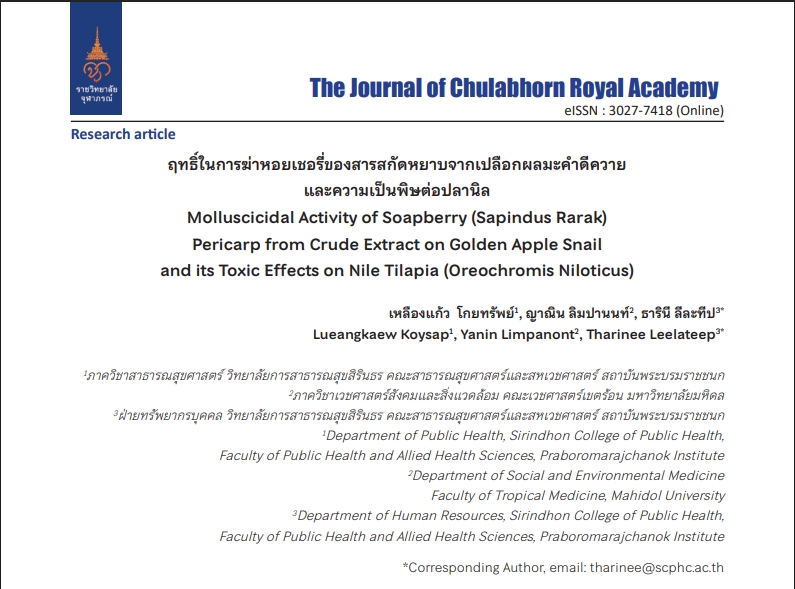
The Molluscicidal Effects on Golden Apple Snail and Toxic Effects on Nile Tilapia (Oreochromis niloticus) from the Soapberry (Sapindus rarak) Pericarp Crude Extract
Keywords:
Biopesticide, Integrated pest management, Aquatic toxicity, SaponinAbstract
The golden apple snail (Pomacea canaliculata Lamarck) is an invasive species that causes ecological damage, agricultural losses and public health concerns. It act as an intermediate host of the parasite Angiostrongilus cantonensis. Traditional eradication methods, such as physical and biological control, are often difficult to implement effectively. As a result, most farmers prefer to use chemical methods due to their high effectiveness. However, these methods can have negative impacts on both the environment and human health. Therefore, the use of herbal extracts with molluscicidal properties that are environmentally friendly and safe for human health, is a promising alternative for controlling this snail. The molluscicidal activity from the soapberry (Sapindus rarak) pericarp crude extract has been reported, but its toxic effects on other aquatic organisms have not been thoroughly investigated. This research aims to study: 1) the molluscicidal effect of the soapberry pericarp crude extract on the golden apple snails, 2) its bioactive compounds, and 3) its toxic effects on Nile tilapias (Oreochromis niloticus). The results showed that at the concentrations of 25 ppm and 50 ppm of soapberry pericarp crude extract caused 50% mortality in snails within 24 hours and 90% within 72 hours, respectively. However, this concentration caused 100% mortality in Nile tilapias within 48 hours. Hederagenin was the bioactive compound found at 0.44%. It is a glycoside saponin with hemolytic properties on organisms. Hence, it might be the cause of snail and Nile tilapia mortality in this study. Our findings recommended that farmers should avoid using soapberry crude extract to eliminate the golden apple snails in the rice fields, lotus ponds, fish ponds, shrimp ponds, or other aquatic animal nurseries, as it is toxic to aquatic animals.
Downloads
References
สุภักษร เจริญเกียรติ, การติมา ทรงคุณ, พีระยศ แข็งขัน, ฤชุอร วรรณะ. ผลของสารสกัดจากพืชในการกำจัด
หอยเชอรี่. วารสารแก่นเกษตร. 2558;43(1):643-649.
María ES, Pablo RM. Global records of the invasive freshwater apple snail Pomacea
canaliculata (Lamarck, 1822). Biogeographia –The Journal of Integrative Biogeography.
;40(1):1-14. https://doi.org/10.21426/B6.39864.
Saveanu L, Manara E, Martín PR. Sediment ingestion in the invasive apple snail Pomacea
canaliculata. Aquatic Ecology. 2023;57:433-442. https://doi: 10.1007/s10452-023-10020-2.
Eimumpai K, Chaipakdee M, Chaipakdee W, Sonsa T. Information about Asian openbill in
Thailand. Wildlife Research Group, Office of Wildlife Conservation, Department of National
Park, Wildlife and Plant Conservation, Bangkok, Thailand. 2013. 98 pp (in Thai).
Chaichana R, Joshi RC. Invasive apple snails (Pomacea spp.) in Thailand: current status and
integrated management. Agriculture Development. (2018). Access September 12, 2025,
Retrieved fromhttps://taa-international.org/wp-
content/uploads/2018/07/Ag4Dev33Web_version.pdf#page=28
Keawjam Rojana. The Apple Snails of Thailand Distribution, Habitats and Shell Morphology.
Malacological Review. 1986;(19):61-81.
Lv SY, Zhang P, Steinmann GJ, Yang K, Yang XN, Zhou et al. The Emergence of
Angiostrongyliasis in the People’s Republic of China: The Interplay between Invasive Snails,
Climate Change and Transmission Dynamics. Freshwater Biology 2011;56(4):717–734.
https://doi.org/10.1111/j.1365-2427.2011.02579.x.
Matsukura K, Izumi Y, Yoshida K, Wada T. Cold Tolerance of Invasive Freshwater Snails,
Pomacea canaliculata, P. maculata, and Their Hybrids Helps Explain Their Different
Distributions. Freshwater Biology. 2016;61(1):80-87. https://doi.org/10.1111/fwb.12681.
ญาณิศา นราพงษ์, นพคุณ ภักดีณรงค์. โรคเยื่อหุ้มสมองอักเสบอันเนื่องมาจากพยาธิตัวกลม Angiostrongylus
Cantonensis Eosinophilic Meningitis due to Angiostrongylus Cantonensis. J Sci Technol MSU.
; 36(1):140-147.
อับดุลฮากัม ดูมีแด, อภิชาติ วิทยตะ. พยาธิปอดหนูและโฮสตตัวกลางในธรรมชาติ The Rat Lungworm and
Natural Intermediate Hosts. วารสารวิทยาศาสตร์และเทคโนโลยี. 2561;26(2):300-312.
รัตนาภรณ์ โรจนทัพพะ. A Case Report : A Live Intracameral Angiostrongyliasis with Anterior
Uveitis รายงานผู้ป่วย : พยาธิหอยโข่งในช่องหน้าลูกตา. Thai J Ophthalmol. 2563;34(2):84-92.
อานุช ครีรรัฐนิคม, สุดสาคร พุกงาม. รูปแบบการจัดการหอยเชอรี่ในนาข้าว บริเวณอำเภอป่าพะยอม จังหวัด
พัทลุง. รายงานผลการวิจัย. ภาควิชาชีววิทยา คณะวิทยาศาสตร์ มหาวิทยาลัยทักษิณ. 2559.
Teo SS. Evaluation of different species of fish for biological control of golden apple snail
Pomacea canaliculata (Lamarck) in rice. Crop Protection. 2006;25(9):1004-1012.
https://doi.org/10.1016/j.cropro.2006.01.012
Thailand Pesticide Alert Network. Summary of imported hazardous materials for agriculture
http://www.thaipan.org/sites/default/files/file_info/pesticide_doc34.pdf (in Thai).
เมื่อวันที่ 10/09/2025.
นุชจรินทร์ แกล้วกล้า, กฤติยากร แสนพันธ. การศึกษาเบื้องต้นถึงผลของสารสกัดหยาบจากผักชีช้างที่มีต่อ
การพัฒนาในระยะต่าง ๆ ของหอยเชอรี่. วารสารวิทยาศาสตร์และนวัตกรรมท้องถิ่น. 2567;1(2):33-48.
Demetillo MT, Baguio ML, Limitares DE, Madjos GG, Abrenica-Adamat LR. Effect of
Cymbopogon citratus (lemon grass) crude leaf extracts on the developmental stages of
Pomacea canaliculata (golden apple snail). AES Bioflux. 2015;7(3):460-467.
https://aes.bioflux.com.ro/docs/2015.460-467.pdf
ตรัย วงษ์ศิริ, อภิญญา โชติญาโณ, รัชดาภรณ์ เบญจวัฒนานนท์. ประสิทธิภาพของสารสกัดจากพืชมอลลัสซิ
เดสเพื่อการควบคุมหอยเชอรี่ (Pomacea canaliculata). วารสารเกษตรพระวรุณ. 2023;20(2):167–176.
Lueangkaew Koysap, Jiraporn Ruangsittichai, Sumate Ampawong, Sumet Kongkiatpaiboon,
Suwalee Worakhunpiset, Urusa Thaenkham, et al. Assessing the efficacy of soapberry
(Sapindus rarak) crude extract for controlling giant African land snail (Lissachatina fulica).
Management of Biological Invasions. 2022;13(4):690-704.
https://doi.org/10.3391/mbi.2022.13.4.07
Welzen PV. An Introduction to the Sapindaceae in Thailand. Thai Forest Bulletin
(Botany). 1997;25:21-53.
World Health Organization. Molluscicide screening and evaluation. Bulletin of the World
Health Organization. 1965;33:567-81.
ชมพูนุช จรรยาเพศ, ศิริพร ซึงสนธิพร, ทักษิณ อาชวาคม. ทดสอบสารสกัดจากพืชในการป้องกันกำจัดหอย
เชอรี่และผลกระทบต่อสัตว์น้ำ. รายงานผลการวิจัย. กลุ่มงานสัตววิทยาการเกษตร กองกีฎและสัตววิทยา
กรมวิชาการเกษตร. 2539:264-265.
Organization for Economic Co-operation and Development (OECD) guideline for the testing
of chemicals. test guideline No. 203 Fish. Acute Toxicity Testing. 2019.
ศูนย์ข้อมูลสมุนไพร จาก https://medplant.mahidol.ac.th/pubhealth/Sapindus_rarak.html
เมื่อวันที่ 11 กันยายน 2568
Castillo-Ruiz M, Cañon-Jones H, Schlotterbeck T, Lopez MA, Tomas Á, San Martín R. Safety
and efficacy of quinoa (Chenopodium quinoa) saponins derived molluscicide to control of
Pomacea maculata in rice fields in the Ebro Delta, Spain. Crop Protection. 2018;111:42–49.
https://doi.org/10.1016/j.cropro.2018.04.016.
Wisetkomolmat J, Suppakittpaisarn P, Sommano SR. Detergent plants of northern Thailand:
Potential sources of natural saponins. Resources. 2019;8:10. https://doi.org/10.3390/
resources8010010.
Asao Y, Morikawa T, Xie Y, Okamoto M, Hamao M, Matsuda H, et al. Structures of Acetylated
oleanane-type triterpene saponins, rarasaponins IV, V, and VI, and anti-hyperlipidemic
constituents from the pericarps of Sapindus rarak. Chemical & Pharmaceutical Bulletin.
; 57:198-203. https://doi.org/10.1248/cpb.57.198.
Hamburger M, Slacanin I, Hostettmann K, Dyatmiko W, Sutarjadi. Acetylated saponins
with molluscicidal activity from Sapindus rarak: unambiguous structure determination by
proton nuclear magnetic resonance and quantitative analysis. Phytochemical Analysis.
;3:231-237. https://doi.org/10.1002/pca.2800030507.
สำนักงานประชาสัมพันธ์จังหวัดราชบุรี, ครม. เห็นชอบตามกระทรวงเกษตรและสหกรณ์ แผนปฏิบัติการ
แก้ไขปัญหาการแพร่ระบาดของปลาหมอคางดำ พ.ศ. 2567 – 2570. จาก
https://ratchaburi.prd.go.th/th/content/category/detail/id/57/iid/317329 เมื่อวันที่ 19 ตุลาคม
อภิรดี หันพงศ์กิตติกูล, วงศ์ปฐม กมลรัตน์, ทิวารัตน์ เถลิงเกียรติลีลา, สุภาภรณ์ ชาวสวน. ความหลากหลาย
ทางพันธุกรรมกับพันธุปฎิทรรศน์ของการระบาดปลาหมอคางดำในประเทศไทย. วารสารการประมง
อิเล็กทรอนิกส์.2020;3(4):11–31.
Downloads
Published
How to Cite
Issue
Section
License
Copyright (c) 2026 Chulabhorn Royal Academy

This work is licensed under a Creative Commons Attribution-NonCommercial-NoDerivatives 4.0 International License.
Copyright and Disclaimer
Articles published in this journal are the copyright of Chulabhorn Royal Academy.
The opinions expressed in each article are those of the individual authors and do not necessarily reflect the views of Chulabhorn Royal Academy or any other faculty members of the Academy. The authors are fully responsible for all content in their respective articles. In the event of any errors or inaccuracies, the responsibility lies solely with the individual authors.


