ผลของส่วนสกัดดอกและใบขี้เหล็กต่อการลดน้ำตาลในเลือดแบบ in vitro
คำสำคัญ:
ขี้เหล็ก, การต้านโรคเบาหวาน, การยับยั้ง DPP-VI, การยับยั้งแอลฟากลูโคซิเดส, การแพร่กลูโคสบทคัดย่อ
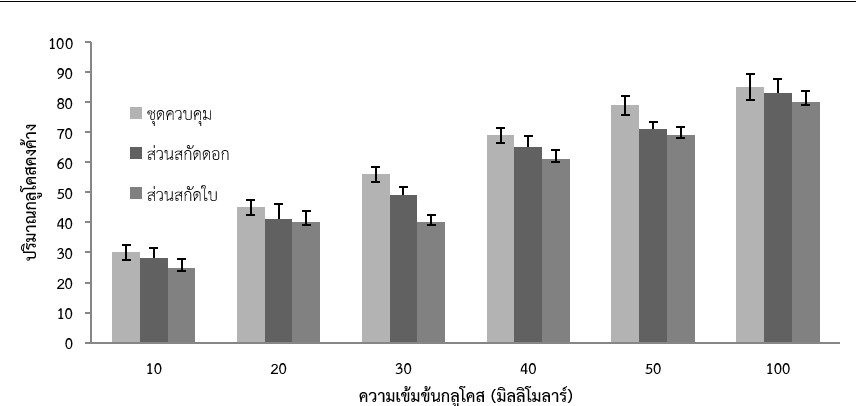
ภูมิหลัง: โรคเบาหวานคือโรคเรื้อรังที่เกิดจากความผิดปกติของเมแทบอลิซึม ที่เกิดจากความผิดปกติของการหลั่งอินซูลิน นอกจากนี้โรคเบาหวานมีความเสี่ยงต่อการพัฒนาไปสู่การเกิดโรคแทรกซ้อนเนื่องจากการมีระดับน้ำตาลในเลือดสูงเป็นระยะเวลายาวนาน วัตถุประสงค์: งานวิจัยนี้มีวัตถุประสงค์เพื่อศึกษาประสิทธิภาพการลดระดับน้ำตาลในเลือดจากดอกและใบขี้เหล็ก ผ่านการยับยั้งไดเปปทิดิว เฟปทิเดส (Dipeptidyl Peptidase IV, DPP-IV) แอลฟากลูโคซิเดส การดูดซับกลูโคส และการแพร่กลูโคสในหลอดทดลอง วิธีการศึกษา: ส่วนสกัดเมทานอลของดอกและใบขี้เหล็กโดยประเมินการยับยั้ง DPP-IV แอลฟากลูโคซิเดสจากลำไส้เล็กของหนู (มอลเทส และซูเครส) การดูดซับกลูโคส การแพร่ของกลูโคสในหลอดทดลอง และการทดสอบสารพฤกษเคมีเบื้องต้น ผลการศึกษา: การศึกษาพฤกษเคมีเบื้องต้นพบสารฟลาโวนอยด์ แอลคาลอยด์ และสารประกอบฟีนอลิกในส่วนสกัดดอกและใบ การศึกษาส่วนสกัดเมทานอลของใบพบว่ามีฤทธิ์การยังยั้ง DPP-IV และแอลฟากลูโคซิเดส ชนิด มอลเทส และซูเครสที่สูงสุด โดยมีค่า IC50 เท่ากับ 0.40, 3.77 และ 3.64 มิลลิกรัม/มิลลิลิตร ตามลำดับซึ่งมากกว่าส่วนสกัดของดอก วิลดากลิปทินและอะคาร์โบสเป็นสารมาตรฐาน สำหรับการศึกษาการยับยั้ง DPP-IV และแอลฟากลูโคซิเดส ชนิด มอลเทส และซูเครส โดยมีค่า IC50 เท่ากับ 0.32, 0.36 และ 0.97 ตามลำดับ นอกจากนี้ส่วนสกัดเมทานอลของดอกและใบมีประสิทธิภาพในการดูดซับ และชะลอการแพร่ของกลูโคสในหลอดทดลอง บทสรุป: ผลการศึกษาส่วนสกัดเมทานอล ของดอกและใบ สามารถนำไปพัฒนาเป็นตัวยาลดระดับน้ำตาลในกระแสเลือดสำหรับการรักษาโรคเบาหวาน
Downloads
เอกสารอ้างอิง
Acharjee S, Ghosh B, Al-Dhubiab BE, Nair AB. (2013). Understanding type 1 diabetes: etiology and models. Can J Diabetes. 2013;37(4):269-276. https://doi.org/10.1016/j.jcjd.2013.05.001
Lopez-Candales, A. (2001). Metabolic syndrome X: a comprehensive review of the pathophysiology and recommended therapy. J Med. 2011;32(5-6):283-300. https://doi.org/10.1155/2014/943162
Perfetti R, Barnett PS, Mathur R, Egan JM. Novel therapeutic strategies for the treatment of type 2 diabetes. Diabetes Metab Rev. 1998;14(3):207-225. https://doi.org/10.1002/(SICI)1099-0895(1998090)14:3%3C207::AID-DMR214%3E3.0.CO;2-J
Singh AK. Dipeptidyl peptidase-4 inhibitors: Novel mechanism of actions. Indian J Endocrinol Metab. 2014;18(6):753-759. https://doi.org/10.4103/2230-8210.141319
Franco OL, Rigden DJ, Melo FR, Grossi-De-Sa MF. Plant alpha-amylase inhibitors and their interaction with insect alpha-amylases. Eur J Biochem. 2002;269(2):397-412. https://doi.org/10.1046/j.0014-2956.2001.02656.x
Rengasamy KR, Aderogba MA, Amoo SO, Stirk WA, Van Staden J. Potential antiradical and alpha-glucosidase inhibitors from Ecklonia maxima (Osbeck) Papenfuss. Food Chem. 2013;141(2):1412-1415. https://doi.org/10.1016/j.foodchem.2013.04.019
Jensen M. Trees Commonly Cultivated in Southeast Asia-an illustrated field guide. FAO, Bangkok, Thailand; 1995:38-93. https://www.fao.org/tempref/docrep/fao/005/ac775e/AC775E00.pdf
Kamagate M, Camille K, Mathieu K, Akoubet A, Yao A, Die-Kakou HM. Ethnobotany, phytochemistry, pharmacology, and toxicology profiles of Cassia siamea Lam. J Phytopharmacol. 2014;3:57-76. https://doi.org/10.2174/2210315507666170509125800
Ravi KJ, Ganga RB, Lakshmi NM, Mallikarjun RT. Evaluation of antidiabetic activity of Cassia siamea leaves in alloxan induced diabetic rats. Int J Phytopharm. 2013;4:237-240. https://doi.org/10.3923/crcpaj.2012.10.17
Kumar S, Kumar V, Prakash O. Antidiabetic and anti-lipemic effects of Cassia siamea leaves extract in streptozotocin induced diabetic rats. Asian Pac J Trop Med. 2010;3:871-873. https://doi.org/10.1016/S1995-7645(10)60209-X
Iqbal E, Kamariah AS, Lim L. Phytochemical screening, Total phenolics and Antioxidant Activities of Bark and Leaf extracts of Goniothalamus velutinus (Airy Shaw) from Brunei Darussalam. J King Saud Univ Sci. 2015;27:224-232. https://doi.org/10.1016/j.jksus.2015.02.003
Al-Masri IM, Mohammad MK, MO Tahaa. Inhibition of dipeptidyl peptidase-IV (DPP- IV) is one of the mechanisms explaining the hypoglycemic effect of berberine. J Enzym Inhib Med Chem. 2009;24:1061-1066. https://doi.org/10.1080/14756360802610761
Damsud T, Adisakwattana S, Phuwapraisirisan P. Three new phenylpropanoyl amides from the leaves of Piper sarmentosum and their alfa-glucosidase inhibitory activities. Phytochem Lett. 2013;6(3):350-354. https://doi.org/10.1016/j.phytol.2013.04.001
Ou S, Kwok K, Li Y, Fu L. In vitro study of possible role dietary fibre in lowering postprandial serum glucose. J Agric Food Chem. 2001;49(2):1026-1029. https://doi.org/10.1021/jf000574n
Edwards CA, Johnson IT, Read NW. Do viscous polysaccharides slow absorption by inhibiting diffusion or convection? Eur J Clin Nutr. 1988;42(4):307-312. https://doi.org/10.1590/S0100-879X1997001200009
Onanong K, Sirithon S, Natthida W, Naret M. Phenolic compound and antioxidant activities of edible flowers from Thailand. J Funct Foods. 2011;3(2):88-99. https://doi.org/10.1016/j.jff.2011.03.002
Shahriar K, Robin JM. Chromone and Flavonoid Alkaloids:Occurrence and Bioactivity. MOLECULES. 2012;17(1):191-206. https://doi.org/10.3390/molecules17010191
Morita H, Oshimi S, Hirasawa Y, Koyama K, Honda T, Ekasari W, Indrayanto GC. Cassiarins A and B, novel antiplasmodial alkaloids form Cassia siamea. Org Lett. 2007;9(18):3691-3693. https://doi.org/10.1021/ol701623n
Padumanonda T, Suntornsuk L, Gritsanapan W. A quantitative analysis of barakol content in Senna siamea leaves and flowers by CCM-densitometry. Med Princ Pract. 2007;16(1):47-52. https://doi.org/10.1159/000096140
Sarian MN, Ahmed QU, Mat So’ad SZ, et al. Antioxidant and Antidiabetic Effects of Flavonoids: A Structure-Activity Relationship Based Study. Chevalot I, ed. BioMed Research International. 2017;2017:8386065. https://doi.org/10.1155/2017/8386065
Kumar S, Krishnan S, Kumar A, Kishore K, Murari K, Kumar B, et al. Antihyperglycemic activity with DPP-IV inhibition of alkaloids from seed extract of Castanospermum australe: Investigation by experimental validation and molecular docking. Asian Pac J Trop Med. 2012;20(1):24-31. https://doi.org/10.1016/S1995-7645(10)60209-X
Yin Z, Zhang W, Feng F, Zhang Y,Kang W. alfa-Glucosidase inhibitors isolated from medicinal plants. Food Science and Human Wellness. 2014;3(3-4):136-174. https://doi.org/10.1016/j.fshw.2014.11.003
ดาวน์โหลด
เผยแพร่แล้ว
รูปแบบการอ้างอิง
ฉบับ
ประเภทบทความ
สัญญาอนุญาต
บทความที่ได้รับการตีพิมพ์เป็นลิขสิทธิ์ของราชวิทยาลัยจุฬาภรณ์
ข้อความที่ปรากฏในบทความแต่ละเรื่องในวารสารวิชาการเล่มนี้เป็นความคิดเห็นส่วนตัวของผู้เขียนแต่ละท่านไม่เกี่ยวข้องกับราชวิทยาลัยจุฬาภรณ์ และคณาจารย์ท่านอื่น ในราชวิทยาลัยฯ แต่อย่างใด ความรับผิดชอบองค์ประกอบทั้งหมดของบทความแต่ละเรื่องเป็นของผู้เขียนแต่ละท่าน หากมีความผิดพลาดใด ๆ ผู้เขียนแต่ละท่านจะรับผิดชอบบทความของตนเองแต่ผู้เดียว


