
อุบัติการณ์ Escherichia coli สร้างเบต้าแลคทาเมสแบบขยายผลที่แยกได้จาก ฟาร์มปศุสัตว์ในจังหวัดสกลนคร
คำสำคัญ:
แบคทีเรีย, การดื้อยา, ฟาร์มปศุสัตว์บทคัดย่อ
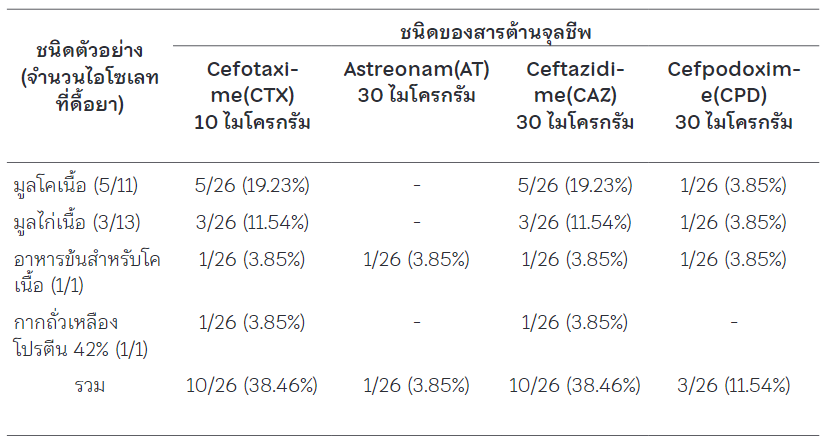
บทนำ: เนื่องจากหลาย ๆ ประเทศรวมถึงประเทศไทย ได้รายงานอุบัติการณ์การดื้อยาต้านจุลชีพกลุ่ม เบต้า-แลคแทม (Beta-lactam) และ/หรือ การพบยีนที่ควบคุมการสร้างเอนไซม์เบต้าแลคทาเมสแบบขยายผล (extended spectrum beta-lactamase; ESBL) ของเชื้อ Escherichia coli จากสัตว์เลี้ยง สัตว์ป่วยด้วยโรคติดเชื้อในระบบทางเดินอาหารและระบบทางเดินปัสสาวะ รวมไปถึงสัตว์ที่มนุษย์บริโภคเป็นอาหาร และเนื่องจากเชื้อชนิดนี้สามารถส่งต่อยีนดื้อยาสู่มนุษย์ผ่านทางห่วงโซ่อาหาร จึงเป็นที่น่ากังวลว่า ฟาร์มปศุสัตว์จะเป็นแหล่งสะสมและแพร่เชื้อ E. coli ที่สร้างเอนไซม์ ESBL (ESBL-producing E. coli) สู่มนุษย์ ซึ่งอาจจะนำาไปสู่ปัญหาสาธารณสุขที่สำคัญคือการใช้ยาต้านจุลชีพเพื่อการรักษาในมนุษย์ไม่ได้ผลเนื่องจากเชื้อดื้อยา วัตถุประสงค์: เพื่อทำาการคัดแยกเชื้อ E. coli จากฟาร์มปศุสัตว์แห่งหนึ่งในจังหวัดสกลนคร และ ทำาการประเมินความไวต่อยาต้านจุลชีพในกลุ่มเบต้า-แลคแทม และการสร้างเอนไซม์ ESBL แบบขยายผล ของเชื้อ E. coli ที่แยกได้ เพื่อเป็นข้อมูลพื้นฐานในการเฝ้าระวังสถานการณ์การดื้อยาต้านจุลชีพที่อาจส่งผลกระทบต่อมนุษย์ผ่านทางห่วงโซ่อาหารต่อไปในอนาคต วิธีการศึกษา: ทำาการคัดแยกเชื้อ E. coli จากตัวอย่างในฟาร์มปศุสัตว์แห่งหนึ่งในจังหวัดสกลนครจำนวน 50 ตัวอย่าง แล้วนำเชื้อมาทดสอบการดื้อต่อ สารต้านจุลชีพกลุ่มเบต้า-แลคแทมด้วยวิธี disc diffusion method และทดสอบยืนยันการสร้างเอนไซม์ เบต้า-แลคทาเมสแบบขยายผลด้วยวิธี combination disc test ผลการศึกษา: พบเชื้อแบคทีเรียชนิด E. coli จำนวน 26 ไอโซเลท จากตัวอย่างจำนวน 50 ตัวอย่าง และการทดสอบด้วยวิธี disc diffusion method พบว่าเชื้อ E. coli จำนวน 10 ไอโซเลท ดื้อต่อสารต้านจุลชีพที่นำามาทดสอบ ประกอบด้วย cefotaxime aztreonam ceftazidime และ cefpodoxime คิดเป็นร้อยละ 38.46 ร้อยละ 3.85 ร้อยละ 38.46 และ ร้อยละ 11.54 ตามลำาดับ จากนั้นนำ E. coli ทัง 10 ไอโซเลทมาทดสอบยืนยันการสร้างเอนไซม์เบต้า-แลคทาเมส แบบขยายผล ด้วยวิธี combination disc test ประกอบด้วยชุดของยา cefotaxime และ cefotaxime-clavulanic acid และชุดของยา ceftazidime และ ceftazidime-clavulanic acid พบว่า E. coli ทั้ง 10 ไอโซเลท สามารถสร้างเอนไซม์ดังกล่าวได้ บทสรุป: ผลการศึกษาในครังนี้แสดงให้เห็นว่าฟาร์มเลี้ยงสัตว์เป็นแหล่งสะสมและสามารถเป็นแหล่งแพร่กระจายเชื้อ E. coli ที่สามารถสร้างเอนไซม์เบต้า-แลคทาเมสแบบขยายผล และสามารถนำไปเป็นข้อมูลพื้นฐานเพื่อการเฝ้าระวังสถานการณ์การดื้อยาต้านจุลชีพที่อาจส่งผล กระทบต่อมนุษย์ผ่านทางห่วงโซ่อาหารต่อไปในอนาคต
Downloads
เอกสารอ้างอิง
Terajima J, Izumiya H, Hara-Kudo Y, Ohnishi M. Shiga Toxin (Verotoxin)-producing Escherichia coli and Foodborne Disease: A Review. Food Saf (Tokyo). 2017;5(2):35-53. Published 2017 Jun 3. https://doi.org/10.14252/foodsafetyfscj.2016029
PMid:32231928 PMCid:PMC6989183
Blaak H, van Hoek AH, Veenman C, et al. Extended spectrum ß-lactamase- and constitutively AmpC-producing Enterobacteriaceae on fresh produce and in the agricultural environment. Int J Food Microbiol. 2014;168-169:8-16. https://doi.org/10.1016/j.ijfoodmicro.2013.10.006 PMid:24211774
Aijuka M, Buys EM. Persistence of foodborne diarrheagenic Escherichia coli in the agricultural and food production environment: Implications for food safety and public health. Food Microbiol. 2019;82: 363-370. https://doi.org/10.1016/j.fm.2019.03.018 PMid:31027795
ปิยะรัตน์ จิตรภิรมย์ และกิจจา จิตรภิรมย์. ESBL เอนไซม์บีตา-แลคทาเมสที่มีฤทธิ์ขยายอำานาจ การดื้อยา. ก้าวทันโลกวิทยาศาสตร์. 2553;10(1): 20-28.
Turner PJ. Extended-spectrum betalactamases.Clin Infect Dis. 2005;41 Suppl 4:S273-S275.
https://doi.org/10.1086/430789 PMid:16032564
Hanhaboon P, Kimprasit T, Wajjwalku W, Amavisit P. Extended Spectrum Betalactamase Producing Escherichia coli Isolated from Infected Canines. Thai J Vet Med. 2015; 45(2): 263-267.
. Li S, Liu J, Zhou Y, Miao Z. Characterization of ESBL-producing Escherichia coli recovered from companion dogs in Tai'an, China. J Infect Dev Ctries. 2017;11(3):282- 286. Published 2017 Mar 31.
https://doi.org/10.3855/jidc.8138 PMid:28368864
Dierikx CM, van der Goot JA, Smith HE, Kant A, Mevius DJ. Presence of ESBL/AmpC-producing Escherichia coli in the broiler production pyramid: a descriptive study. PLoS One. 2013;8(11):e79005. Published 2013 Nov 7. https://doi.org/10.1371/journal.pone.0079005 PMid:24244401 PMCid:PMC3820706
Trongjit S, Chuanchuen R. Whole genome sequencing and characteristics of Escherichia coli with co-existence of ESBL and mcr genes from pigs. PLoS One. 2021;16(11): e0260011. Published 2021 Nov 16. https://doi.org/10.1371/journal.pone.0260011 PMid:34784400 PMCid:PMC8594834
Overdevest I, Willemsen I, Rijnsburger M, et al. Extended-spectrum β-lactamase genes of Escherichia coli in chicken meat and humans, The Netherlands. Emerg Infect Dis. 2011;17(7):1216-1222. https://doi.org/10.3201/eid1707.110209 PMid:21762575 PMCid:PMC3381403
Päivärinta M, Latvio S, FredrikssonAhomaa M, Heikinheimo A. Whole genome sequence analysis of antimicrobial resistance genes, multilocus sequence types and plasmid sequences in ESBL/AmpC Escherichia coli isolated from broiler caecum and meat. Int J Food Microbiol. 2020;315: 108361. https://doi.org/10.1016/j.ijfoodmicro.2019.108361 PMid:31734617
Apostolakos I, Feudi C, Eichhorn I, et al. High-resolution characterisation of ESBL/pAmpC-producing Escherichia coli isolated from the broiler production pyramid. Sci Rep. 2020;10(1):11123. Published 2020 Jul 7. https://doi.org/10.1038/s41598-020-68036-9 PMid:32636426 PMCid:PMC7341882
Zheng B, Feng C, Xu H, et al. Detection and characterization of ESBL-producing Escherichia coli expressing mcr-1 from dairy cows in China. J Antimicrob Chemother. 2019;74(2):321-325. https://doi.org/10.1093/jac/dky446 PMid:30418551
Kimprasit T, Kumla S, Sirilaophaisan S, Sukontasing S, Hondo E, Iida A, et al. Prevalence and characteristics of extended spectrum beta-lactamase producing Escherichia coli isolated from flies in rural Sakon Nakhon, Thailand. Agr. Nat. Res. 2022; 56(6): 1077-1082. Available from: https://doi.org/10.34044/j.anres.2022.56.6.02
Clinical and Laboratory Standards Institute (CLSI). Performance Standards for Antimicrobial Susceptibility Testing; Twenty-Fourth Informational Supplement. CLSI Document M100-S24, Wayne, 2014;34(1).
WHO. WHO integrated global surveillance on ESBL-producing E. coli using a "One Health" approach: implementation and opportunities. 2021. Available from: https://www.who.int/publications/i/item/who-integrated-global-surveillance-onesbl-producing-e.-coli-using-a-onehealth-approach.
Ben Said L, Jouini A, Klibi N, et al. Detection of extended-spectrum beta-lactamase (ESBL)-producing Enterobacteriaceae in vegetables, soil and water of the farm environment in Tunisia. Int J Food Microbiol. 2015;203:86-92. https://doi.org/10.1016/j.ijfoodmicro.2015.02.023 PMid:25791254
Dahms C, Hübner NO, Kossow A, Mellmann A, Dittmann K, Kramer A. Occurrence of ESBL-Producing Escherichia coli in Livestock and Farm Workers in Mecklenburg-Western Pomerania, Germany. PLoS One. 2015;10(11): e0143326. Published 2015 Nov 25. https://doi.org/10.1371/journal.pone.0143326 PMid:26606146 PMCid:PMC4659621
Grami R, Dahmen S, Mansour W, et al. blaCTX-M-15-carrying F2:A-:B- plasmid in Escherichia coli from cattle milk in Tunisia. Microb Drug Resist. 2014;20(4):344-349. https://doi.org/10.1089/mdr.2013.0160 PMid:24428239
Onanga R, Mbehang Nguema PP, Ndong Atome GR, et al. Prevalence of ExtendedSpectrum β-Lactamases in E. coli of Rats in the Region North East of Gabon. Vet Med Int. 2020;2020:5163493. Published 2020 Jul 18. https://doi.org/10.1155/2020/5163493 PMid:32733665 PMCid:PMC7383316
ดาวน์โหลด
เผยแพร่แล้ว
รูปแบบการอ้างอิง
ฉบับ
ประเภทบทความ
สัญญาอนุญาต
ลิขสิทธิ์ (c) 2023 ราชวิทยาลัยจุฬาภรณ์

อนุญาตภายใต้เงื่อนไข Creative Commons Attribution-NonCommercial-NoDerivatives 4.0 International License.
บทความที่ได้รับการตีพิมพ์เป็นลิขสิทธิ์ของราชวิทยาลัยจุฬาภรณ์
ข้อความที่ปรากฏในบทความแต่ละเรื่องในวารสารวิชาการเล่มนี้เป็นความคิดเห็นส่วนตัวของผู้เขียนแต่ละท่านไม่เกี่ยวข้องกับราชวิทยาลัยจุฬาภรณ์ และคณาจารย์ท่านอื่น ในราชวิทยาลัยฯ แต่อย่างใด ความรับผิดชอบองค์ประกอบทั้งหมดของบทความแต่ละเรื่องเป็นของผู้เขียนแต่ละท่าน หากมีความผิดพลาดใด ๆ ผู้เขียนแต่ละท่านจะรับผิดชอบบทความของตนเองแต่ผู้เดียว


