
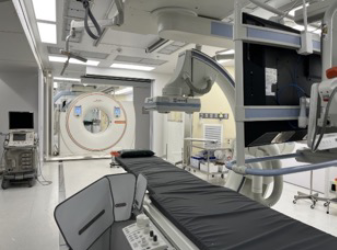
เครื่องเอกซเรย์หลอดเลือดระนาบเดียวและเอกซเรย์คอมพิวเตอร์ระบบไฮบริด เพื่อใช้ในการตรวจระบบหลอดเลือดและการทำหัตถการของรังสีร่วมรักษาในประเทศไทย
คำสำคัญ:
เครื่องเอกซเรย์หลอดเลือดระนาบเดียวและเอกซเรย์คอมพิวเตอร์ระบบไฮบริด, การตรวจวินิจฉัย หลอดเลือด, มะเร็งตับ, ภาวะเลือดออก, รังสีร่วมรักษามะเร็งบทคัดย่อ
ในปัจจุบันการรักษาด้วยรังสีร่วมรักษาต้องพบเจอกับความท้าทาย จากการเพิ่มขึ้นของโรคที่มีความซับซ้อน อันเนื่องจากการเติบโดของจำนวนประชากร ที่มีความจำเป็นต้องเข้ารับการรักษาโรคที่มีความรุนแรงและ เร่งด่วน ไม่ว่าจะเป็นโรคมะเร็งตับ ภาวะเลือดออกในทางเดินอาหารและภาวะเลือดออกจากการบาดเจ็บ ในช่วงระยะเวลาไม่กี่ปีที่ผ่านมา ได้มีการพัฒนานวัตกรรมใหม่ ๆ เพื่อรองรับความก้าวหน้าของการสร้างภาพทางรังสีวิทยา ในขณะเดียวกันมี การคิดค้นความรู้ทางรังสีวิทยา เพื่อตอบสนองต่อการรักษาที่ทันสมัยและ มีความซับซ้อน
เครื่องเอกซเรย์หลอดเลือดระนาบเดียวและเอกซเรย์คอมพิวเตอร์ระบบไฮบริด(hybrid angiography-CT) เป็นนวัตกรรมที่รวมภาพจากทั้งเอกซเรย์ระบบหลอดเลือดระนาบเดียวและภาพจากเครื่องเอกซเรย์คอมพิวเตอร์ไว้ในเครื่องเดียวกัน เพื่อเพิ่มประสิทธิภาพในการทำหัตถการทางรังสีร่วมรักษาและเพิ่มความมั่นใจให้กับรังสีแพทย์ นอกจากนี้ ยังส่งผลให้การรักษามีความปลอดภัยและให้ผลลัพธ์ที่ดีกว่าโดยเฉพาะอย่างยิ่งในด้านการรักษาโรคมะเร็งและการรักษาในภาวะฉุกเฉิน โดยเป็นทางเลือกในการรักษาที่ก่อให้เกิดการบาดเจ็บเพียงเล็กน้อย และมีการนำนวัตกรรมนี้ไปพัฒนาต่อยอดเพื่อนำไปใช้ในการวินิจฉัยและรักษาต่อไปอีกด้วย
Downloads
เอกสารอ้างอิง
Tanaka T, Arai Y, Inaba Y, et al. Current role of hybrid CT/angiography system compared with C-arm cone beam CT for interventional oncology. Br J Radiol. 2014;87(1041):20140126. doi:10.1259/bjr.20140126
Lionberg A, Nijhawan K, Navuluri R, et al. Hybrid angiography-CT for transarterial radioembolization: a pictorial essay. Abdom Radiol (NY). 2021;46 (6):2850- 2854. doi:10.1007/s00261-020-02914-8
Erinjeri JP, Doustaly R, Avignon G, et al. Utilization of integrated angiography-CT interventional radiology suites at a tertiary cancer center. BMC Med Imaging. 2020;20(1):114. Published 2020 Oct 15. doi:10.1186/s12880-020-00515-x
Knavel EM, Brace CL. Tumor ablation: common modalities and general practices. Tech Vasc Interv Radiol. 2013;16(4):192-200. doi:10.1053/j.tvir.2013. 08.002
Balogh J, Victor D 3rd, Asham EH, et al. Hepatocellular carcinoma: a review. J Hepatocell Carcinoma. 2016;3:41-53. Published 2016 Oct 5. doi:10.2147/JHC.S61146
Llovet JM, Kelley RK, Villanueva A, et al. Hepatocellular carcinoma. Nat Rev Dis Primers. 2021;7(1):6. Published 2021 Jan 21. doi:10.1038/s41572-020-00240-3
Philips CA, Rajesh S, Nair DC, Ahamed R, Abduljaleel JK, Augustine P. Hepatocellular Carcinoma in 2021: An Exhaustive Update. Cureus. 2021;13(11): e19274. Published 2021 Nov 5. doi:10.7759/cureus.19274
Aditya Kale. Hepatocellular Carcinoma: Diagnosis and Surveillance. In: Georgios Tsoulfas, ed. Hepatocellular Carcinoma. IntechOpen; 2021:Ch. 4. doi: 10.5772/intechopen.99839
Llovet JM, Kelley RK, Villanueva A, et al. Hepatocellular carcinoma. Nat Rev Dis Primers. 2021;7(1):6. Published 2021 Jan 21. doi:10.1038/s41572-020-00240-3
Hojjat Ahmadzadehfar, Amir Sabet, Hans Jürgen Biersack. Radioembolization for the Treatment of Unresectable Hepatocellular Carcinoma. In: Ahmed O. Kaseb, ed. Hepatocellular Carcinoma. IntechOpen; 2013:Ch. 3. doi:10.5772/56291
Reig M, Forner A, Rimola J, et al. BCLC strategy for prognosis prediction and treatment recommendation: The 2022 update. J Hepatol. 2022;76(3):681-693. doi:10.1016/j.jhep.2021.11.018
Galle, P., Forner, A., Llovet, J., Mazzaferro, V., Piscaglia, F., & Raoul, J. et al. (2018). EASL Clinical Practice Guidelines: Management of hepatocellular carcinoma. Journal Of Hepatology, 69(1), 182-236. doi:10.1016/j.jhep.2018.03.019
Marrero JA, Kulik LM, Sirlin CB, et al. Diagnosis, Staging, and Management of Hepatocellular Carcinoma: 2018 Practice Guidance by the American Association for the Study of Liver Diseases. Hepatology. 2018;68(2):723-750. doi:10.1002/hep.29913
Müller L, Stoehr F, Mähringer-Kunz A, Hahn F, Weinmann A, Kloeckner R. Current Strategies to Identify Patients That Will Benefit from TACE Treatment and Future Directions a Practical Step-by-Step Guide.J Hepatocell Carcinoma. 2021;8:403-419. Published 2021 May 13. doi:10.2147/JHC.S285735
Walker, T. (2011). Transarterial Chemoembolization Can Be Safely Performed in Patients with Hepatocellular Carcinoma Invading the Main Portal Vein and May Improve the Overall Survival. Yearbook Of Diagnostic Radiology, 2011, 240-243. doi: 10.1016/j.yrad.2011.02.019
Dioguardi Burgio M, Sartoris R, Libotean C, et al. Lipiodol retention pattern after TACE for HCC is a predictor for local progression in lesions with complete response. Cancer Imaging. 2019;19(1):75. Published 2019 Nov 15. doi:10.1186/s40644-019-0260-2
Li HZ, Tan J, Tang T, An TZ, Li JX, Xiao YD. Chemoembolization Plus Microwave Ablation vs Chemoembolization Alone in Unresectable Hepatocellular Carcinoma Beyond the Milan Criteria: A Propensity Scoring Matching Study. J Hepatocell Carcinoma. 2021;8:1311-1322. Published 2021 Nov 1. doi:10.2147/JHC.S338456
Papakostidis C, Kanakaris N, Dimitriou R, Giannoudis PV. The role of arterial embolization in controlling pelvic fracture haemorrhage: a systematic review of the literature. Eur J Radiol. 2012;81(5):897-904. doi:10.1016/j.ejrad.2011.02.049
Geeraedts LM Jr, Kaasjager HA, van Vugt AB, Frölke JP. Exsanguination in trauma: A review of diagnostics and treatment options. Injury. 2009;40(1):11-20. doi:10.1016/j.injry.2008.10.007
Zealley IA, Chakraverty S. The role of interventional radiology in trauma. BMJ. 2010;340:c497. Published 2010 Feb 8. doi:10.1136/bmj.c497
Ierardi AM, Duka E, Lucchina N, et al. The role of interventional radiology in abdominopelvic trauma. Br J Radiol. 2016;89(1061):20150866. doi:10.1259/bjr.20150866
Hoff WS, Holevar M, Nagy KK, et al. Practice management guidelines for the evaluation of blunt abdominal trauma: the East practice management guidelines work group. J Trauma. 2002; 53(3):602-615. doi:10.1097/00005373-200209000-00038
Al-Thani H, Abdelrahman H, Barah A, Asim M, El-Menyar A. Utility of Angioembolization in Patients with Abdominal and Pelvic Traumatic Bleeding: Descriptive Observational Analysis from a Level 1 Trauma Center. Ther Clin Risk Manag. 2021;17:333-343. Published 2021 Apr 19. doi:10.2147/TCRM.S303518
Wada D, Nakamori Y, Yamakawa K, Fujimi S. First clinical experience with IVR-CT system in the emergency room: Positive impact on trauma workflow. Scandinavian Journal of Trauma, Resuscitation and Emergency Medicine. 2012;20(1):52. doi:10.1186/1757-7241-20-52
Ramaswamy RS, Choi HW, Mouser HC, et al. Role of interventional radiology in the management of acute gastrointestinal bleeding. World J Radiol. 2014;6 (4):82-92. doi:10.4329/wjr.v6.i4.82
Loffroy R, Estivalet L, Cherblanc V, et al. Transcatheter embolization as the new reference standard for endoscopically unmanageable upper gastrointestinal bleeding. World J Gastrointest Surg. 2012;4(10):223-227. doi:10.4240/wjgs.v4.i10.223
Rösch, Josef, et al. “Selective Arterial Embolization.” Radiology, vol. 102, no. 2, 1972, pp. 303–306., https://doi.org/10.1148/102.2.303.
Lang EV, Picus D, Marx MV, Hicks ME. Massive arterial hemorrhage from the stomach and lower esophagus: impact of embolotherapy on survival. Radiology. 1990;177(1):249-252. doi:10.1148/radiology.177.1.2399325
Muhammad, Azeemuddin, et al. “Empiric Transcatheter Arterial Embolization for Massive or Recurrent Gastrointestinal Bleeding: Ten-Year Experience from a Single Tertiary Care Center.” Cureus. 2019, https://doi.org/10.7759/cureus.4228
Fontana, Federico, et al. “Transcatheter Arterial Embolization in Acute Non-Variceal Gastrointestinal Bleedings: A Ten-Year Single-Center Experience in 91 Patients and Review of the Literature.” Journal of Clinical Medicine, vol. 10, no. 21, 2021, p. 4979., https://doi.org/10.3390/jcm10214979
ดาวน์โหลด
เผยแพร่แล้ว
รูปแบบการอ้างอิง
ฉบับ
ประเภทบทความ
สัญญาอนุญาต
ลิขสิทธิ์ (c) 2023 ราชวิทยาลัยจุฬาภรณ์

อนุญาตภายใต้เงื่อนไข Creative Commons Attribution-NonCommercial-NoDerivatives 4.0 International License.
บทความที่ได้รับการตีพิมพ์เป็นลิขสิทธิ์ของราชวิทยาลัยจุฬาภรณ์
ข้อความที่ปรากฏในบทความแต่ละเรื่องในวารสารวิชาการเล่มนี้เป็นความคิดเห็นส่วนตัวของผู้เขียนแต่ละท่านไม่เกี่ยวข้องกับราชวิทยาลัยจุฬาภรณ์ และคณาจารย์ท่านอื่น ในราชวิทยาลัยฯ แต่อย่างใด ความรับผิดชอบองค์ประกอบทั้งหมดของบทความแต่ละเรื่องเป็นของผู้เขียนแต่ละท่าน หากมีความผิดพลาดใด ๆ ผู้เขียนแต่ละท่านจะรับผิดชอบบทความของตนเองแต่ผู้เดียว


