
อาการทางสุขภาพจากการรับสัมผัสสารเบนซีนในความเข้มข้นระดับต่ำ ในกลุ่มผู้ปฏิบัติงานในพื้นที่สถานีให้บริการน้ำมันเชื้อเพลิง จังหวัดระยอง
คำสำคัญ:
อาการทางสุขภาพ, สารเบนซีน, สถานีบริการน้ำมันเชื้อเพลิง, จังหวัดระยองบทคัดย่อ
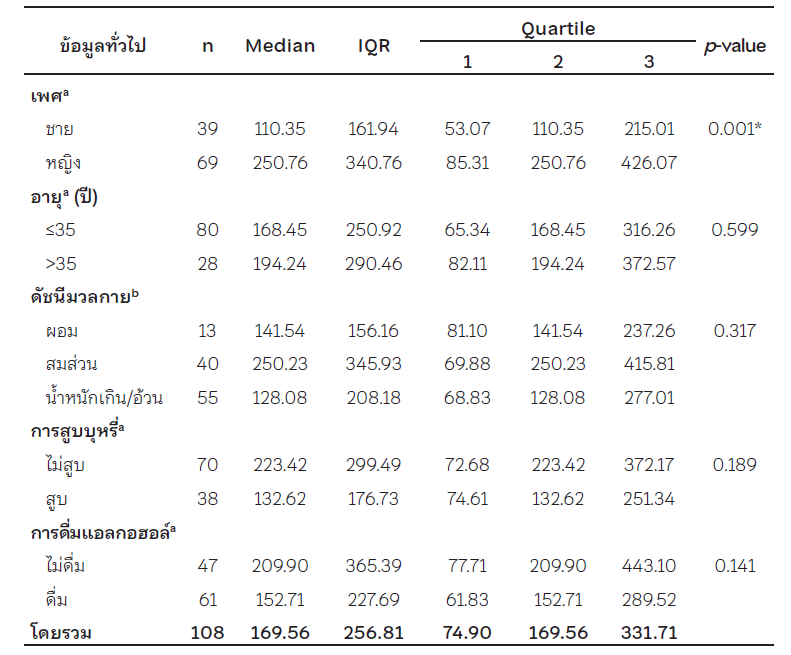
บทนำ: ผู้ประกอบอาชีพในสถานีเติมน้ำมันเชื้อเพลิงมีโอกาสรับสัมผัสสารเบนซีนและเกิดผลกระทบต่อสุขภาพได้ อย่างไรตามการรับสัมผัสสารเบนซีนความเข้มข้นระดับต่ำยังมีข้อมูลผลกระทบต่ออาการสุขภาพไม่ชัดเจน วัตถุประสงค์: เพื่อศึกษาอาการทางสุขภาพจากการรับสัมผัสสารเบนซีนในความเข้มข้นระดับต่ำของผู้ปฏิบัติงานในพื้นที่สถานีให้บริการน้ำมันเชื้อเพลิง ในจังหวัดระยอง วิธีการศึกษา: การศึกษารูปแบบภาคตัดขวาง โดยกลุ่มตัวอย่างเป็นผู้ประกอบอาชีพในสถานีบริการน้ำมันเชื้อเพลิง จำนวน 108 คน ปฏิบัติงานใน 5 สถานี ฯ เครื่องมือที่ใช้ในการวิจัย คือ แบบสัมภาษณ์อาการทางสุขภาพใน 4 ระบบ ได้แก่ ระบบทางเดินหายใจ ระบบประสาท ระบบผิวหนัง และระบบสายตา จำนวน 13 อาการ และเครื่องโครมาโทกราฟีของเหลวสมรรถนะสูงเพื่อวิเคราะห์หาปริมาณกรดมิวโคนิก ผลการศึกษา: พนักงานมีค่ามัธยฐานของกรดมิวโคนิก เท่ากับ 169.56 µg/g Cr (พิสัยควอไทล์ เท่ากับ 256.81 µg/g Cr) สำหรับอาการสุขภาพ พบอาการ 3 อันดับแรก ได้แก่ ปวดศีรษะ เวียนศีรษะ และหายใจมีเสียงหวีด ร้อยละ 42.6 37.0 และ 25.9 ตามลำดับ ผลจากการเปรียบเทียบ พบว่า กลุ่มที่เกิดอาการผิดปกติ จัดอยู่กลุ่มที่มีปริมาณกรดมิวโคนิกมากกว่ากลุ่มที่ไม่เกิดอาการอย่างมีนัยสำคัญทางสถิติ (p<0.05) ได้แก่ ปวดศีรษะ เวียนศีรษะ หายใจมีเสียงหวีด มองภาพไม่ชัด ไอมีเสมหะ เหนื่อยง่าย หายใจลำบาก คลื่นไส้ และผื่นแดงที่ผิวหนัง ผลการทดสอบความสัมพันธ์พบปริมาณกรดมิวโคนิกมีความสัมพันธ์กับจำนวนอาการอย่างมีนัยสำคัญทางสถิติ (p<0.05) (R2=0.251) บทสรุป: การรับสัมผัสสารเบนซีนมีความสัมพันธ์ต่อการเกิดอาการผิดปกติของผู้ประกอบอาชีพ จำนวน 9 อาการ สามารถนำอาการผิดปกติดังกล่าวมาเป็นข้อบ่งชี้ในการคัดกรองการรับสัมผัสสารเบนซีนได้ โดยผู้ประกอบอาชีพสังเกตได้ด้วยตนเอง การศึกษาวิจัยเพิ่มเติมควรดำเนินการเพื่อพัฒนาแบบสอบถามคัดกรองมาตรฐานสำหรับกลุ่มผู้ปฏิบัติงานในสถานีบริการน้ำมันเชื้อเพลิง
Downloads
เอกสารอ้างอิง
Alyami AR. Occupational exposure assessment to gasoline vapours under various conditions at public gasoline stations, Athens J Sci. 2017;4(4):323-342. doi.org/10.30958/ajs.4-4-4
Hajizadeh Y, Mokhtari M, Faraji M, Mohammadi A, Nemati S, Ghanbari R. Trends of BTEX in the central urban area of Iran: A preliminary study of photochemical ozone pollution and health risk assessment. Atmos Pollut Res. 2018;9(2):220-229. doi.org/10.1016/j.apr.2017.09.005
Correa SM, Arbilla G, Marquws MRC, Oliveira KMPG. The impact of BTEX emissions from gas stations into the atmosphere. Atmos Pollut Res. 2011;3(2):163-169. doi.org/10.5094/APR.2012.016
Sekar A, Varghese G, Varma MK. Analysis of benzene air quality standards, monitoring methods and concentrations in indoor and outdoor environment. Heliyon. 2019;5:e02918. doi.org/10.1016/j.heliyon.2019.e02918
Geraldino BR, Nunes FN, Gomes B, Giardini I, Silva PVB, Campos E, et al. Analysis of benzene exposure in gas station workers using trans,trans-muconic acid. Int J Environ Res Public Health. 2020;17:e02918. doi:10.3390/ijerph17155295
Tongsantia U, Chaiklieng S, Suggaravetsiri P, Andajani S, Autrup H. Factors affecting adverse health effects of gasoline station workers. Int J Environ Res Public Health. 2021;18:10014. doi.org/10.3390/ijerph181910014
McNally K, Sams C, Loizou GD, Jones K. (2017). Evidence for non-linear metabolism at low benzene exposures? A reanalysis of data. Chem Biol Interact. 2017;278:256-268. doi.org/10.1016/j.cbi.2017.09.002
Kasemy ZA, Kamel GM, Abdel-Rasoul GM, Ismail AA. Environmental and health of effects of benzene exposure among Egyptian taxi drivers. J Environ Public Health. 2019;18:10014. doi.org/10.1155/2019/7078024
กฎกระทรวง. กำหนดมาตรฐานการตรวจสุขภาพลูกจ้างซึ่งทำงานเกี่ยวกับปัจจัยเสี่ยง พ.ศ. 2563. ราชกิจจานุเบกษา เล่ม 137 ตอนที่ 80 ก. ลงวันที่ 5 ตุลาคม 2563
American Conference of Governmental Industrial Hygienists (ACGIH). TLVs and BEIs. United States of America. 2021.
ยุทธนา ยานะ วิวัฒน์ เอกบูรณะวัฒน์ วิชยุตม์ ทัพวงษ์. การสำรวจจำนวนและความสามารถของห้องปฏิบัติการตรวจวิเคราะห์ตัวบ่งชี้ทางชีวภาพของสารเคมีที่ใช้ในอุตสาหกรรมในประเทศไทย พ.ศ. 2557. วารสารสาธารณสุขมหาวิทยาลัยบูรพา 2558 10;49-64.
สุนิสา ชายเกลี้ยง, พรนภา ศุกรเวทย์ศิริ, ศศิธร ตั้งสวัสดิ์, วิชัย พฤกษ์ธารากุล.การประเมินความเสี่ยงต่อสุขภาพโดยใช้ตัวบ่งชี้ทางชีวภาพของการสัมผัสสารเบนซีนใน พนักงานสานีบริการน้ำมันดชื้อเพลิง. วารสารวิชาการสาธารณสุข 2560;26: 272-280.
ฌาน ปัทมะ พลยง ทนงศักดิ์ ยิ่งรัตนสุข จินตนา ศิริวราศัย อนามัย เทศกะทึก. ตัวแปรกวนของกรดซอร์บิกที่ผสมในอาหารต่อดัชนีชี้วัดทางชีวภาพของสารเบนซีนก่อนเข้าทำงานในพนักงานให้บริการน้ำมันเชื้อเพลิง. การประชุมวิชาการระดับชาติ ครั้งที่ 5. มหาวิทยาลัยราชภัฏกาญจนบุรี; 2563. น.149-158.
สุนิสา ชายเกลี้ยง, รัชนี นันทนุช. ปัจจัยที่มีความสัมพันธ์กับอาการไม่พึงประสงค์จาก สารเบนซีนของพนักงานสถานีบริการน้ำมันเชื้อเพลิง. ศรีนครินทร์เวชสาร 2558;30(5): 458-466.
Werder E, Gam KB, Engel L, Kwok R, Ekenga C, Curry M, et al. Predictors of blood volatile organic compound levels in Gulf coast residents. J Expo Sci Environ Epidemiol. 2018;28:358-370. doi.org/10.1038/s41370-017-0010-0
Hajrah U, Kusumayati A, Hermawati E. Effects of exposure on respiratory symptoms to workers in the informal footwear industry. Indian J Public Health Res Dev. 2020;11(3):1201-1206. doi.org/10.37506/ijphrd.v11i3.1577
Arrandale V, Meijster T, Pronk A, Doekes G, Redlich CA, Holness DL, Heederik. Skin symptoms in bakery and auto body shop workers: associations with exposure and respiratory symptoms. Int Arch Occup Environ Health. 2013;86:167-175. doi.org/10.1007/s00420-012-0760-x
Fenga C, Gangemi S, Teodoro M, Rapisarda V, Golokhvast K, Anisimov NY, et al. 8-Hydroxydeoxyquanosine as a biomarker of oxidative DNA damage in workers exposed to low-dose benzene. Toxicol Rep. 2017;4 :291-295. doi.org/10.1016/j.toxrep.2017.05.008
International Agency for Research on Cancer (IARC). (2021). Agents classified by the IARC monographs, volumes 1–129. [Online] 2021; Available from: http://monographs.iarc.fr/ENG/Classification/index.php
Moro AM, Brucker N, Charao MF, Sauer E, Freitas F, Durgante J, et al. Early hematological and immunological alterations in gasoline station attendants exposed to benzene. Environ Res. 2015;137:349-356. doi:10. 1016/j.envres.2014.11.003.
Vlaanderen J, Lan Q, Kromhout H, Rothman N, Vermeulen R. Occupational benzene exposure and the risk of lymphoma subtypes: a meta-analysis of cohort studies incorporating three study quality dimensions.Environ Health Perspect. 2011;119(2):159-167. doi:10.1289/ehp.1002318
Sithisarankul P, Intawong C. Preliminary report of health effects among oil spill cleanup workers and volunteers, Thailand, 2013. J Health Res. 2015;29(3): 197-201. doi:10.14456/jhr.2015.6
Mandiracioglu A, Akqur S, Kocabiyik N, Sener U. Evaluation of neuro psychological symptoms and exposure to benzene, toluene and xylene among two different furniture worker groups in Izmir. Toxicol Ind Health. 2011;27(9):802-809. doi.org/10.1177/0748233711399309
Tunsaringkarn T, Ketkaew P, Siriwong W, Rungsiyotin A, Zapuang K. Benzene exposure and its association with sickness exhibited in gasoline station workers. Int J Environ Pollut Solut. 2013;1: 1-8. doi:10.7726 /ijeps.2013.1001
Chaiklieng S, Suggaravetsiri P, Autrup H. Risk Assessment on Benzene Exposure among Gasoline Station Workers. Int Journal of Environ Res Public Health. 2019; 16(14):2545. doi.org/10.3390/ijerph16142545.
Onchoi C, Kongtip P, Yoosook W, Chantanakul S. High performance liquid chromatography for determination of urinary metabolites of toluene, xylene and styrene and its application. Southeast Asian J Trop Med Public Health. 2008;39(6):1164-1171.
กองโรคไม่ติดต่อ. รู้ตัวเลข รู้ความเสี่ยงสุขภาพ. นนทบุรี: สำนักพิมพ์อักษรกราฟฟิคแอนด์ดีไซน์; 2564.
Chaikleng S, Suggaratsiri P, Kaminski N, Autrup H. Factors affecting urinary tt-muconic acid detection among benzene exposed workers at gasoline stations. Int J Environ Res Public Health. 2019;16:4209. doi:10.3390/ijerph16214209
กระทรวงพลังงาน. สรุปข้อมูลพลังงาน. [ออนไลน์] กระทรวงพลังงาน. จาก: https://data.energy.go.th/factsheet/province/21/2020 [เมื่อวันที่ 5 ตุลาคม 2563]
Tunsaringkarn T, Suwansaksri J, Soogarun S, Siriwong W, Rungsiyothin A, Zapuang K, et al. Genotoxic monitoring and benzene exposure assessment of gasoline station workers in metropolitan Bangkok: sister chromatid exchange (SCE) and urinary trans, trans-muconic acid (t,t-MA). Asian Pac J Cancer Prev. 2011;12(1):223-227.
Blank IH, McAuliffe DJ. Penetration of benzene through human skin. J Invest Dermatol. 1985;85: 522–526. doi:10.1111/1523-1747.ep12277325
Frasch HF, Barbero AM. In vitro human skin permeation of benzene in gasoline: Effects of concentration, multiple dosing and skin preparation. J Expo Sci Environ Epidemiol. 2018;28:193-201. doi:10.1038/jes.2017.10
Alvas LP, Vieira DSP, Nunes LSS, Cruz LPS, Reis ACS, Gomes IVS, et al. Relationship between symptoms, use of PPE and habits related to occupational exposure to BTEX compounds in workers of gas stations in Bahia, Brazil. J Environ Protect. 2017;8(5):650-661. doi:10.4236 /JEP.2017.85042
Joshi DR, Adhikari N. An overview on common organic solvent and toxicity. J Pharm Res Int. 2019;28(3): 1-18. doi:10.9734/JPRI/2019/v28i330 203
Ekpenyong CE, Asuquo AE. Recent advances in occupational and environmental health hazards of workers exposed to gasoline compounds. Int J Occup Med Environ Health. 2017;30(1):1-26. doi:10.13075/ijomeh.1896.00800
Kim KH, Jahan SA, Lee JT. Exposure to formaldehyde and its potential human health hazards. J Environ Sci Health C. 2011;29:277-299. doi:10.1080/10590501.2011.629972.
ดาวน์โหลด
เผยแพร่แล้ว
รูปแบบการอ้างอิง
ฉบับ
ประเภทบทความ
สัญญาอนุญาต
ลิขสิทธิ์ (c) 2023 ราชวิทยาลัยจุฬาภรณ์

อนุญาตภายใต้เงื่อนไข Creative Commons Attribution-NonCommercial-NoDerivatives 4.0 International License.
บทความที่ได้รับการตีพิมพ์เป็นลิขสิทธิ์ของราชวิทยาลัยจุฬาภรณ์
ข้อความที่ปรากฏในบทความแต่ละเรื่องในวารสารวิชาการเล่มนี้เป็นความคิดเห็นส่วนตัวของผู้เขียนแต่ละท่านไม่เกี่ยวข้องกับราชวิทยาลัยจุฬาภรณ์ และคณาจารย์ท่านอื่น ในราชวิทยาลัยฯ แต่อย่างใด ความรับผิดชอบองค์ประกอบทั้งหมดของบทความแต่ละเรื่องเป็นของผู้เขียนแต่ละท่าน หากมีความผิดพลาดใด ๆ ผู้เขียนแต่ละท่านจะรับผิดชอบบทความของตนเองแต่ผู้เดียว


