
ผลของโปรแกรมการกระตุ้นการดูดกลืนโดยไม่ให้สารอาหาร ในทารกแรกเกิดก่อนกำหนดในโรงพยาบาลมหาวิทยาลัยนเรศวร
คำสำคัญ:
ทารกแรกเกิดก่อนกำหนด, การกระตุ้นการดูดกลืน, การดูดโดยไม่ให้สารอาหาร, NOMASบทคัดย่อ
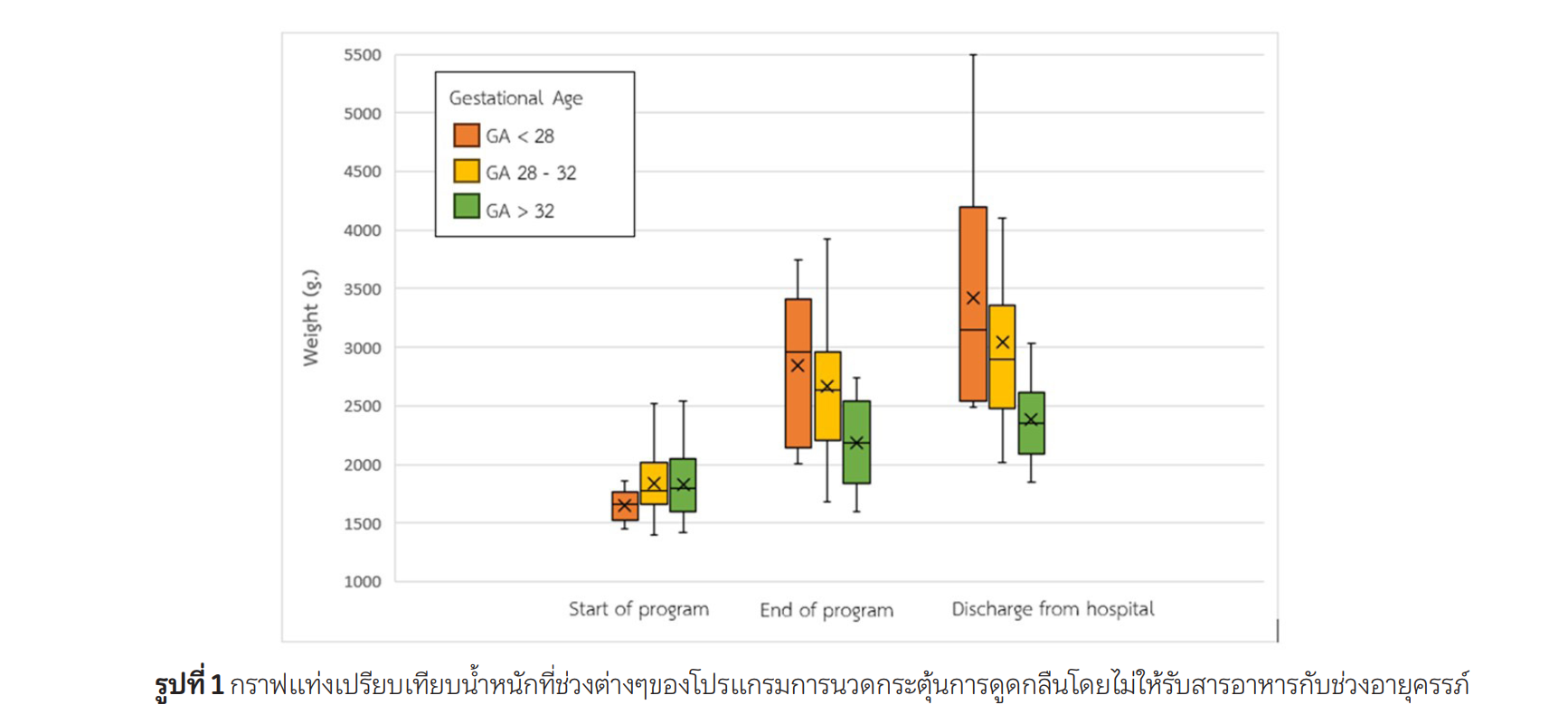
ความเป็นมา: ทารกแรกเกิดก่อนกำหนดมักมีพัฒนาการของการประสานการดูด การกลืน และการหายใจล่าช้า ซึ่งส่งผลต่อการดูดนมและการเจริญเติบโต การกระตุ้นการดูดกลืนโดยไม่ให้สารอาหารเป็นวิธีที่อาจช่วยส่งเสริมการทำงานร่วมกันของกล้ามเนื้อช่องปากและเพิ่มความพร้อมในการกิน วัตถุประสงค์: เพื่อศึกษาผลของโปรแกรมการกระตุ้นการดูดกลืนโดยไม่ให้สารอาหารต่อการเพิ่มน้ำหนัก ระยะเวลานอนโรงพยาบาล และภาวะแทรกซ้อนในทารกแรกเกิดคลอดก่อนกำหนด โดยเปรียบเทียบในแต่ละกลุ่มอายุครรภ์ วิธีการ: การศึกษาแบบย้อนหลังในทารกที่มีอายุครรภ์หลังปฏิสนธิ (postmenstrual age) ตั้งแต่ 34 สัปดาห์ขึ้นไป ที่เข้ารับการรักษาในโรงพยาบาลมหาวิทยาลัยนเรศวร โปรแกรมประกอบด้วยการประเมินความพร้อมในการดูดกลืนโดยใช้แบบประเมิน Neonatal Oral Motor Assessment Scale (NOMAS) การนวดกระตุ้นช่องปาก และการดูดโดยไม่ให้สารอาหาร ประเมินผลลัพธ์ด้านน้ำหนัก ระยะเวลานอนโรงพยาบาล และภาวะแทรกซ้อน เช่น ภาวะตัวเขียวหรือออกซิเจนต่ำ เปรียบเทียบระหว่างกลุ่มอายุครรภ์ <28 สัปดาห์, 28–32 สัปดาห์ และ >32 สัปดาห์ ผลการศึกษา: ทารกจำนวน 48 ราย (เพศชาย 28 ราย เพศหญิง 20 ราย) พบว่า กลุ่มอายุครรภ์ <28 สัปดาห์มีการเพิ่มน้ำหนักมากกว่ากลุ่มอื่นอย่างมีนัยสำคัญทางสถิติ (p <0.05) และมีระยะเวลานอนโรงพยาบาลกว่ากลุ่มอายุครรภ์ 28-32 สัปดาห์ และ กลุ่มอายุครรภ์ >32 สัปดาห์ (p <0.001) สรุป: โปรแกรมกระตุ้นการดูดกลืนโดยไม่ให้สารอาหารอาจส่งเสริมการเพิ่มน้ำหนักในทารกเกิดก่อนกำหนด โดยเฉพาะกลุ่มที่อายุครรภ์น้อย อย่างไรก็ตาม ควรติดตามภาวะแทรกซ้อนในกลุ่มอายุต่ำกว่า 28 สัปดาห์อย่างใกล้ชิด
Downloads
เอกสารอ้างอิง
Lau C, Smith EO. Interventions to improve the oral feeding performance of preterm infants. Acta Paediatr. 2012;101(7):e269-74.doi:10.1111/j.1651-2227.2012.02662.x.
Feştilă D, Ghergie M, Muntean A, Matiz D, Şerb Nescu A. Suckling and non-nutritive sucking habit: what should we know? . Clujul Med. 2014;87(1):11-4. doi: 10.15386/cjm.2014.8872.871.df1mg2.
Lau C. Development of Suck and Swallow Mechanisms in Infants. Ann Nutr Metab. 2015;2015:7-14.doi: 10.1159/000381361.
Pickler RH, Best A, Crosson D. The effect of feeding experience on clinical outcomes in preterm infants. J Perinatol. 2009.;29:124-9.doi: 10.1038/jp.2008.140.
Amaizu N, Shulman R, Schanler R, Lau C. Maturation of oral feeding skills in preterm infants. Acta Paediatr. 2008;97(1):61-7.doi: 10.1111/j.1651-2227.2007.00548.x.
Dietrich LJ, Gong A, Gelfond J, Blanco CL. Oral feeding trajectories and neurodevelopmental outcomes at 12 and 24 month follow-up for preterm infants. J Neonatal Perinatal Med. 2024;17(1):21-30. doi:10.3233/NPM-230088.)
Tsai YL, Hsieh PC, Chen TY, Lin YC. Effects of Complete Oral Motor Intervention and Nonnutritive Sucking Alone on the Feeding Performance of Premature Infants: A Systematic Review and Meta-Analysis. Children (Basel). 2023;11(1):4. Published 2023 Dec 20. doi:10.3390/children11010004
Pineda R, Dewey K, Jacobsen A, Smith J. Non-nutritive sucking in the preterm infant. Am J Perinatol. 2019;36(3):268-76.;36(3):268-76.doi: 10.1055/s-0038-1667289.
Singh P, Malshe N, Kallimath A, et al. Randomised controlled trial to compare the effect of PIOMI (structured) and routine oromotor (unstructured) stimulation in improving readiness for oral feeding in preterm neonates. Front Pediatr. 2023;11:1296863. Published 2023 Nov 16. doi:10.3389/fped.2023.1296863
Field TM.Touch for socioemotional and physical well-being: A review. Dev Rev. 2010;30(4): 367-83.DOI: https://doi.org/10.1016/j.dr.2011.01.001
Barlow SM. Oral and respiratory control for preterm feeding. Curr Opin Otolaryngol Head Neck Surg. 2009;17(3):179-86.doi: 10.1097/MOO.0b013e32832b36fe.
Puopolo KM, Benitz WE, Zaoutis TE; COMMITTEE ON FETUS AND NEWBORN; COMMITTEE ON INFECTIOUS DISEASES. Management of Neonates Born at ≤34 6/7 Weeks’ Gestation With Suspected or Proven Early-Onset Bacterial Sepsis. Pediatrics. 2018;142(6).doi: 10.1542/peds.2018-2896.
Longoni L, Provenzi L, Cavallini A, Sacchi D, Scotto di Minico G, Borgatti R. Predictors and outcomes of the Neonatal Oral Motor Assessment Scale (NOMAS) performance: a systematic review. Eur J Pediatr. 2018 May;177(5):665-673. doi:10.1007/s00431-018-3130-1
Tongsiri P, Wittayasooporn J, Daramas T. Effects of Non-nutritive Sucking with Emptied Breasts on Breast-Feeding Performance in Preterm Infants. Nurs Res Inno J 2022;28(1):30-43.
Zhang Y, Lyu T, Hu X, Shi P, Cao Y, Latour JM. Effect of nonnutritive sucking and oral stimulation on feeding performance in preterm infants: a randomized controlled trial. Pediatr Crit Care Med. 2014;15(7):608-614. doi:10.1097/PCC.0000000000000182
Als H, Duffy FH, McAnulty GB, Rivkin MJ, Vajapeyam S, Mulkern R, et al. Early experience alters brain function and structure. Pediatrics.2004;113(4):846-57. doi: 10.1542/peds.113.4.846.
Pimenta HP, Moreira ME, Rocha AD, Gomes SC Jr, Pinto LW, Lucena SL. Effects of non-nutritive sucking and oral stimulation on breastfeeding rates for preterm, low birth weight infants: a randomized clinical trial. J Pediatr. 2008;84(5):423-7.doi: 10.2223/JPED.1839.
Slocum C, Arko M, Di Fiore J, Martin RJ, Hibbs AM. Apnea, bradycardia and desaturation in preterm infants before and after feeding. J Perinatol. 2009;29(3):209–12. doi:10.1038/jp.2008.226.
ดาวน์โหลด
เผยแพร่แล้ว
รูปแบบการอ้างอิง
ฉบับ
ประเภทบทความ
สัญญาอนุญาต
ลิขสิทธิ์ (c) 2026 ราชวิทยาลัยจุฬาภรณ์

อนุญาตภายใต้เงื่อนไข Creative Commons Attribution-NonCommercial-NoDerivatives 4.0 International License.
บทความที่ได้รับการตีพิมพ์เป็นลิขสิทธิ์ของราชวิทยาลัยจุฬาภรณ์
ข้อความที่ปรากฏในบทความแต่ละเรื่องในวารสารวิชาการเล่มนี้เป็นความคิดเห็นส่วนตัวของผู้เขียนแต่ละท่านไม่เกี่ยวข้องกับราชวิทยาลัยจุฬาภรณ์ และคณาจารย์ท่านอื่น ในราชวิทยาลัยฯ แต่อย่างใด ความรับผิดชอบองค์ประกอบทั้งหมดของบทความแต่ละเรื่องเป็นของผู้เขียนแต่ละท่าน หากมีความผิดพลาดใด ๆ ผู้เขียนแต่ละท่านจะรับผิดชอบบทความของตนเองแต่ผู้เดียว


