The Effects of a Problem-Solving Therapy Program on Stress in Women Newly Diagnosed with Breast Cancer
Keywords:
Problem-Solving Therapy Program, Stress, Women Newly Diagnosed with Breast CancerAbstract
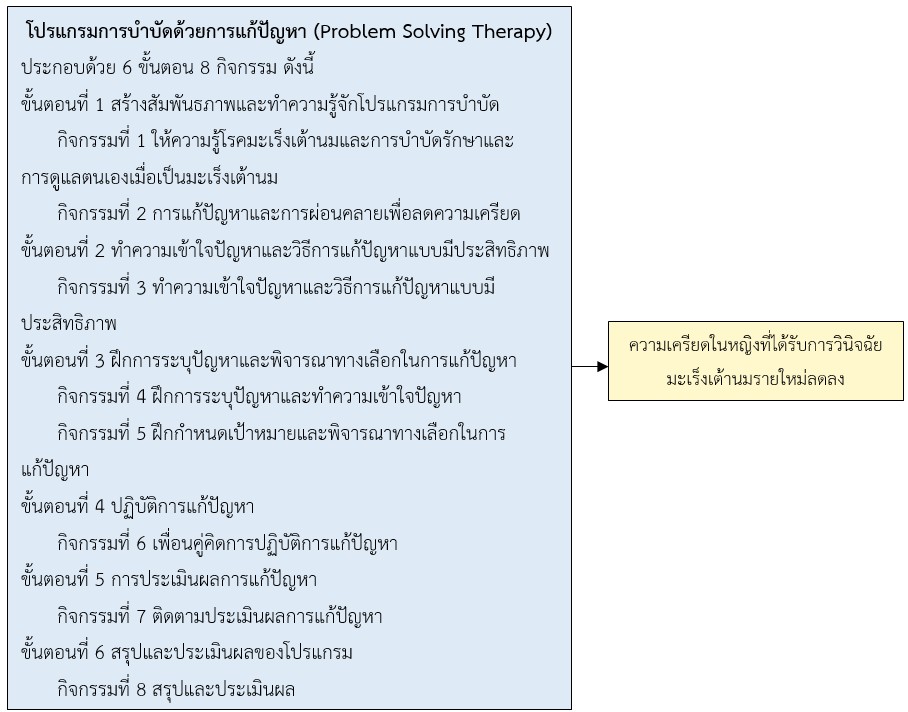
This quasi-experimental study with a two-group pretest–posttest design aimed to compare the mean stress scores before and after participation in a problem-solving therapy program among newly diagnosed breast cancer women. The sample consisted of 58 participants, including newly diagnosed breast cancer women in the experimental group and a control group receiving routine nursing care, with 29 participants in each group. Participants were selected using multi-stage random sampling. Data collection instruments included a general information record form, a stress assessment scale, and a problem-solving measurement scale. The intervention tool was a problem-solving therapy program designed to reduce stress in newly diagnosed breast cancer women. Descriptive statistics were used to analyze general information. The mean stress scores before and after the program within the experimental group were analyzed using the Wilcoxon signed-rank test, while differences in mean stress scores between the experimental and control groups were analyzed using the Mann–Whitney U test.
The results showed that the mean stress score of the experimental group before participation in the program was significantly higher than after participation (p-value < 0.05). Moreover, the mean stress score of the experimental group was significantly lower than that of the control group (p-value < 0.05). These findings indicate that the problem-solving therapy program effectively reduces stress in newly diagnosed breast cancer women. Therefore, it should be implemented as an intervention to alleviate stress in this population.
References
ชุติมา ไวยสุระสิงห์. (2561). ผลของการให้การปรึกษาแบบกลุ่มต่อความสามารถในการปรับตัวของผู้ป่วยมะเร็ง เต้านม. วิทยานิพนธ์ปริญญามหาบัณฑิต มหาวิทยาลัยมหิดล.
ณหทัย วงศ์ปการันย์ และทินกร วงศ์ปการันย์. (2553). แบบประเมินความเครียดจากการรับรู้ 10 ข้อ (T-PSS-10) ฉบับภาษาไทย: การศึกษาคุณสมบัติทางจิตวิทยาในกลุ่มตัวอย่างนักศึกษามหาวิทยาลัยไทย. วารสารแพทยสมาคมแห่งประเทศไทย, 93(9), 1072-1077.
เธียรชัย งามทิพย์วัฒนา และกนกรัตน์ สุขตุงคะ. (2543). การศึกษาองค์ประกอบและพัฒนาแบบวัดทักษะการแก้ปัญหาของนักศึกษามหาวิทยาลัย วิทยานิพนธ์ปริญญามหาบัณฑิต จุฬาลงกรณ์มหาวิทยาลัย.
นุชจรี หยองทอง และนุชจรี สิงห์พันธ์. (2566). ผลของโปรแกรมการส่งเสริมความรอบรู้ด้านสุขภาพต่อพฤติกรรมการจัดการตนเองของผู้ป่วยโรคไตเรื้อรัง. วารสารการพยาบาลและการดูแลสุขภาพ, 41(3), 136-146.
ประคอง กรรณสูต. (2542). สถิติเพื่อการวิจัยทางพฤติกรรมศาสตร์. (พิมพ์ครั้งที่ 3). กรุงเทพฯ: สำนักพิมพ์แห่งจุฬาลงกรณ์มหาวิทยาลัย.
ราตรี ทองยู, วรรณา คงสุริยะนาวิน, อทิตยา พรชัย, เกตุ โอว ยอง และลิวรรณ อุนนาภิรักษ์. (2554). ผลของโปรแกรมกลุ่มบำบัดแบบแก้ไขปัญหา ต่อภาวะเครียดและความสามารถในการปรับตัวของผู้ป่วยมะเร็ง เต้านม. วารสารจิตวิทยาการปรึกษาและจิตบำบัด, 10(2), 45-58.
สุมาลี คำสุข. (2563). การให้คำปรึกษาสำหรับผู้ป่วยมะเร็งเต้านมระยะเริ่มแรก. วิทยานิพนธ์ปริญญามหาบัณฑิต มหาวิทยาลัยเชียงใหม่.
สุกัญญา สุทธศิลปะ. (2559). การพัฒนารูปแบบการแก้ปัญหาเชิงสร้างสรรค์ตามแนวคิดของฟลัดด์และแจ็คสันร่วมกับบทบาทสมมติเพื่อเสริมสร้างความสามารถในการแก้ปัญหาของนักเรียน. วิทยานิพนธ์ปริญญามหาบัณฑิต มหาวิทยาลัยราชภัฏเชียงใหม่.
สถาบันมะเร็งแห่งชาติ. (2567). สถิติโรคมะเร็งประเทศไทย พ.ศ. 2567. สืบค้นเมื่อ 1 กรกฎาคม 2568 จาก https://www.nci.go.th/th/.
อังศณา คล้ายสุข. (2562). ผลกระทบทางจิตใจและสังคมของผู้ป่วยมะเร็งเต้านม. วารสารสุขภาพจิตแห่งประเทศไทย, 27(1), 45-58.
Cohen, S., Kamarck, T., & Murmelstein, R. (1983). A global measure of perceived stress. Journal of Health and Social Behavior, 24(4), 385-396. https://doi.org/10.2307/2136404
D’Zurilla, T. J., & Goldfried, M. R. (1971). Problem solving and behavior modification. Journal of Consulting and Clinical Psychology, 37(3), 407-428. https://doi.org/10.1037/h0031960
D’Zurilla, T. J., Nezu, A. M., & Nezu, C. M. (2007). Social problem solving: Theory and assessment. New York: Oxford University Press.
Heppner, P. P. & Petersen, C. H. (1982). The development and implications of a personal problem-solving inventory. Journal of Counseling Psychology, 29(1), 66-75. https://doi.org/10.1037/0022-0167.29.1.66
Lourenço, C., Conceição, F., Jerónimo, C., Lamghari, M., & Sousa, D. M. (2022). Stress in Metastatic Breast Cancer: To the bone and beyond. Cancers, 14(8), 1881. https://doi.org/10.3390/cancers14081881
Nezu, A. M. & D’Zurilla, T. J. (2007). Problem-solving therapy: A positive approach to clinical intervention (2nd ed.). New York: Springer Publishing Company.
Nezu, A. M. & D’Zurilla, T. J. (2012). Problem-solving therapy: A positive approach to clinical intervention (3rd ed.). New York: Springer Publishing Company.
Nezu, A. M. & D’Zurilla, T. J. (2022). Problem-solving therapy: A social competence approach to clinical intervention (3rd ed.). New York: Springer Publishing Company.
Nezu, A. M. (2019). Problem-solving therapy: A positive approach to clinical intervention (3rd ed.). New York: Springer Publishing Company.
Noyes, K. et al. (2022). Problem-solving skills training in adult cancer survivors: Bright IDEAS-AC pilot study. Cancer Treatment and Research Communications, 31, 100552. https://doi.org/10.1016/j.ctarc.2022.100552
Polit, D. F & Hungler, B. P. (1999). Nursing research: Principles and methods (6th ed.). Philadelphia: Lippincott.
Sharma, T., M., Mishra, R., Kumar, A., & Bandna, G. (2022). Body image and self-esteem issues in breast cancer survivors. Cancer Research, Statistics, and Treatment 5(1), 90-96, https://doi.org/10.4103/crst.crst_170_21
World Health Organization. (2024). Global cancer burden growing, amidst mounting need for services. Retrieved July 1, 2025 from https://www.iarc.who.int/news-events/global-cancer-burden-growing-amidst-mounting-need-for-services/.
Downloads
Published
How to Cite
Issue
Section
License
Copyright (c) 2025 Journal of Nursing and Public Health Research

This work is licensed under a Creative Commons Attribution-NonCommercial-NoDerivatives 4.0 International License.
1. บทความหรือข้อคิดเห็นใด ๆ ที่ปรากฏในวารสารวิจัยการพยาบาลและการสาธารณสุข ที่เป็นวรรณกรรมของผู้เขียน บรรณาธิการไม่จำเป็นต้องเห็นด้วย
2. บทความที่ได้รับการตีพิมพ์ถือเป็นลิขสิทธิ์ของ วารสารวิจัยการพยาบาลและการสาธารณสุข