Effectiveness of a Health Literacy Enhancement Program for Older Adults with Hypertension
Keywords:
Health Literacy, Self-Care Behaviors, Hypertension, Older AdultsAbstract
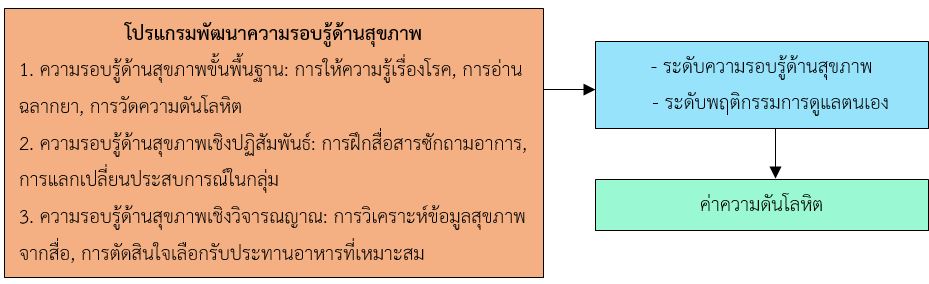
This quasi-experimental study with a one-group pretest–posttest design aimed to compare health literacy, self-care behaviors, and blood pressure levels among older adults with hypertension before and after receiving a health literacy enhancement program. The sample consisted of 30 older adults with hypertension who received services at Ban Mae Pha Haen Subdistrict Health Promoting Hospital, Chiang Mai Province. Participants were selected using simple random sampling. The intervention tool was a health literacy enhancement program developed by the researcher. Data collection instruments included a health literacy assessment and a health behavior questionnaire based on the 3E2S principles. Data were analyzed using descriptive statistics and paired t-test.
The results revealed that after completing the program, the participants had an overall good level of health literacy, which significantly increased (p-value < 0.001). In addition, the mean self-care behavior scores significantly improved (p-value < 0.001), and both systolic and diastolic blood pressure levels significantly decreased (p-value < 0.001). Therefore, the health literacy enhancement program was effective in improving self-care behaviors and controlling blood pressure among older adults with hypertension. Therefore, healthcare providers should be encouraged to apply this program in healthcare settings to sustainably improve the quality of care for older adults.
References
กรมกิจการผู้สูงอายุ. (2564). ปัญหาสุขภาพผู้สูงอายุไทย. สืบค้นเมื่อ 7 กรกฎาคม 2565 จากhttps://www.dop.go.th/th/know/15/466.
กรมควบคุมโรค กระทรวงสาธารณสุข. (2562). รายงานสถานการณ์โรค NCDs เบาหวาน ความดันโลหิตสูงและปัจจัยเสี่ยงที่เกี่ยวข้อง พ.ศ. 2562. กรุงเทพฯ: อักษรกราฟฟิคแอนด์ดีไซน์.
กลุ่มโรคไม่ติดต่อเรื้อรัง สำนักโรคไม่ติดต่อ กระทรวงสาธารณสุข. (2559). หลักสูตรการปรับเปลี่ยนพฤติกรรมสุขภาพ สำหรับพยาบาลผู้จัดการรายกรณีโรคเรื้อรัง. กรุงเทพฯ: สำนักงานกิจการโรงพิมพ์องค์กรสงเคราะห์ทหารผ่านศึกษาในพระบรมราชูปถัมภ์.
กองสุขศึกษา. (2561). 3อ. 2ส. เคล็ดลับสุขภาพดีของวัยทำงาน. สืบค้นเมื่อ 7 พฤศจิกายน 2563 จากhttp://www.thaihealth.or.th/Content.
ขวัญเมือง แก้วดำเกิง. (2561). ความรอบรู้ด้านสุขภาพ: เข้าถึง เข้าใจ และการนำไปใช้ (พิมพ์ครั้งที่ 2). กรุงเทพฯ: อมรินทร์พริ้นติ้งแอนด์พับลิชชิ่ง.
จันจิราภรณ์ วิชัย, สายสมร พลดงนอก และกิตติศักดิ์ สวรรยาวิสุทธิ์. (2558). ความรู้เรื่องโรคความดันโลหิตสูง (Hypertension). ขอนแก่น: หน่วยสร้างเสริมสุขภาพ งานเวชกรรมสังคม โรงพยาบาลศรีนครินทร์.
ธารินี ศรีศักดิ์นอก. (2566). การพัฒนาโปรแกรมการเสริมสร้างความรอบรู้ด้านสุขภาพของผู้สูงอายุในการ เลือกใช้ยาและ ผลิตภัณฑ์สุขภาพในโรงเรียนผู้สูงอายุ ภาคตะวันออกเฉียงเหนือ. คณะเภสัชศาสตร์ มหาวิทยาลัยมหาสารคาม. สืบค้นเมื่อ 7 กรกฎาคม 2565 จาก https://www.doctorkasem-foundation.org/wp-content/uploads/2023/09/02126504.pdf.
พิมพ์ใจ อุ่นบ้าน, สุมิตรพร จอมจันทร์ และณิชชา ทิพย์วรรณ. (2564). ผลของโปรแกรมการจัดการตนเองต่อพฤติกรรมการดูแลตนเองและการควบคุมความดันโลหิตของผู้ป่วยความดันโลหิตสูงที่ควบคุมไม่ได้. วารสารวิทยาลัยพยาบาลบรมราชชนนี อุตรดิตถ์, 13(2), 59-72.
โรงพยาบาลส่งเสริมสุขภาพตำบลบ้านแม่ผาแหน. (2563). รายงานทะเบียนกลุ่มเสี่ยงโรคหลอดเลือดสมอง. เชียงใหม่. เอกสารอัดสำเนา.
วัชรพร เชยสุวรรณ. (2560). ความรอบรู้ด้านสุขภาพ: แนวคิดและการประยุกต์สู่การปฏิบัติการพยาบาล. วารสารแพทย์นาวี, 44(3), 183-197.
วิชัย เอกพลากร, หทัยชนก พรรคเจริญ และวราภรณ์ เสถียรนพเก้า. (2564). การสำรวจสุขภาพประชาชนไทยโดยการตรวจร่างกาย ครั้งที่ 6 พ.ศ. 2562-2563. นนทบุรี: สถาบันวิจัยระบบสาธารณสุข.
วิมล โรมา และคณะ. (2562). การสำรวจความรอบรู้ด้านสุขภาพของประชาชนไทย อายุ 15 ปี ขึ้นไป พ.ศ. 2562. สืบค้นเมื่อ 7 กรกฎาคม 2565 จาก https://www.dop.go.th/th/know/15/466.
สมาคมความดันโลหิตสูงแห่งประเทศไทย. (2562). แนวทางการรักษาโรคความดันโลหิตสูง ในเวชปฏิบัติทั่วไป พ.ศ. 2562-2019 Thai Guidelines on The Treatment of Hypertension. กรุงเทพฯ: ทริค ธิงค์.
สุจินดา คงเนียม. (2566). ประสิทธิผลของโปรแกรมพัฒนาความรอบรู้ด้านสุขภาพสำหรับผู้ป่วยโรค ความดันโลหิตสูงที่เสี่ยงต่อโรคหัวใจและหลอดเลือด อำเภอเมืองตรัง จังหวัดตรัง. วิทยานิพนธ์ปริญญาพยาบาลศาสตร มหาบัณฑิต สาขาวิชาการพยาบาลศาสตร์ มหาวิทยาลัยสุโขทัยธรรมาธิราช.
สำนักงานสาธารณสุขจังหวัดเชียงใหม่. (2563). รายงานผลการดำเนินงานตามตัวชี้วัด. สืบค้นเมื่อ 7 พฤศจิกายน 2563 จาก https://www.chiangmaihealth.go.th/cmpho_web/.
Cohen, J. (1988). Statistical Power Analysis for Behavioral Sciences. New York: Academic Press.
Ettehad, D., et al. (2016). Blood pressure lowering for prevention of cardiovascular disease and death: A systematic review and meta-analysis. The Lancet, 387(10022), 957-967.
Faul, F., Erdfelder, E., Lang, A.-G., & Buchner, A. (2007). G*Power 3: A flexible statistical power analysis program for the social, behavioral, and biomedical sciences. Behavior Research Methods, 39, 175-191. https://doi.org/10.3758/bf03193146
Kanfer, F. H. & Gaelick-Buys, L. (1991). Self-management methods. In F. H. Kanfer & A. Goldstein (Eds.), Helping people change: A textbook of methods. New York: Pergamon Press.
Nutbeam, D. (2008). The evolving concept of health literacy. Social Science & Medicine (1982), 67(12), 2072-2078. https://doi.org/10.1016/j.socscimed.2008.09.050
Osborn, C. Y., Paasche-Orlow, M. K., Bailey, S. C., & Wolf, M. S. (2011). The mechanisms linking health literacy to behavior and health status. American Journal of Health Behavior, 35(1), 118-128. https://doi.org/10.5993/ajhb.35.1.11
Wagner, E. H., Austin, B. T., Davis, C., Hindmarsh, M., Schaefer, J., & Bonomi, A. (2001). Improving chronic illness care: Translating evidence into action. Health Affairs (Project Hope), 20(6), 64-78. https://doi.org/10.1377/hlthaff.20.6.64
Whelton, P. K., et al. (2002). Primary prevention of hypertension: clinical and public health advisory from The National High Blood Pressure Education Program. JAMA, 288(15), 1882-1888. https://doi.org/10.1001/jama.288.15.1882
Downloads
Published
How to Cite
Issue
Section
License
Copyright (c) 2026 Journal of Nursing and Public Health Research

This work is licensed under a Creative Commons Attribution-NonCommercial-NoDerivatives 4.0 International License.
1. บทความหรือข้อคิดเห็นใด ๆ ที่ปรากฏในวารสารวิจัยการพยาบาลและการสาธารณสุข ที่เป็นวรรณกรรมของผู้เขียน บรรณาธิการไม่จำเป็นต้องเห็นด้วย
2. บทความที่ได้รับการตีพิมพ์ถือเป็นลิขสิทธิ์ของ วารสารวิจัยการพยาบาลและการสาธารณสุข