Development and Evaluation of a Self-Management Model for Patients with Type 2 Diabetes with Family and Community Participation among Ethnic Groups in Mae La Noi District, Mae Hong Son Province
Keywords:
Self-Management, Type 2 Diabetes Mellitus, Family and Community Participation, Ethnic GroupsAbstract
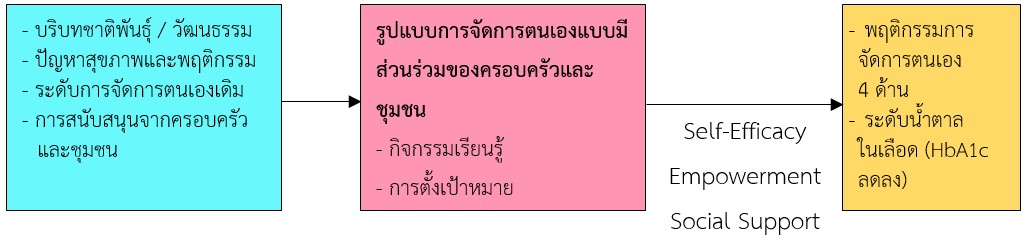
This research and development study aimed to develop and evaluate the effectiveness of a self-management model for patients with type 2 diabetes, involving family and community participation among ethnic groups in Mae La Noi District, Mae Hong Son Province, Thailand, on self-care behaviors and glycated hemoglobin (HbA1c) levels. The study was conducted in two phases. Phase 1 involved the development of the self-management model. Phase 2 evaluated the effectiveness of the model using a quasi-experimental one-group pretest–posttest design (n=40). Data collection instruments included a self-management behavior assessment questionnaire and laboratory testing of glycated hemoglobin (HbA1c). Quantitative data were analyzed using descriptive statistics and comparisons of mean scores before and after the intervention, while qualitative data were analyzed using content analysis.
The results showed that the developed self-management model consisted of four key components: culturally appropriate education and skill training, family support for behavioral change, participation of village health volunteers and community members in follow-up care, and proactive home visits conducted by a multidisciplinary team. After the intervention, participants demonstrated significantly higher mean scores of self-management behaviors (p-value = 0.01) and a significant improvement in glycated hemoglobin levels (p-value < .001). Therefore, this model can be applied to the care of patients with type 2 diabetes in primary health care settings through collaboration among health professionals, families, and communities, particularly in remote areas or among ethnic populations.
References
ขนิษฐา พิศฉลาด และพงษ์ภัทร์ รัตนสุวรรณ. (2564). ประสบการณ์การดูแลผู้สูงอายุโรคเบาหวานชนิดที่ 2 กลุ่มชาติพันธุ์ ของบุคลากรสุขภาพ. วารสารพยาบาลตำรวจ, 13(1), 24-33.
มยุรี ปะวันนา. (2566). ผลของโปรแกรมการจัดการโรคเบาหวานด้วยตนเองต่อพฤติกรรมการจัดการตนเอง ระดับน้ำตาลสะสมในเลือด และผลลัพธ์ทางคลินิกของผู้ป่วยเบาหวานชนิดที่ 2 ที่ควบคุมระดับน้ำตาลในเลือดไม่ได้. วารสารวิชาการสำนักงานสาธารณสุขจังหวัดมหาสารคาม, 8(15), 70-74.
วัชรินทร์ คำสา และเอกลักษณ์ เด็กยอง. (2567). การดูแลผู้ป่วยโรคไม่ติดต่อเรื้อรังกลุ่มชาติพันธุ์กะเหรี่ยงที่มีความต่างทางวัฒนธรรม: บทบาทพยาบาล. วารสารวิจัยการพยาบาลและการสาธารณสุข, 4(2), e266538.
สมปรารถนา ทรายหมอ และสุทธิชัย ศิรินวล. (2565). ปัจจัยที่มีผลต่อการจัดการตนเองในการควบคุมระดับน้ำตาลในเลือดในผู้ป่วยเบาหวานชนิดไม่พึ่งอินซูลินของกลุ่มชาติพันธุ์ อำเภอแม่สาย จังหวัดเชียงราย. วารสารโรคและภัยสุขภาพ สำนักงานป้องกันควบคุมโรคที่ 3 จังหวัดนครสวรรค์, 16(3), 15-25.
สำนักงานสาธารณสุขจังหวัดแม่ฮ่องสอน. (2566). รายงานสรุปข้อมูลผู้ป่วยเบาหวานจังหวัดแม่ฮ่องสอน. แม่ฮ่องสอน: สำนักงานสาธารณสุขจังหวัดแม่ฮ่องสอน.
สำนักงานสาธารณสุขอำเภอแม่ลาน้อย. (2567). รายงานสรุปข้อมูลผู้ป่วยเบาหวานในอำเภอแม่ลาน้อย. แม่ฮ่องสอน: สำนักงานสาธารณสุขอำเภอแม่ลาน้อย จังหวัดแม่ฮ่องสอน.
Amani, N., Nazari, A. M., Sanaie, N., Abbasi, A., & Borhani, F. (2025). Effects of family-centered empowerment program on illness acceptance and self-management of patients with type 2 diabetes: A randomized controlled trial. Scientific Reports, 15(1), 21615. https://doi.org/10.1038/s41598-025-05833-0
American Diabetes Association. (2024). 5. Facilitating positive health behaviors and well-being to improve health outcomes: Standards of care in diabetes—2024. Diabetes Care, 47(Suppl. 1), S77-S110. https://doi.org/10.2337/dc24-S005
Aung, T. N. N., Khin, E. T., Moolphate, S., Angkurawaranon, C., Yuasa, M., & Aung, M. N. (2024). Social support for Thai adults with type 2 diabetes: A case-control study. Diabetes, metabolic syndrome and obesity: targets and therapy, 17, 3753-3765. https://doi.org/10.2147/DMSO.S478283
Azmiardi, A., Murti, B., Febrinasari, R. P., & Tamtomo, D. G. (2021). The effect of family involvement in diabetes self-management education on glycemic control in patients with type 2 diabetes mellitus: A systematic review and meta-analysis. Journal of Public Health and Development, 19(3), 164-167.
Corbin, J. M. & Strauss, A. (1988). Unending work and care: Managing chronic illness at home. San Francisco: Jossey-Bass.
Funnell, M. M., et al. (2009). National standards for diabetes self-management education. Diabetes Care, 32(Suppl 1), S87-S94. https://doi.org/10.2337/dc09-S087
Grady, P. A. & Gough, L. L. (2014). Self-management: A comprehensive approach to management of chronic conditions. American Journal of Public Health, 104(8), e25-e31. https://doi.org/10.2105/AJPH.2014.302041
GBD 2021 Diabetes Collaborators. (2023). Global, regional, and national burden of diabetes from 1990 to 2021, with projections of prevalence to 2050: A systematic analysis for the Global Burden of Disease Study 2021. The Lancet, 402(10397), 203-234. https://doi.org/10.1016/S0140-6736(23)01301-6
International Diabetes Federation. (2024). Thailand. In IDF diabetes atlas. Retrieved August 15, 2025 from https://idf.org/our-network/regions-and-members/western-pacific/members/thailand/.
Lincoln, Y. S. & Guba, E. G. (1985). Naturalistic inquiry. London: Sage Publications.
Lorig, K. R., & Holman, H. R. (2003). Self-management education: History, definition, outcomes, and mechanisms. Annals of Behavioral Medicine, 26(1), 1-7. https://doi.org/10.1207/S15324796ABM2601_01
Matrook, K. A., Cowman, S., Pertl, M., & Whitford, D. (2024). Nurse-led family-based approach in primary health care for patients with type 2 diabetes mellitus: A qualitative study. International Journal of Qualitative Studies on Health and Well-Being, 19(1), 2323060. https://doi.org/10.1080/17482631.2024.2323060
Reyes, P. J. D., Medina, D., & Serrano, K. F. (2024). Effectiveness of family-focused interventions in patients with type 2 diabetes mellitus in family and community practice: A systematic review and meta-analysis. The Philippine Academy of Family Physicians Journal, 62(1), 135-148.
Nelson, L. A., et al. (2023). Glycemic outcomes of a family-focused intervention for adults with type 2 diabetes: Main, mediated, and subgroup effects from the FAMS 2.0 RCT. Diabetes Research and Clinical Practice, 206, 110991. https://doi.org/10.1016/j.diabres.2023.110991
World Health Organization. (2016). Global report on diabetes. World Health Organization. Retrieved January 15, 2026 from https://www.who.int/publications/i/item/9789241565257.
Zhu, L., et al. (2025). Effectiveness of a family-based self-management intervention for type 2 diabetes patients receiving family doctor contract services: A community-based randomized controlled trial. Journal of Primary Care & Community Health, 16, 1-13.
Downloads
Published
How to Cite
Issue
Section
License
Copyright (c) 2026 Journal of Nursing and Public Health Research

This work is licensed under a Creative Commons Attribution-NonCommercial-NoDerivatives 4.0 International License.
1. บทความหรือข้อคิดเห็นใด ๆ ที่ปรากฏในวารสารวิจัยการพยาบาลและการสาธารณสุข ที่เป็นวรรณกรรมของผู้เขียน บรรณาธิการไม่จำเป็นต้องเห็นด้วย
2. บทความที่ได้รับการตีพิมพ์ถือเป็นลิขสิทธิ์ของ วารสารวิจัยการพยาบาลและการสาธารณสุข