
Effects of a Case-Based Medication Adherence Promotion Program among Uncontrolled Hypertensive Patients at a Private Hospital in Bangkok
Keywords:
Hypertension, Medication Adherence, Roy Adaptation Model, Case ManagementAbstract
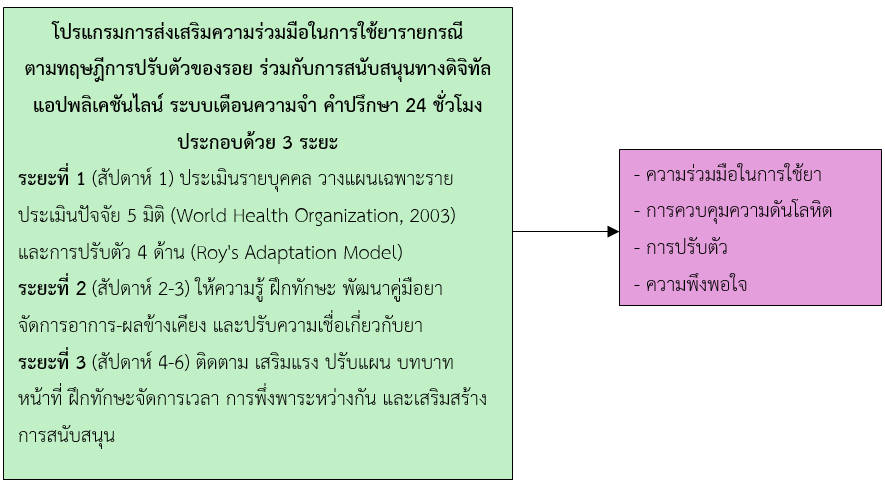
This quasi-experimental study with a two-group pretest–posttest design aimed to: 1) compare medication adherence scores and blood pressure levels among patients with uncontrolled hypertension before and after participation in a case management medication adherence promotion program; 2) compare medication adherence scores and blood pressure control outcomes between the experimental and control groups after the intervention; 3) compare adaptation scores based on Roy’s Adaptation Theory between the experimental and control groups after the intervention; and 4) examine patient satisfaction with the program. The sample consisted of 60 patients with uncontrolled hypertension and low medication adherence scores, divided equally into an experimental group and a control group (30 participants each) using matching and random assignment. The experimental group received a case management medication adherence promotion program developed based on Roy’s Adaptation Theory integrated with the World Health Organization’s five-dimensional adherence framework for a period of 6 weeks, with continuous support through the Line application throughout the study. The control group received standard care. Research instruments included the 8-item Morisky Medication Adherence Scale (MMAS-8), the Roy Adaptation Assessment Questionnaire, and a satisfaction questionnaire. Data were analyzed using independent and paired t-tests.
The findings revealed that, after completion of the program, the experimental group demonstrated a statistically significant increase in medication adherence scores from 3.80 to 6.40 points (p-value < 0.001), which was significantly higher than that of the control group (p-value < 0.001). The experimental group also achieved a mean reduction in systolic blood pressure of 19.70 mmHg, and 70% of participants achieved the treatment target of <130/80 mmHg compared with 30% in the control group (p-value = 0.001; RR = 2.33; NNT = 2.50). In addition, the experimental group had significantly higher adaptation scores across all four modes of Roy’s Adaptation Theory compared with the control group (p-value < 0.001). Participants also reported a very high level of satisfaction with the program (Mean = 4.60, S.D. = 0.40). Therefore, the case management medication adherence promotion program based on Roy’s Adaptation Theory combined with digital support through the Line application was effective in improving medication adherence, reducing blood pressure, and enhancing holistic adaptation among patients with uncontrolled hypertension. The program should be applied in primary healthcare services and extended to the management of other chronic diseases.
References
งานเวชระเบียน โรงพยาบาลเอกชนแห่งหนึ่งในกรุงเทพมหานคร. (2568). สถิติผู้ป่วยโรคความดันโลหิตสูงที่ควบคุมระดับความดันโลหิตไม่ได้ ประจำปี พ.ศ. 2568. [ข้อมูลที่ไม่ได้ตีพิมพ์]. โรงพยาบาลเอกชนแห่งหนึ่งในกรุงเทพมหานคร.
จุฑารัตน์ วงศ์สิน, อิทธิพล ทองแก้ว และจัดสดา ป่านจันทร์. (2564). ประสิทธิผลของแอปพลิเคชันไลน์และการให้คำปรึกษาทางโทรศัพท์ในการปรับปรุงความร่วมมือในการใช้ยา: การศึกษาแบบสุ่มที่มีกลุ่มควบคุมในผู้ป่วยเบาหวานชนิดที่ 2 ที่ควบคุมไม่ได้. วารสารส่งเสริมสุขภาพ, 11(4), 438-443.
พนิตนันท์ วงศ์สุวรรณ. (2560). การพัฒนาเครื่องมือแบบประเมินแรงจูงใจในการรับประทานยาและพฤติกรรมการรับประทานยาอย่างต่อเนื่องในผู้สูงอายุโรคความดันโลหิตสูงในชุมชน. วารสารการพยาบาลและการศึกษา, 10(1), 90-104.
ศิริลักษณ์ นาคมี, มาลี สุขสิริ และปราณี ชุนหงษ์. (2565). การประยุกต์ใช้ทฤษฎีการปรับตัวของรอยในโปรแกรมการดูแลผู้ป่วยโรคเรื้อรัง. วารสารวิทยาศาสตร์การพยาบาล, 40(2), 125-138.
สุภัทรา กิตติวรชัย, นิรันดร์ สารพันธ์ และวราภรณ์ ชาตรี. (2564). เทคโนโลยีสารสนเทศเพื่อการติดตามความร่วมมือในการใช้ยาของผู้ป่วยความดันโลหิตสูงในชุมชน. วารสารวิจัยวิทยาศาสตร์สุขภาพ, 15(1), 78-89.
Aekplakorn, W., et al. (2024). Trends in hypertension prevalence, awareness, treatment, and control in the Thai population, 2004 to 2020. BMC Public Health, 24(1), 3149. https://doi.org/10.1186/s12889-024-20643-1
Backes, C., Moyses Marques, A., Chavez Miranda, J., Krouwer, J. S., & Wittenberg, C. (2021). Digital medication adherence support: Could healthcare providers recommend mobile health apps?, Frontiers in Medical Technology, 2, 616242. https://doi.org/10.3389/fmedt.2020.616242
Burnier, M. & Egan, B. M. (2019). Adherence in hypertension. Circulation Research, 124(7), 1124-1140. https://doi.org/10.1161/CIRCRESAHA.118.313220
Conn, V. S., Ruppar, T. M., Enriquez, M., & Cooper, P. (2016). Medication adherence interventions that target subjects with adherence problems: Systematic review and meta-analysis. Research in Social and Administrative Pharmacy, 12(2), 218-246. https://doi.org/10.1016/j.sapharm.2015.06.001
Demirel, C. & Kiliç, S. P. (2024). The effects of education based on the Roy Adaptation Model on medication adherence and psychosocial adjustment in hypertensive patients. Journal of Vascular Nursing, 42(2), 89-98. https://doi.org/10.1016/j.jvn.2024.02.001
Diviani, N., van den Putte, B., Giani, S., & van Weert, J. C. M. (2015). Low health literacy and evaluation of online health information: A systematic review of the literature. Journal of Medical Internet Research, 17(5), e112. https://doi.org/10.2196/jmir.4018
Estrela, M., Semedo, G., Roque, F., Lopes Ferreira, P., & Herdeiro, M. T. (2023). Sociodemographic determinants of digital health literacy: A systematic review and meta-analysis. International Journal of Medical Informatics, 177, 105124. https://doi.org/10.1016/j.ijmedinf.2023.105124
Guo, Z., et al. (2021). Socioeconomic disparities in eHealth literacy and preventive behaviors during the COVID-19 pandemic in Hong Kong: Cross-sectional study. Journal of Medical Internet Research, 23(4), e24577. https://doi.org/10.2196/24577
Kumar, K., Greenfield, G., Wankya-Muleba, M., Humphries, R., & Car, J. (2023). Effectiveness of mobile applications on medication adherence in adults with chronic diseases: A systematic review and meta-analysis. Journal of Managed Care & Specialty Pharmacy, 29(4), 394-405. https://doi.org/10.18553/jmcp.2023.29.4.394
Lee, S., Bae, S. S., Jang, S. I., & Park, E. C. (2021). Multidimensional factors affecting medication adherence among patients with chronic obstructive pulmonary disease. Journal of Clinical Nursing, 30(13-14), 1913-1925. https://doi.org/10.1111/jocn.15738
Menditto, E., et al. (2019). Adherence to treatment and related factors among patients with chronic conditions in primary care: A cross-sectional study. BMC Primary Care, 20(1), 132. https://doi.org/10.1186/s12875-019-1012-2
Pickering, T. G., et al. (2005). Recommendations for blood pressure measurement in humans and experimental animals: Part 1: Blood pressure measurement in humans. Circulation, 111(5), 697-716. https://doi.org/10.1161/01.CIR.0000154900.76284.F6
Roy, C., & Andrews, H. A. (2009). The Roy adaptation model (3rd ed.). London: Pearson.
Sakthong, P., Chabunthom, R., & Charoenvisuthiwongs, R. (2009). Psychometric properties of the Thai version of the 8-item Morisky Medication Adherence Scale in patients with type 2 diabetes. Annals of Pharmacotherapy, 43(5), 950-957. https://doi.org/10.1345/aph.1L453
Wang, T., Huang, Y. M., & Chan, H. Y. (2024). Exploration of features of mobile applications for medication adherence in Asia: Narrative review. Journal of Medical Internet Research, 26(1), e60787. https://doi.org/10.2196/60787
Wongpakaran, N., et al. (2019). Prevalence of uncontrolled hypertension among hypertensive patients: A nation-wide survey in Thailand. BMC Research Notes, 12(1), 380. https://doi.org/10.1186/s13104-019-4417-7
World Health Organization. (2003). Adherence to long-term therapies: Evidence for action. World Health Organization. Retrieved August 9, 2025, from https://www.who.int/publications/i/item/924154599X.
World Health Organization. (2025). Hypertension. Retrieved August 9, 2025 from https://www.who.int/news-room/fact-sheets/detail/hypertension.
Zhang, J., Guo, L., Mao, J., Li, H., Wang, Y., & Chen, X. (2021). The effects of nursing of Roy adaptation model on the elderly hypertensive: A randomised control study. Annals of Palliative Medicine, 10(12), 12149-12158. https://doi.org/10.21037/apm-21-3290
Downloads
Published
How to Cite
Issue
Section
License
Copyright (c) 2026 Journal of Nursing and Public Health Research

This work is licensed under a Creative Commons Attribution-NonCommercial-NoDerivatives 4.0 International License.
1. บทความหรือข้อคิดเห็นใด ๆ ที่ปรากฏในวารสารวิจัยการพยาบาลและการสาธารณสุข ที่เป็นวรรณกรรมของผู้เขียน บรรณาธิการไม่จำเป็นต้องเห็นด้วย
2. บทความที่ได้รับการตีพิมพ์ถือเป็นลิขสิทธิ์ของ วารสารวิจัยการพยาบาลและการสาธารณสุข