Integrating Buddhist Wisdom with Holistic Health Promotion: A Case Study of Monks in the Digital Era in Muang Uttaradit District
Keywords:
Buddhist Wisdom, Holistic Health, Digital Technology, Monks, Research and DevelopmentAbstract
This research and development study aimed to: (1) examine the situation of holistic health and digital technology use among monks, (2) analyze the relationship between adherence to Buddhist principles and holistic well-being, and (3) develop and evaluate the effectiveness of a holistic health promotion program integrating Buddhist wisdom with digital technology. The research was conducted in four phases: situational analysis, program development, program implementation and evaluation, and program refinement into a finalized version. Participants consisted of 250 monks in Mueang Uttaradit District, Uttaradit Province, selected through multistage sampling. The research instruments included a questionnaire on holistic health status and digital technology use, a holistic well-being assessment, and a program satisfaction questionnaire. Quantitative data were analyzed using descriptive statistics, t-tests, Pearson’s correlation, and multiple regression analysis. Qualitative data were analyzed using content analysis.
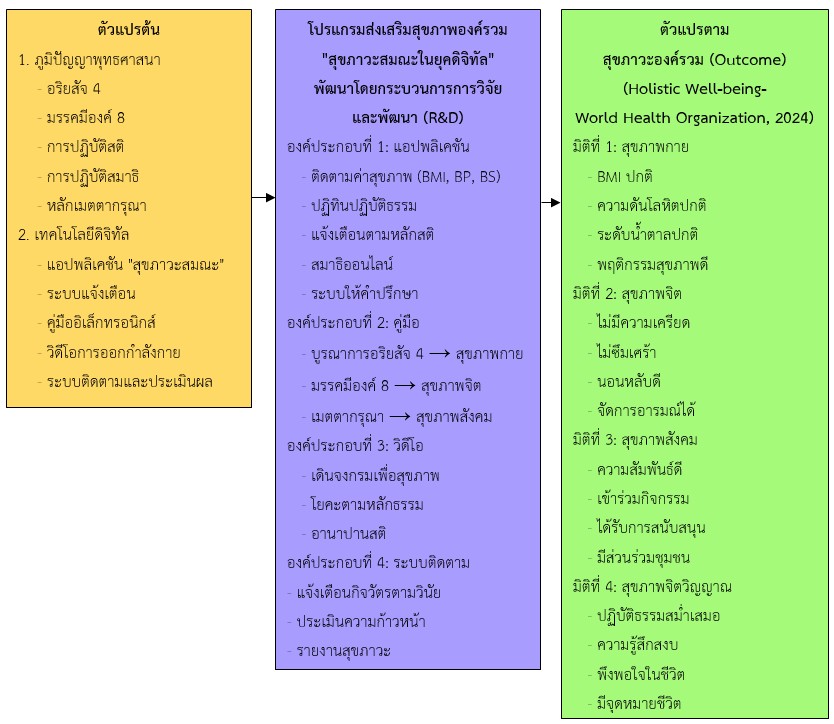
The results showed that 30.80% of the monks had a body mass index in the obese range, 21.60% had hypertension, and 17.20% experienced high levels of stress. A total of 95.20% of the monks used smartphones, with an average usage of 3.80 hours per day. Adherence to Buddhist principles was positively associated with holistic well-being at a statistically significant level (p-value < 0.001). The “Samanah Well-being in the Digital Era” program consisted of a health-recording application, an electronic manual integrating Buddhist principles with health care, exercise videos based on Buddhist practices, and a monitoring and evaluation system. After three months of program implementation, the monks showed significant improvement in holistic well-being across all dimensions (p-value < 0.001). Participants reported a high level of satisfaction with the program (Mean = 4.24). These findings indicate that the program has strong potential to promote holistic well-being among monks and could be expanded to support the implementation of health-promoting temple policies.
References
กรมอนามัย กระทรวงสาธารณสุข. (2567). รายงานประจำปีสถานการณ์สุขภาพพระสงฆ์ไทย 2567. กรุงเทพฯ: โรงพิมพ์สหกรณ์การเกษตรแห่งประเทศไทย.
สถาบันพระปกเกล้า. (2567). การสำรวจสุขภาพจิตพระสงฆ์ในเขตเมือง ประเทศไทย 2567. กรุงเทพฯ: สถาบันพระปกเกล้า.
สำนักงานพระพุทธศาสนาแห่งชาติ. (2567). สถิติพระสงฆ์และวัดทั่วประเทศไทย 2567. นครปฐม: สำนักงานพระพุทธศาสนาแห่งชาติ.
สำนักงานพัฒนาธุรกรรมทางอิเล็กทรอนิกส์. (2567). การสำรวจพฤติกรรมการใช้อินเทอร์เน็ตของพระสงฆ์ไทย 2567. กรุงเทพฯ: สำนักงานพัฒนาธุรกรรมทางอิเล็กทรอนิกส์.
สำนักงานพระพุทธศาสนาจังหวัดอุตรดิตถ์. (2567). สถิติพระสงฆ์และวัดในจังหวัดอุตรดิตถ์ 2567. อุตรดิตถ์: สำนักงานพระพุทธศาสนาจังหวัดอุตรดิตถ์.
Agarwal, V. & Jones, C. (2022). Social media's role in the changing religious landscape of contemporary Bangkok. Religions, 13(5), 421. https://doi.org/10.3390/rel13050421
Jeamjitvibool, T., Tankumpuan, T., Lukkahatai, N., & Davidson, P. M. (2022). Buddhist monks as a community health resource: An integrative review. Research in Nursing & Health, 45(4), 366-380. https://doi.org/10.1002/nur.22215
Ko-amornsup, W., et al. (2024). Health survey of monks residing in urban areas: The Bangkok Noi model. Siriraj Medical Journal, 76(11), 620-631. https://doi.org/10.33192/smj.v76i11.269296
Langgapin, S., Boonchieng, W., Chautrakarn, S., Maneeton, N., & Senawan, S. (2024a). Development of a monk-led elderly mental health counseling program in Thai Buddhist communities. Religions, 15(8), 998. https://doi.org/10.3390/rel15080998
Langgapin, S., Boonchieng, W., Chautrakarn, S., Maneeton, N., & Senawan, S. (2024b). Effectiveness of the Buddhist-based elderly mental health counseling training program for Thai health volunteer monks. Religions, 15(12), 1472. https://doi.org/10.3390/rel15121472
Reilly, E. D. & Van Stuyvenberg, C. M. (2023). Loving-kindness meditation and self-compassion: A meta-analysis. Mindfulness, 14(1), 1-17. https://doi.org/10.1007/s12671-022-01972-x
Van Gucht, D., Raes, F., & Koval, P. (2024). Loving-kindness and compassion meditation in the workplace: A meta-analysis. Stress & Health, 40(5), e3273. https://doi.org/10.1002/smi.3273
Witarto, B. S., et al. (2022). Effectiveness of online mindfulness-based interventions in improving mental health during the COVID-19 pandemic: A systematic review and meta-analysis of randomized controlled trials. PLOS ONE, 17(9), e0274177. https://doi.org/10.1371/journal.pone.0274177
World Health Organization. (2024). Holistic health framework: Integrating physical, mental, social, and spiritual well-being. Geneva: World Health Organization.
Yamane, T. (1973). Statistics: An introductory analysis (3rd ed.). New York: Harper & Row.
Downloads
Published
How to Cite
Issue
Section
License
Copyright (c) 2026 Journal of Nursing and Public Health Research

This work is licensed under a Creative Commons Attribution-NonCommercial-NoDerivatives 4.0 International License.
1. บทความหรือข้อคิดเห็นใด ๆ ที่ปรากฏในวารสารวิจัยการพยาบาลและการสาธารณสุข ที่เป็นวรรณกรรมของผู้เขียน บรรณาธิการไม่จำเป็นต้องเห็นด้วย
2. บทความที่ได้รับการตีพิมพ์ถือเป็นลิขสิทธิ์ของ วารสารวิจัยการพยาบาลและการสาธารณสุข