Factors Associated with Adaptation of First-Year Nursing Students at Boromarajonani College of Nursing, Uttaradit
Keywords:
Adaptation, Nursing Students, First-Year, Roy's Adaptation TheoryAbstract
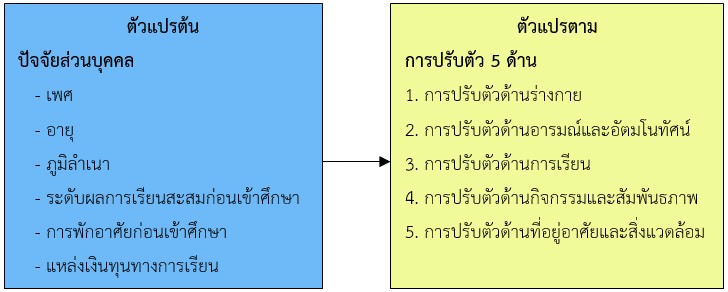
This cross-sectional descriptive study aimed to: 1) examine the level of adaptation among first-year nursing students at Boromarajonani College of Nursing, Uttaradit; 2) compare adaptation by personal factors; 3) explore the relationships between personal factors and adaptation; and 4) identify predictors of adaptation. The sample consisted of 130 first-year nursing students in the 2024 academic year. Research instruments included a demographic questionnaire and a five-domain adaptation questionnaire. Data were analyzed using descriptive statistics. Differences in adaptation were examined using t-tests and one-way analysis of variance. Relationships between personal factors and adaptation were analyzed using Pearson’s product–moment correlation and point-biserial correlation. Predictors of adaptation were identified using stepwise multiple regression analysis.
The results showed that the overall level of adaptation was high (Mean = 130.40, S.D. = 9.41). The highest mean score was found in the activity and interpersonal relationship domain, while the physical domain had the lowest mean score. No significant difference in overall adaptation was found by gender. However, students who lived with their parents prior to enrollment had significantly higher overall adaptation than those who did not (p-value < 0.05). Correlation analysis indicated that gender and pre-enrollment living arrangement were positively associated with adaptation at a low level, while prior grade point average was moderately positively associated with academic adaptation (p-value < 0.01). Stepwise multiple regression analysis revealed that pre-enrollment living arrangement and prior GPA jointly predicted overall adaptation, accounting for 8.20% of the variance (R² = 0.08, p-value < 0.01). These findings can be used as baseline information for developing systematic and context-appropriate programs to promote nursing students’ adaptation.
References
Choi, M.-Y., Park, S., & Noh, G.-O. (2024). Social support for nursing students: A concept analysis study. Nurse Education Today, 132, 106038. https://doi.org/10.1016/j.nedt.2023.106038
Dias, J. J. M., et al. (2024). Nursing students’ stressors and coping strategies during their clinical practicum: A qualitative study. BMC Nursing, 23, 541. https://doi.org/10.1186/s12912-024-01962-5
Gause, G., Sehularo, L. A., & Matsipane, M. J. (2024). Coping strategies used by undergraduate first-year nursing students during transition from basic to higher education: A qualitative study. BMC Nursing, 23, 276. https://doi.org/10.1186/s12912-024-01938-5
Irvine, S., Williams, B., Smallridge, A., Solomonides, I., Gong, Y. H., & Andrew, S. (2021). The self-regulated learner, entry characteristics and academic performance of undergraduate nursing students transitioning to university. Nurse Education Today, 105, 105041. https://doi.org/10.1016/j.nedt.2021.105041
Jiesisibieke, Z. L., et al. (2024). Academic resilience of nursing students during COVID-19: An analysis using machine learning methods. Nursing Open, 11(10), e70018. https://doi.org/10.1002/nop2.70018
Karimi Mirzanezam, A., et al. (2024). Nursing students’ perceptions of their clinical learning environment and supervision: A scoping review. BMC Medical Education, 24, 1216. https://doi.org/10.1186/s12909-024-06562-0
Labrague, L. J. (2024). Umbrella review: Stress levels, sources of stress, and coping mechanisms among student nurses. Nursing Reports, 14(1), 362-375. https://doi.org/10.3390/nursrep14010028
Lohmae, Y., Yeepaloh, M., Kajornkittiya, K., & Bunlap, P. (2021). Factors related to adaptationsof the firstyear nursing students studying at anursing college in a southern border province of Thailand. Journal of Nursing and Health Research, 22(3), 135-146.
Middleton, R., Tower, M., Pighills, A., & Perkins, L. (2021). Students’ perceptions of belonging in a School of Nursing at a regional university in Australia. Nurse Education Today, 99, 104817. https://doi.org/10.1016/j.nedt.2021.104817
Montague, J., Tsui, J., Kamstra-Cooper, K., Connell, M., Atack, L., & Haghiri-Vijeh, R. (2025). Adapting to change: Undergraduate nursing students’ sense of belonging transitioning from online to in-person learning environments. Journal of Advanced Nursing, 81(1), 513-522. https://doi.org/10.1111/jan.16389
Park, J.-Y., & Hong, O. (2021). Perceived stress, coping strategies, and mental health of nursing students during clinical practice. Nurse Education Today, 102, 104911. https://doi.org/10.1016/j.nedt.2021.104911
Park, S., & Choi, M.-Y. (2025). Resilience of nursing students: A concept analysis study. Nurse Education Today, 144, 106463. https://doi.org/10.1016/j.nedt.2024.106463
Roy, C., & Andrews, H. A. (2009). The Roy Adaptation Model (3rd ed.). New Jersey: Pearson/Prentice Hall.
Shen, Y., Feng, H., & Li, X. (2024). Academic resilience in nursing students: A concept analysis. BMC Nursing, 23, 431. https://doi.org/10.1186/s12912-024-02133-2
Singer, D. L., Sapp, A., & Baker, K. A. (2022). Belongingness in undergraduate/pre-licensure nursing students in the clinical learning environment: A scoping review. Nurse Education in Practice, 64, 103422. https://doi.org/10.1016/j.nepr.2022.103422
Solak, M., Adıgüzel, K., Akça, N., Çiçek, Ö., Özkan, F., & Ergin, E. (2024). Evaluation of stress, bio-psycho-social response and coping behaviour of nursing students during practical training. BMC Nursing, 23, 652. https://doi.org/10.1186/s12912-024-02265-5
Squire, D., Gonzalez, L., & Shayan, C. (2024). Enhancing sense of belonging in nursing student clinical placements to advance learning and identity development. Journal of Professional Nursing, 51, 109-114. https://doi.org/10.1016/j.profnurs.2024.01.007
Tsai, L. H., See, L. C., Fan, J. Y., Tsai, C. C., Chen, C. M., & Peng, W. S. (2024). Trajectory of change in perceived stress, coping strategies and clinical competence among undergraduate nursing students during clinical practicum: A longitudinal cohort study. BMC Medical Education, 24(1), 349. https://doi.org/10.1186/s12909-024-05332-2
Zhang, J., et al. (2022). The clinical learning environment, supervision and future intention to work as a nurse in nursing students: A cross-sectional descriptive study. BMC Medical Education, 22, 548. https://doi.org/10.1186/s12909-022-03609-y
Downloads
Published
How to Cite
Issue
Section
License
Copyright (c) 2026 Journal of Nursing and Public Health Research

This work is licensed under a Creative Commons Attribution-NonCommercial-NoDerivatives 4.0 International License.
1. บทความหรือข้อคิดเห็นใด ๆ ที่ปรากฏในวารสารวิจัยการพยาบาลและการสาธารณสุข ที่เป็นวรรณกรรมของผู้เขียน บรรณาธิการไม่จำเป็นต้องเห็นด้วย
2. บทความที่ได้รับการตีพิมพ์ถือเป็นลิขสิทธิ์ของ วารสารวิจัยการพยาบาลและการสาธารณสุข