The Effect of a Mindfulness-Based Cgnitive Therapy Program on Anxiety and Depression among Patients with Breast Cancer Receiving Chemotherapy
Keywords:
Mindfulness-Based Cognitive Therapy, Anxiety, Depression, Breast Cancer PatientsAbstract
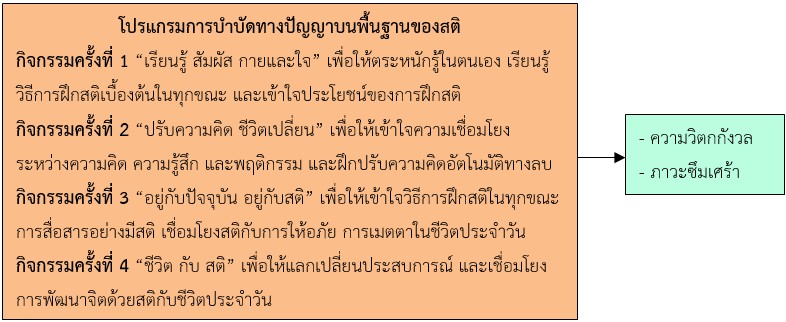
This quasi-experimental study using a two-group repeated-measures design aimed to examine the effects of a Mindfulness-Based Cognitive Therapy (MBCT) program on anxiety and depression among patients with breast cancer receiving chemotherapy. The sample consisted of 40 patients with breast cancer receiving chemotherapy at the outpatient department of Chonburi Cancer Hospital. The research participants were divided into two groups: an experimental group and a control group, with 20 participants in each group. The experimental group participated in the MBCT program consisting of four sessions, each lasting 60-90 minutes, whereas the control group received usual care. The research instruments included the MBCT program and the Thai version of the Hospital Anxiety and Depression Scale (HADS). Data were collected at three time points: before the intervention, immediately after the intervention, and at follow-up. Data were analyzed using repeated-measures analysis of variance, and pairwise comparisons were performed using the Bonferroni post hoc test.
The results revealed that participants in the experimental group had significantly lower mean anxiety scores at both the post-intervention and follow-up assessments compared with the pre-intervention assessment (F(2,38) = 267.77, p-value < 0.001, η² = 0.93). Similarly, the mean depression scores significantly decreased following the intervention (F(2,38) = 376.66, p-value < 0.001, η² = 0.95). Between-group comparisons showed that the experimental group had significantly lower mean anxiety scores than the control group at both the post-intervention and follow-up assessments (F(2,76) = 99.92, p-value < 0.001, η² = 0.72). Likewise, the experimental group demonstrated significantly lower mean depression scores than the control group (F(2,76) = 120.77, p-value < 0.001, η² = 0.76). The findings indicate that the Mindfulness-Based Cognitive Therapy (MBCT) program was effective in reducing anxiety and depression among patients with breast cancer receiving chemotherapy. The program should therefore be integrated into standard care to enhance the effectiveness of psychosocial care and rehabilitation for this patient population.
References
กลุ่มงานวิชาการพยาบาล โรงพยาบาลมะเร็งชลบุรี. (2565). รายงานประจำปี. ชลบุรี: โรงพยาบาลมะเร็งจังหวัดชลบุรี.
ธนา นิลชัยโกวิทย์, มาโนช หล่อตระกูล และอุมาภรณ์ ไพศาลสุทธิเดช. (2539). การพัฒนาแบบสอบถาม Hospital Anxiety and Depression Scale ฉบับภาษาไทยในผู้ป่วยมะเร็ง. วารสารสมาคมจิตแพทย์แห่งประเทศไทย, 41(1), 18-30.
ภิญโญ อุทธิยา. (2563). บทบาทของพยาบาลหน่วยบริการพยาบาลผู้ป่วยที่บ้านในการดูแลผู้ป่วยสูงอายุโรคมะเร็งระยะท้าย. วารสารพยาบาลทหารบก, 21(1), 18-25.
ธรรมนูญ เปรมใจ, กิตติพร เนาว์สุวรรณ และนภชา สิงห์วีรธรรม. (2565). ผลของการใช้โปรแกรมการให้ข้อมูลการรักษาอย่างมีแบบแผนต่อความวิตกกังวลของมารดาผู้ป่วยเด็กที่เข้ารับการรักษาในแผนกผู้ป่วยใน. วารสารวิจัยการพยาบาลและการสาธารณสุข, 2(2), 25-37.
โรงพยาบาลมะเร็งชลบุรี. (2569). สถิติโรคมะเร็งระดับโรงพยาบาลมะเร็งชลบุรี HOS–BASED CANCER REGISTRY 2024 เล่มที่ 25. สืบค้นเมื่อ 30 กรกฎาคม 2569 จาก http://www.ccc.in.th/apps/registry/index.php/ผลงานวิชาการ /hospital-base.
Beck, A.T. (1967). Depression: Clinical, experimental, and theoretical aspects. New York: Hoeber.
Chang, G., Lin, X., Qin, M., Wang, L., & Cai, S. (2024). Symptom cluster study undergoing chemotherapy in breast cancer patients: Latent class analysis and contemporaneous network analysis. Asia-Pacific Journal of Oncology Nursing, 11(6), 100499. https://doi.org/10.1016/j.apjon.2024.100499
Chang, Y.-C., et al. (2023). Immediate impact of Mindfulness-Based Cognitive Therapy (MBCT) among women with breast cancer: A systematic review and meta-analysis. BMC Women's Health, 23(1), 331. https://doi.org/10.1186/s12905-023-02486-x
Faul, F., Erdfelder, E., Buchner, A., & Lang, A.-G. (2009). Statistical power analyses using GPower 3.1: Tests for correlation and regression analyses*. Behavior Research Methods, 41(4), 1149-1160. https://doi.org/10.3758/BRM.41.4.1149
Fereidouni, Z., et al. (2024). The Impact of Cancer on Mental Health and the Importance of Supportive Services. Galen medical journal, 13, e3327. https://doi.org/10.31661/gmj.v13i.3327
Getie, A., Ayalneh, M., & Bimerew, M. (2025). Global prevalence and determinant factors of pain, depression, and anxiety among cancer patients: An umbrella review of systematic reviews and meta-analyses. BMC Psychiatry, 25(1), 156. https://doi.org/10.1186/s12888-025-06599-5
Grassi, L., et al. (2023). Anxiety and depression in adult cancer patients: ESMO clinical practice guideline. ESMO Open, 8(2), 101155. https://doi.org/10.1016/j.esmoop.2023.101155
Hessami, A., et al. (2025). Depression, anxiety, and stress in breast cancer patients: Prevalence, associated risk factors, and clinical correlates. Scientific Reports, 15, 31084. https://doi.org/10.1038/s41598-025-17285-7
Jiang, C. H., Zhu, F., & Qin, T. T. (2020). Relationships between chronic diseases and depression among middle-aged and elderly people in China: A prospective study from CHARLS. Current Medical Science, 40(5), 858-870. https://doi.org/10.1007/s11596-020-2270-5
Johns, S. A., Brown, L. F., Beck-Coon, K., Monahan, P. O., Tong, Y., & Kroenke, K. (2015). Randomized controlled pilot study of mindfulness-based stress reduction for persistently fatigued cancer survivors. Psycho-Oncology, 24(8), 885-893. https://doi.org/10.1002/pon.3648
Kabat-Zinn, J. (2003). Mindfulness-based interventions in context: Past, present, and future. Clinical Psychology: Science and Practice, 10(2), 144-156. https://doi.org/10.1093/clipsy.bpg016
Kim, J., et al. (2025). Global patterns and trends in breast cancer incidence and mortality across 185 countries. Nature Medicine, 31, 1154-1162. https://doi.org/10.1038/s41591-025-03502-3
Konieczny, M., et al. (2025). Anxiety and depression in breast cancer patients before and after chemotherapy: A pre-post study without a control group. Journal of Clinical Medicine, 14(22), 8105. https://doi.org/10.3390/jcm14228105
Londoudi, A., et al. (2024). Assessment of the Relationship between fear of cancer recurrence, spiritual well-being, and mental health among cancer patients: A cross-sectional study. Nursing Reports (Pavia, Italy), 14(1), 317-327. https://doi.org/10.3390/nursrep14010024
Magomedova, A., & Fatima, G. (2025). Mental health and well-being in the modern era: A comprehensive review of challenges and interventions. Cureus, 17(1), e77683. https://doi.org/10.7759/cureus.77683
Moreira, M. de F., Gamboa, O. L., & Pinho Oliveira, M. A. (2022). A single-blind, randomized, pilot study of a brief mindfulness‐based intervention for the endometriosis-related pain management. European Journal of Pain, 26(6), 1147-1162. https://doi.org/10.1002/ejp.1939
National Cancer Institute. (2025). Cancer trends progress report. U.S. Department of Health and Human Services, National Institutes of Health. Retrieved July 30, 2026 from https://progressreport.cancer.gov/treatment/breast_cancer.
Norwinda, N., Dewi, Y. S., & Krisnana, I. (2024). The effect of mindfulness-based cognitive therapy on anxiety and depression levels in breast cancer patients: A systematic review. Indonesian Journal of Global Health Research, 6(S6), 961-972. https://doi.org/10.37287/ijghr.v6iS6.5019
Nissen, E. R., et al. (2020). Internet-delivered mindfulness-based cognitive therapy for anxiety and depression in cancer survivors: A randomized controlled trial. Psycho-Oncology, 29(1), 68-75. https://doi.org/10.1002/pon.5237
Segal, Z. V., Williams, J. M. G., & Teasdale, J. D. (2002). Mindfulness-based cognitive therapy for depression: A new approach to preventing relapse. 550 Seventh Avenue, New York: Guilford Press.
Segal, Z. V., Williams, J. M. G., & Teasdale, J. D. (2018). Mindfulness-based cognitive therapy for depression (2nd ed.). New York: Guilford Press.
Sheikhzadeh, M., Zanjani, Z., & Baari, A. (2021). Efficacy of mindfulness-based cognitive therapy and cognitive behavioral therapy for anxiety, depression, and fatigue in cancer patients: A randomized clinical trial. Iranian Journal of Psychiatry, 16(3), 271-280. https://doi.org/10.18502/ijps.v16i3.6252
Wagle, N. S., et al. (2025). Cancer treatment and survivorship statistics, 2025. CA: A Cancer Journal for Clinicians, 75(4), 308-340. https://doi.org/10.3322/caac.70011
Wei, S., Qin, W., Yu, Z., Cao, Y., & Li, P. (2025). The effectiveness of mindfulness-based cognitive therapy on rumination and related psychological indicators: A systematic review and meta-analysis. BMC Psychology, 13(1), 968. https://doi.org/10.1186/s40359-025-03348-x
Wu, K., et al. (2023). Mindfulness based stress reduction combined with early cardiac rehabilitation improves negative mood states and cardiac function in patients with acute myocardial infarction assisted with an intra-aortic balloon pump: A randomized controlled trial. Frontiers in Cardiovascular Medicine, 10, 1166157. https://doi.org/10.3389/fcvm.2023.1166157
Yan, J., Wang, F., & Yu, X. (2025). Effects of mindfulness therapy on breast cancer patients with depression or anxiety: A systematic review and meta-analysis. Actas Espanolas De Psiquiatria, 53(2), 422-432. https://doi.org/10.62641/aep.v53i2.1949
Zainudin, Z., Haryanto, H., & Suriadi, S. (2026). Emotional distress and coping responses to chemotherapy side effects in cancer patients: A systematic review. Journal of Mental Health Concerns, 4(6), 463-471. https://doi.org/10.56922/mhc.v4i6.2538
Zigmond, A. S. & Snaith, R. P. (1983). The hospital anxiety and depression scale. Acta Psychiatrica Scandinavica, 67(6), 361-370. https://doi.org/10.1111/j.1600-0447.1983.tb09716.x
Downloads
Published
How to Cite
Issue
Section
License
Copyright (c) 2026 Journal of Nursing and Public Health Research

This work is licensed under a Creative Commons Attribution-NonCommercial-NoDerivatives 4.0 International License.
1. บทความหรือข้อคิดเห็นใด ๆ ที่ปรากฏในวารสารวิจัยการพยาบาลและการสาธารณสุข ที่เป็นวรรณกรรมของผู้เขียน บรรณาธิการไม่จำเป็นต้องเห็นด้วย
2. บทความที่ได้รับการตีพิมพ์ถือเป็นลิขสิทธิ์ของ วารสารวิจัยการพยาบาลและการสาธารณสุข