ผลของโปรแกรมการบำบัดทางปัญญาบนพื้นฐานของสติต่อความวิตกกังวลและภาวะซึมเศร้า ในผู้ป่วยมะเร็งเต้านมที่ได้รับเคมีบำบัด
คำสำคัญ:
โปรแกรมการบำบัดทางปัญญาบนพื้นฐานของส, ความวิตกกังวล, ภาวะซึมเศร้า, ผู้ป่วยมะเร็งเต้านมบทคัดย่อ
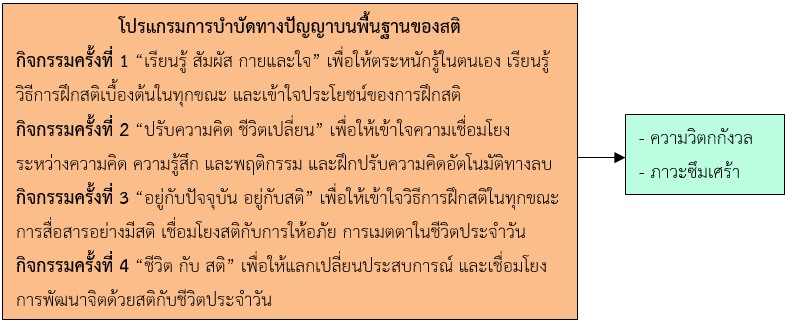
การวิจัยกึ่งทดลองแบบสองกลุ่มวัดซ้ำนี้ มีวัตถุประสงค์เพื่อศึกษาผลของโปรแกรมการบำบัดทางปัญญาบนพื้นฐานของสติ ต่อความวิตกกังวลและภาวะซึมเศร้าในผู้ป่วยมะเร็งเต้านมที่ได้รับเคมีบำบัด กลุ่มตัวอย่าง คือ ผู้ป่วยมะเร็งเต้านมที่ได้รับเคมีบำบัดซึ่งมารับบริการ ณ แผนกผู้ป่วยนอก โรงพยาบาลมะเร็งชลบุรี จำนวน 40 คน แบ่งเป็นกลุ่มทดลองและกลุ่มควบคุม กลุ่มละ 20 คน กลุ่มทดลองได้รับโปรแกรมการบำบัดทางปัญญาบนพื้นฐานของสติ จำนวน 4 ครั้ง ครั้งละ 60-90 นาที ส่วนกลุ่มควบคุมได้รับการดูแลตามปกติ เครื่องมือที่ใช้ในการวิจัยประกอบด้วย โปรแกรมการบำบัดทางปัญญาบนพื้นฐานของสติ และแบบประเมินความวิตกกังวลและภาวะซึมเศร้าฉบับภาษาไทย เก็บรวบรวมข้อมูลใน 3 ระยะ ได้แก่ ก่อนการทดลอง หลังการทดลอง และระยะติดตามผล วิเคราะห์ข้อมูลด้วยการวิเคราะห์ความแปรปรวนแบบวัดซ้ำ และเปรียบเทียบความแตกต่างรายคู่ด้วยวิธีของบอนเฟอโรนี
ผลการวิจัยพบว่า กลุ่มทดลองหลังเข้าร่วมโปรแกรมทั้งในระยะหลังการทดลอง และระยะติดตามผล มีคะแนนเฉลี่ยความวิตกกังวลลดลงกว่าระยะก่อนการทดลองอย่างมีนัยสำคัญทางสถิติ F(2,38) = 267.77, p-value < 0.001, η² = 0.93) เช่นเดียวกับคะแนนเฉลี่ยภาวะซึมเศร้าที่ลดต่ำลงกว่าเดิมอย่างมีนัยสำคัญทางสถิติ (F(2,38) = 376.66, p-value < 0.001, η² = 0.95) เมื่อเปรียบเทียบระหว่างกลุ่ม พบว่า กลุ่มทดลองมีคะแนนเฉลี่ยความวิตกกังวลในระยะหลังการทดลอง และระยะติดตามผลต่ำกว่ากลุ่มควบคุมอย่างมีนัยสำคัญทางสถิติ (F(2,76) = 99.92, p-value < 0.001, η² = 0.72) รวมทั้งมีคะแนนเฉลี่ยภาวะซึมเศร้าต่ำกว่ากลุ่มควบคุมอย่างมีนัยสำคัญทางสถิติ (F(2,76) = 120.77, p-value < 0.001, η² = 0.76) สรุปได้ว่าโปรแกรมการบำบัดทางปัญญาบนพื้นฐานของสติมีประสิทธิผลในการลดความวิตกกังวล และภาวะซึมเศร้าในผู้ป่วยมะเร็งเต้านมที่ได้รับเคมีบำบัด จึงควรส่งเสริมการนำโปรแกรมไปบูรณาการร่วมกับการดูแลตามมาตรฐานเพื่อยกระดับประสิทธิภาพในการดูแลและฟื้นฟูภาวะทางจิตสังคมของผู้ป่วยให้เกิดประโยชน์สูงสุดต่อไป
เอกสารอ้างอิง
กลุ่มงานวิชาการพยาบาล โรงพยาบาลมะเร็งชลบุรี. (2565). รายงานประจำปี. ชลบุรี: โรงพยาบาลมะเร็งจังหวัดชลบุรี.
ธนา นิลชัยโกวิทย์, มาโนช หล่อตระกูล และอุมาภรณ์ ไพศาลสุทธิเดช. (2539). การพัฒนาแบบสอบถาม Hospital Anxiety and Depression Scale ฉบับภาษาไทยในผู้ป่วยมะเร็ง. วารสารสมาคมจิตแพทย์แห่งประเทศไทย, 41(1), 18-30.
ภิญโญ อุทธิยา. (2563). บทบาทของพยาบาลหน่วยบริการพยาบาลผู้ป่วยที่บ้านในการดูแลผู้ป่วยสูงอายุโรคมะเร็งระยะท้าย. วารสารพยาบาลทหารบก, 21(1), 18-25.
ธรรมนูญ เปรมใจ, กิตติพร เนาว์สุวรรณ และนภชา สิงห์วีรธรรม. (2565). ผลของการใช้โปรแกรมการให้ข้อมูลการรักษาอย่างมีแบบแผนต่อความวิตกกังวลของมารดาผู้ป่วยเด็กที่เข้ารับการรักษาในแผนกผู้ป่วยใน. วารสารวิจัยการพยาบาลและการสาธารณสุข, 2(2), 25-37.
โรงพยาบาลมะเร็งชลบุรี. (2569). สถิติโรคมะเร็งระดับโรงพยาบาลมะเร็งชลบุรี HOS–BASED CANCER REGISTRY 2024 เล่มที่ 25. สืบค้นเมื่อ 30 กรกฎาคม 2569 จาก http://www.ccc.in.th/apps/registry/index.php/ผลงานวิชาการ /hospital-base.
Beck, A.T. (1967). Depression: Clinical, experimental, and theoretical aspects. New York: Hoeber.
Chang, G., Lin, X., Qin, M., Wang, L., & Cai, S. (2024). Symptom cluster study undergoing chemotherapy in breast cancer patients: Latent class analysis and contemporaneous network analysis. Asia-Pacific Journal of Oncology Nursing, 11(6), 100499. https://doi.org/10.1016/j.apjon.2024.100499
Chang, Y.-C., et al. (2023). Immediate impact of Mindfulness-Based Cognitive Therapy (MBCT) among women with breast cancer: A systematic review and meta-analysis. BMC Women's Health, 23(1), 331. https://doi.org/10.1186/s12905-023-02486-x
Faul, F., Erdfelder, E., Buchner, A., & Lang, A.-G. (2009). Statistical power analyses using GPower 3.1: Tests for correlation and regression analyses*. Behavior Research Methods, 41(4), 1149-1160. https://doi.org/10.3758/BRM.41.4.1149
Fereidouni, Z., et al. (2024). The Impact of Cancer on Mental Health and the Importance of Supportive Services. Galen medical journal, 13, e3327. https://doi.org/10.31661/gmj.v13i.3327
Getie, A., Ayalneh, M., & Bimerew, M. (2025). Global prevalence and determinant factors of pain, depression, and anxiety among cancer patients: An umbrella review of systematic reviews and meta-analyses. BMC Psychiatry, 25(1), 156. https://doi.org/10.1186/s12888-025-06599-5
Grassi, L., et al. (2023). Anxiety and depression in adult cancer patients: ESMO clinical practice guideline. ESMO Open, 8(2), 101155. https://doi.org/10.1016/j.esmoop.2023.101155
Hessami, A., et al. (2025). Depression, anxiety, and stress in breast cancer patients: Prevalence, associated risk factors, and clinical correlates. Scientific Reports, 15, 31084. https://doi.org/10.1038/s41598-025-17285-7
Jiang, C. H., Zhu, F., & Qin, T. T. (2020). Relationships between chronic diseases and depression among middle-aged and elderly people in China: A prospective study from CHARLS. Current Medical Science, 40(5), 858-870. https://doi.org/10.1007/s11596-020-2270-5
Johns, S. A., Brown, L. F., Beck-Coon, K., Monahan, P. O., Tong, Y., & Kroenke, K. (2015). Randomized controlled pilot study of mindfulness-based stress reduction for persistently fatigued cancer survivors. Psycho-Oncology, 24(8), 885-893. https://doi.org/10.1002/pon.3648
Kabat-Zinn, J. (2003). Mindfulness-based interventions in context: Past, present, and future. Clinical Psychology: Science and Practice, 10(2), 144-156. https://doi.org/10.1093/clipsy.bpg016
Kim, J., et al. (2025). Global patterns and trends in breast cancer incidence and mortality across 185 countries. Nature Medicine, 31, 1154-1162. https://doi.org/10.1038/s41591-025-03502-3
Konieczny, M., et al. (2025). Anxiety and depression in breast cancer patients before and after chemotherapy: A pre-post study without a control group. Journal of Clinical Medicine, 14(22), 8105. https://doi.org/10.3390/jcm14228105
Londoudi, A., et al. (2024). Assessment of the Relationship between fear of cancer recurrence, spiritual well-being, and mental health among cancer patients: A cross-sectional study. Nursing Reports (Pavia, Italy), 14(1), 317-327. https://doi.org/10.3390/nursrep14010024
Magomedova, A., & Fatima, G. (2025). Mental health and well-being in the modern era: A comprehensive review of challenges and interventions. Cureus, 17(1), e77683. https://doi.org/10.7759/cureus.77683
Moreira, M. de F., Gamboa, O. L., & Pinho Oliveira, M. A. (2022). A single-blind, randomized, pilot study of a brief mindfulness‐based intervention for the endometriosis-related pain management. European Journal of Pain, 26(6), 1147-1162. https://doi.org/10.1002/ejp.1939
National Cancer Institute. (2025). Cancer trends progress report. U.S. Department of Health and Human Services, National Institutes of Health. Retrieved July 30, 2026 from https://progressreport.cancer.gov/treatment/breast_cancer.
Norwinda, N., Dewi, Y. S., & Krisnana, I. (2024). The effect of mindfulness-based cognitive therapy on anxiety and depression levels in breast cancer patients: A systematic review. Indonesian Journal of Global Health Research, 6(S6), 961-972. https://doi.org/10.37287/ijghr.v6iS6.5019
Nissen, E. R., et al. (2020). Internet-delivered mindfulness-based cognitive therapy for anxiety and depression in cancer survivors: A randomized controlled trial. Psycho-Oncology, 29(1), 68-75. https://doi.org/10.1002/pon.5237
Segal, Z. V., Williams, J. M. G., & Teasdale, J. D. (2002). Mindfulness-based cognitive therapy for depression: A new approach to preventing relapse. 550 Seventh Avenue, New York: Guilford Press.
Segal, Z. V., Williams, J. M. G., & Teasdale, J. D. (2018). Mindfulness-based cognitive therapy for depression (2nd ed.). New York: Guilford Press.
Sheikhzadeh, M., Zanjani, Z., & Baari, A. (2021). Efficacy of mindfulness-based cognitive therapy and cognitive behavioral therapy for anxiety, depression, and fatigue in cancer patients: A randomized clinical trial. Iranian Journal of Psychiatry, 16(3), 271-280. https://doi.org/10.18502/ijps.v16i3.6252
Wagle, N. S., et al. (2025). Cancer treatment and survivorship statistics, 2025. CA: A Cancer Journal for Clinicians, 75(4), 308-340. https://doi.org/10.3322/caac.70011
Wei, S., Qin, W., Yu, Z., Cao, Y., & Li, P. (2025). The effectiveness of mindfulness-based cognitive therapy on rumination and related psychological indicators: A systematic review and meta-analysis. BMC Psychology, 13(1), 968. https://doi.org/10.1186/s40359-025-03348-x
Wu, K., et al. (2023). Mindfulness based stress reduction combined with early cardiac rehabilitation improves negative mood states and cardiac function in patients with acute myocardial infarction assisted with an intra-aortic balloon pump: A randomized controlled trial. Frontiers in Cardiovascular Medicine, 10, 1166157. https://doi.org/10.3389/fcvm.2023.1166157
Yan, J., Wang, F., & Yu, X. (2025). Effects of mindfulness therapy on breast cancer patients with depression or anxiety: A systematic review and meta-analysis. Actas Espanolas De Psiquiatria, 53(2), 422-432. https://doi.org/10.62641/aep.v53i2.1949
Zainudin, Z., Haryanto, H., & Suriadi, S. (2026). Emotional distress and coping responses to chemotherapy side effects in cancer patients: A systematic review. Journal of Mental Health Concerns, 4(6), 463-471. https://doi.org/10.56922/mhc.v4i6.2538
Zigmond, A. S. & Snaith, R. P. (1983). The hospital anxiety and depression scale. Acta Psychiatrica Scandinavica, 67(6), 361-370. https://doi.org/10.1111/j.1600-0447.1983.tb09716.x
ดาวน์โหลด
เผยแพร่แล้ว
รูปแบบการอ้างอิง
ฉบับ
ประเภทบทความ
สัญญาอนุญาต
ลิขสิทธิ์ (c) 2026 วารสารวิจัยการพยาบาลและการสาธารณสุข

อนุญาตภายใต้เงื่อนไข Creative Commons Attribution-NonCommercial-NoDerivatives 4.0 International License.
1. บทความหรือข้อคิดเห็นใด ๆ ที่ปรากฏในวารสารวิจัยการพยาบาลและการสาธารณสุข ที่เป็นวรรณกรรมของผู้เขียน บรรณาธิการไม่จำเป็นต้องเห็นด้วย
2. บทความที่ได้รับการตีพิมพ์ถือเป็นลิขสิทธิ์ของ วารสารวิจัยการพยาบาลและการสาธารณสุข
 Indexed in TCI