The Effects of a Self Management Program on Knowledge, Self-Care Behaviors and Blood Sugar Levels among Patients with Type 2 Diabetes mellitus
Keywords:
Self-Management Promotion Program, Type 2 Diabetes Mellitus, Diabetes Knowledge, Self-Care Behaviors, Blood Glucose LevelAbstract
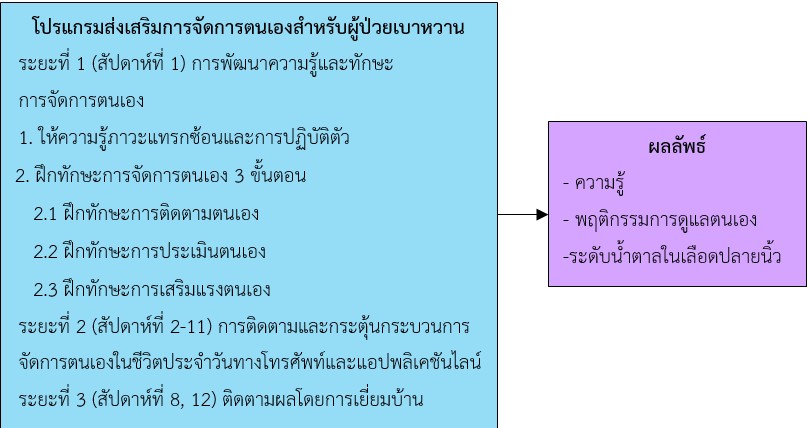
This quasi-experimental study employing a two-group pretest–posttest with follow-up design aimed to examine the effects of a self-management promotion program on diabetes knowledge, self-care behaviors, and blood glucose levels among patients with type 2 diabetes mellitus at Ban Duea Subdistrict Health Promoting Hospital, Nong Khai Province. The sample consisted of 60 participants, who were equally assigned to an experimental group (n = 30) and a control group (n = 30). The experimental group received the self-management promotion program for 12 weeks, whereas the control group received standard care. Data were collected at three time points: baseline (pretest), post-intervention, and follow-up. The research instruments included a self-management promotion program, a diabetes knowledge test, a self-care behavior questionnaire, and a blood glucose record form. Data were analyzed using descriptive statistics and two-way repeated measures ANOVA.
The results revealed that: 1) there were no significant differences in mean diabetes knowledge scores between the experimental and control groups or in the interaction effect between time and group (p-value > 0.05), although diabetes knowledge significantly changed over time (p-value = 0.02); 2) the experimental group demonstrated significantly higher mean self-care behavior scores than the control group (p-value = 0.04), with a significant interaction effect between time and group (p-value = 0.04). Self-care behavior scores at post-intervention and follow-up were significantly higher than those at baseline (p-value < 0.001); and (3) no significant differences in mean blood glucose levels were found between the two groups, and no significant time-by-group interaction was observed (p-value > 0.05). However, blood glucose levels changed significantly over time (p-value < 0.001). In conclusion, the self-management promotion program was effective in improving self-care behaviors among patients with type 2 diabetes mellitus. The program should be integrated into primary healthcare services to enhance diabetes care.
References
กรมควบคุมโรค. (2567). รายงานประจำปี 2567 กองโรคไม่ติดต่อ. กรุงเทพฯ: อักษรกราฟฟิคแอนด์ดีไซน์.
กนกวรรณ ด้วงกลัด, จินตนา วัชรสินธุ์ และวารุณี พรหมภัทร์. (2563). ผลของโปรแกรมการจัดการตนเองต่อพฤติกรรมการจัดการตนเองและระดับน้ำตาลสะสมในเลือดของผู้ป่วยเบาหวานชนิดที่ 2 ที่ควบคุมไม่ได้. วารสารคณะพยาบาลศาสตร์ มหาวิทยาลัยบูรพา, 28(4), 45-57.
ยุวดี คาดีวี, พนิตา จิตจักร, สุขขี แสง และจันทร์ทิต เพียรภายลุน. (2567). ผลของโปรแกรมปรับเปลี่ยนความรู้และทักษะการจัดการตนเองในผู้ป่วยเบาหวานชนิดที่ 2 ที่ควบคุมน้ำตาลในเลือดไม่ได้โรงพยาบาลเขาวง. วารสารอนามัยสิ่งแวดล้อมและสุขภาพชุมชน, 9(6), 113-123.
โรงพยาบาลส่งเสริมสุขภาพตำบลบ้านเดื่อ. (2567). รายงานระบบฐานข้อมูล HDC (Health Data Center). สำนักงานสาธารณสุขจังหวัดหนองคาย. สืบค้นเมื่อ 29 ตุลาคม 2567 จากhttps://hdc.moph.go.th/nki/public/standard-report-detail/137a726340e4dfde7bbbc5d8aeee3ac3.
ศิริพร ปาระมะ, ชาญวิทย์ เปียงน้อย, ระวี วงค์ชัย, นิตยา โปธิบาล และรัชดา เปี้ยฟั่น. (2567). ผลของโปรแกรมการจัดการตนเองต่อพฤติกรรมการควบคุมโรค และระดับน้ำตาลในเลือดของผู้ป่วยโรคเบาหวานชนิดที่ 2. วารสารวิจัยการพยาบาลและสุขภาพ, 25(3), e270503.
สุนันทา พรมป้อง และเบญจวัลย์ เรือนรส. (2568). ผลของโปรแกรมการจัดการตนเองต่อพฤติกรรมการดูแลตนเองและระดับน้ำตาลสะสมในเลือดของผู้ป่วยเบาหวานชนิดที่ 2 ที่ควบคุมระดับน้ำตาลไม่ได้ ในคลินิกโรคเบาหวาน โรงพยาบาลธวัชบุรี. วารสารวิจัยและพัฒนานวัตกรรมทางสุขภาพ, 6(1), 252-262.
สุนันทา ภักดีอำนาจ, เชาวกิจ ศรีเมืองวงศ์ และสุรีรัตน์ ณ วิเชียร. (2566). ผลของโปรแกรมพัฒนาความรู้และปรับเปลี่ยนพฤติกรรมสุขภาพต่อความรู้ พฤติกรรม และระดับน้ำตาลในเลือดของผู้ป่วยเบาหวานชนิดที่ 2 ในเขตเมือง. วารสารวิทยาลัยพยาบาลบรมราชชนนี สุพรรณบุรี, 6(2), 53-66.
สำนักพัฒนากลุ่มโรคร่วมไทย. (2566). ต้นทุนบริการผู้ป่วยนอกรายโรคจากข้อมูลผู้ป่วยรายบุคคลจากการศึกษาต้นทุนรายโรคระยะที่ 1. สืบค้นเมื่อ 30 ตุลาคม 2567 จาก https://tcmc.or.th.
อรุณ จิรวัฒน์กุล. (2556). สถิติทางวิทยาศาสตร์สุขภาพเพื่อการวิจัย (พิมพ์ครั้งที่ 3). กรุงเทพฯ: วิทยพัฒน์.
Creer, L. T. (2000). Self-management of chronic illness. In M. Boekaerts, P. R. Pintrich, & M. Zeidner (Eds.), Handbook of self-regulation. New York: Academic Press.
Faul, F., Erdfelder, E., Lang, A. G., & Buchner, A. (2007). GPower 3: A flexible statistical power analysis program for the social, behavioral, and biomedical sciences. Behavior Research Methods, 39(2), 175-191. https://doi.org/10.3758/BF03193146
Fithria, F., Husna, C., Ahyana, A., Nurhidayah, I., & Jannah, S. R. (2022). Self-management effectiveness on the quality of life of type 2 diabetes mellitus patients during the COVID-19 pandemic in Aceh, Indonesia. Open Access Macedonian Journal of Medical Sciences, 10(G), 492-498. https://doi.org/10.3889/oamjms.2022.9555
Hisni, D., Soewondo, P., Dahlia, D., Haryati, T. S., & Ayubi, D. (2023). The effectiveness of self-management program to prevent diabetic nephropathy progression: A literature review. Central European Journal of Nursing and Midwifery, 14(2), 896-904. https://doi.org/10.15452/cejnm.2023.14.0009
Kanfer, F. H. & Gaelick-Bays, L. (1991). Self-management methods. In F. H. Kanfer & A. P. Goldstein (Eds.), Helping people change: A textbook of methods (4th ed). Headington Hill Hall: Pergamon Press.
Khavere, S., et al. (2025). Effectiveness of self-management interventions on Type 2 diabetes among young adults (18-45 years): A systematic review and meta-analysis. Diabetic Medicine, 42(1), Article e70127. https://doi.org/10.1111/dme.70127
Polit, D. F., & Beck, C. T. (2004). Nursing research: Principles and methods (7th ed.). Philadelphia: Lippincott Williams & Wilkins.
Downloads
Published
How to Cite
Issue
Section
License
Copyright (c) 2026 Journal of Nursing and Public Health Research

This work is licensed under a Creative Commons Attribution-NonCommercial-NoDerivatives 4.0 International License.
1. บทความหรือข้อคิดเห็นใด ๆ ที่ปรากฏในวารสารวิจัยการพยาบาลและการสาธารณสุข ที่เป็นวรรณกรรมของผู้เขียน บรรณาธิการไม่จำเป็นต้องเห็นด้วย
2. บทความที่ได้รับการตีพิมพ์ถือเป็นลิขสิทธิ์ของ วารสารวิจัยการพยาบาลและการสาธารณสุข