Effects of a Self-Management Program on Slowing the Progression of Stage 3 Chronic Kidney Disease in the Primary Care Network of Mueang Chi Health Promoting Hospital, Mueang Lamphun District, Lamphun Province, Thailand
Keywords:
Stage 3 Chronic Kidney Disease, Self-Management Program, Knowledge, Self-Management Behavior, Estimated Glomerular Filtration RateAbstract
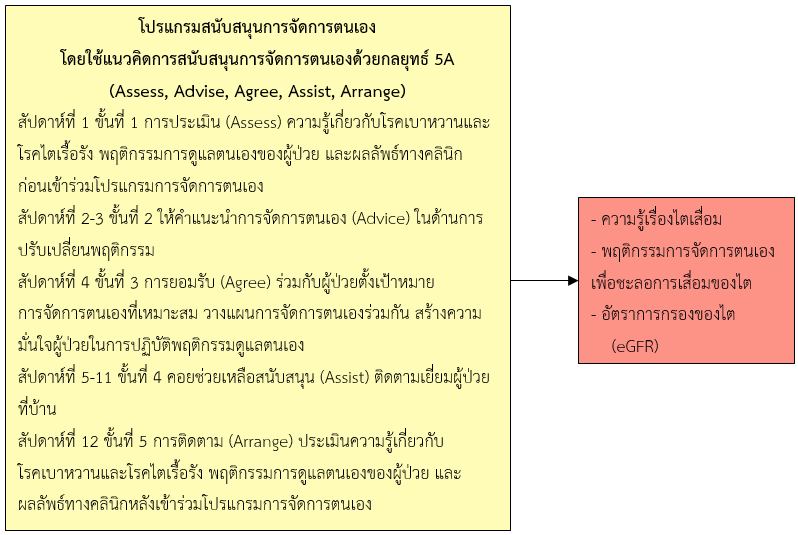
This quasi-experimental study employed a one-group pretest–posttest design to compare the mean knowledge scores, self-management behavior scores, and estimated glomerular filtration rate of patients with stage 3 chronic kidney disease before and after participation in a self-management program. The sample consisted of 40 patients with stage 3 CKD and comorbid diabetes mellitus and/or hypertension who received care at the chronic disease clinic of the Primary Care Network, Mueang Chi Health Promoting Hospital, Lamphun Province, Thailand. Participants were selected using simple random sampling. The research intervention was a self-management program developed based on the Self-Management Concepts of Kanfer and Gaelick-Buys integrated with the 5A Behavior Change Model for Self-Management Support. Data collection instruments included a CKD knowledge questionnaire and a self-management behavior assessment questionnaire. Data were analyzed using descriptive statistics, and pretest–posttest comparisons were performed using the paired t-test.
The results showed that after participating in the self-management program, the participants’ mean knowledge score significantly increased from 19.85 (S.D. = 2.49) to 21.90 (S.D. = 2.59), and the mean self-management behavior score significantly increased from 68.72 (S.D. = 14.91) to 77.60 (S.D. = 7.79) (p-value < 0.001). However, no statistically significant difference was found in the mean estimated glomerular filtration rate (eGFR) before and after participation in the program (p-value = 0.14). These findings indicate that the self-management program effectively improved knowledge and self-management behaviors among patients with stage 3 CKD. Although no significant change in eGFR was observed during the 12-week intervention period, the program may serve as a useful approach for enhancing nursing services and chronic kidney disease management in primary care settings by promoting patients’ self-management capabilities.
References
กองบริหารการสาธารณสุข. (2568). ผลการดำเนินงานของกองบริหารการสาธารณสุข ประจำปีงบประมาณ พ.ศ. 2568. กระทรวงสาธารณสุข. สืบค้นเมื่อ 25 ธันวาคม 2568 จาก http://phdb.moph.go.th.
จันจิรา หินขาว. (2562). ผลของโปรแกรมการจัดการตนเองร่วมกับการสัมภาษณ์เพื่อสร้างแรงจูงใจเพื่อชะลอไตเสื่อมจากเบาหวานต่อพฤติกรรมการจัดการตนเองและผลลัพธ์ทางคลินิกในผู้ป่วยเบาหวานชนิดที่ 2 ที่มีความเสื่อมของไตระยะที่ 3. วารสารวิทยาลัยพยาบาลพระปกเกล้า จันทบุรี, 30(2), 185-202.
จารุวรรณ บุญศล. (2566). รูปแบบการสนับสนุนการจัดการตนเองผู้ป่วยเบาหวานที่มีภาวะไตเสื่อมระยะที่ 3 คลินิกชะลอไตเสื่อม โรงพยาบาลเกษตรวิสัย จังหวัดร้อยเอ็ด. วารสารสุขภาพและสิ่งแวดล้อมศึกษา, 8(4), 560-568.
ธวัชชัย วรพงศธร และสุรีย์พันธุ์ วรพงศธร. (2561). การคำนวณขนาดตัวอย่างสำหรับงานวิจัยโดยใช้โปรแกรมสำเร็จรูป G*Power. สืบค้นเมื่อ 20 มกราคม 2562 จาก http://advisor.anamai.moph.go.th/download/Journal_health/2561/HEALTH41_2 /HEALTH_Vol41No2_02.pdf.
บุญชม ศรีสะอาด. (2560). การวิจัยเบื้องต้น. (พิมพ์ครั้งที่ 10). กรุงเทพฯ: สุวีริยาสาส์น.
รัญชนา หอมสุวรรณ. (2561). ผลของการใช้โปรแกรมชะลอไตเสื่อมในผู้ป่วยเบาหวาน ศูนย์สุขภาพชุมชนเมืองโรงพยาบาลพระนารายณ์มหาราช สาขาเทศบาลตำบลทาศาลา. โรงพยาบาลสิงห์บุรีเวชสาร, 27(1), 55-64.
โรงพยาบาลลำพูน. (2567). รายงานการสรุปการดำเนินงาน โรงพยาบาลลำพูน ปีงบประมาณ พ.ศ. 2567. ลำพูน: โรงพยาบาลลำพูน.
ศิริลักษณ์ ถุงทอง, ทิพมาส ชิณวงศ์ และเพลินพิศ ฐานิวัฒนานนท์. (2558). ผลของโปรแกรมสนับสนุนการ จัดการตนเอง เพื่อชะลอไตเสื่อมจากเบาหวานต่อพฤติกรรมการจัดการตนเอง และผลลัพธ์ทางคลินิก ในผู้ป่วยโรคเบาหวานชนิดที่ 2 ที่ไม่สามารถควบคุมระดับน้ำตาลในเลือดได้. วารสารพยาบาลสงขลา นครินทร์, 35(1), 67-84.
สมาคมโรคไตแห่งประเทศไทย. (2560). คำแนะนำสำหรับการดูแลรักษาโรคไตเรื้อรังแบบองค์รวมชนิดประคับประคอง. กรุงเทพฯ: บริษัท เท็กซ์ แอนด์ เจอร์นัล พับลิเคชั่น จำกัด.
สุจิตรา ภักดิ์จรุง. (2566). ผลของโปรแกรมการจัดการตนเองต่อการชะลอความเสื่อมของไตระยะ 3 โรงพยาบาลคอนสวรรค์ อำเภอคอนสวรรค์ จังหวัดชัยภูมิ. วารสารอนามัยสิ่งแวดล้อม และสุขภาพชุมชน, 8(3), 712-717.
สำนักงานหลักประกันสุขภาพแห่งชาติ. (2566). รายงานการสร้างระบบหลักประกันสุขภาพแห่งชาติ ประจำปีงบประมาณ 2565. กรุงเทพฯ: แสงจันทร์การพิมพ์
GBD Chronic Kidney Disease Collaboration. (2020). Global, regional, and national burden of chronic kidney disease, 1990-2017: A systematic analysis for the Global Burden of Disease Study 2017. Lancet (London, England), 395(10225), 709-733. https://doi.org/10.1016/S0140-6736(20)30045-3
Donald, M., et al. (2018). Self-management interventions for adults with chronic kidney disease: A scoping review. BMJ Open, 8(3), e019814. https://doi.org/10.1136/bmjopen-2017-019814
Faul, F., Erdfelder, E., Buchner, A., & Lang, A.-G. (2009). Statistical power analyses using G*Power 3.1: Tests for correlation and regression analyses. Behavior Research Methods, 41(4), 1149-1160. https://doi.org/10.3758/BRM.41.4.1149
Glasgow, R. E., Funnell, M. M., Bonomi, A. E., Davis, C., Beckham, V., & Wagner, E. H. (2002). Self-management aspects of the improving chronic illness care breakthrough series: Implementation with diabetes and heart failure teams. Annals of Behavioral Medicine : A publication of the Society of Behavioral Medicine, 24(2), 80-87. https://doi.org/10.1207/S15324796ABM2402_04
International Society of Nephrology. (2023). ISN global kidney health atlas. Brussels, Belgium: International Society of Nephrology.
Kanfer, F. H., & Gaelick-Buys, L. (1991). Self-management methods. In F. H. Kanfer & A. P. Goldstein (Eds.), Helping people change: A textbook of methods (4th ed). New York, NY: Pergamon Press.
Madero, M., et al. Evaluation and Management of Chronic Kidney Disease: Synopsis of the Kidney Disease: Improving Global Outcomes 2024 Clinical Practice Guideline. Annals of internal medicine, 178(5), 705-713. https://doi.org/10.7326/ANNALS-24-01926
Levey, A. S., Inker, L. A., & Coresh, J. (2014). GFR estimation: from physiology to public health. American Journal of Kidney Diseases: The Official Journal of the National Kidney Foundation, 63(5), 820-834. https://doi.org/10.1053/j.ajkd.2013.12.006
Lopez-Vargas, P. A., Tong, A., Howell, M., & Craig, J. C. (2016). Educational interventions for patients with CKD: A systematic review. American Journal of Kidney Diseases, 68(3), 353-370.
Polit, D. F. & Beck, C. T. (2017). Nursing research: Generating and assessing evidence for nursing practice (10th ed.). Philadelphia, PA: Wolters Kluwer.
World Health Organization. (2024). Noncommunicable diseases: Key facts. Geneva: World Health Organization.
Downloads
Published
How to Cite
Issue
Section
License
Copyright (c) 2026 Journal of Nursing and Public Health Research

This work is licensed under a Creative Commons Attribution-NonCommercial-NoDerivatives 4.0 International License.
1. บทความหรือข้อคิดเห็นใด ๆ ที่ปรากฏในวารสารวิจัยการพยาบาลและการสาธารณสุข ที่เป็นวรรณกรรมของผู้เขียน บรรณาธิการไม่จำเป็นต้องเห็นด้วย
2. บทความที่ได้รับการตีพิมพ์ถือเป็นลิขสิทธิ์ของ วารสารวิจัยการพยาบาลและการสาธารณสุข