Policy Proposals for Scaling Up the Development of Emergency Medical Service Systems for Community-Dwelling Older Adults with Long-Term Dependency Using Emergency Notification Technology
Keywords:
Policy Proposals, Emergency Medical Service System, Community-Dwelling Older Adults with Long-Term Dependency, Emergency Notification TechnologyAbstract
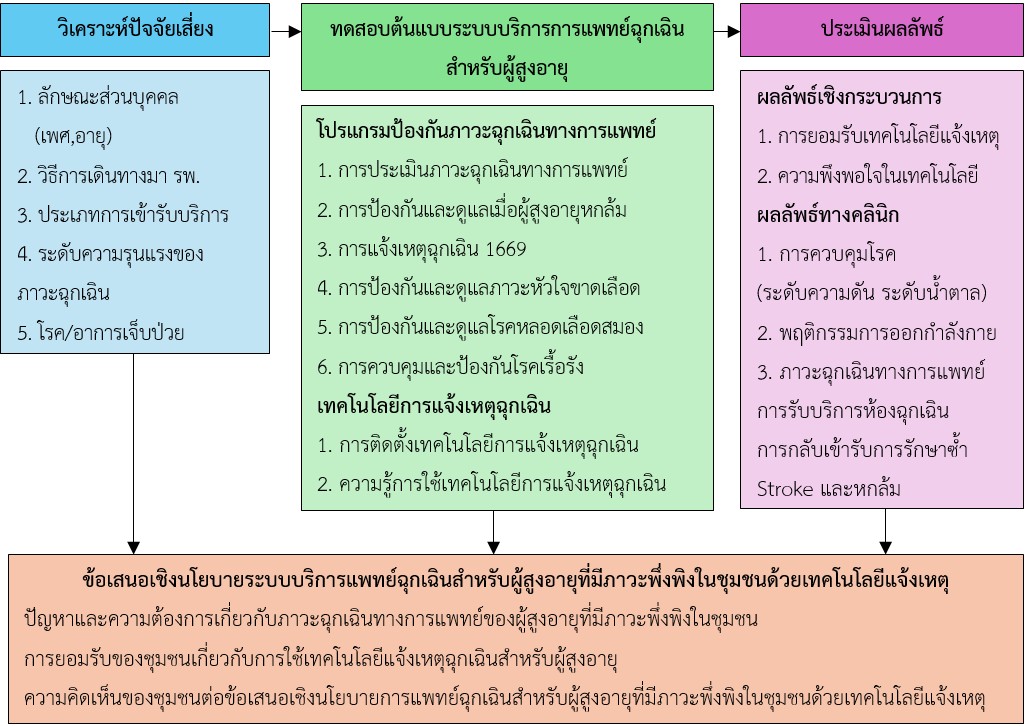
This research and development study aimed to develop policy proposals for an emergency medical service system for community-dwelling older adults with long-term dependency using emergency notification technology. The study was conducted in three phases: 1) analyzing the situation and factors associated with medical emergencies; 2) testing a prototype emergency medical service system using emergency notification technology; and 3) developing policy proposals for scaling up the system. The participants included 1,396 older adults receiving care at an emergency department, 279 older adults with long-term dependency, and 140 stakeholders. Research instruments included medical record forms, an emergency medical event prevention outcome assessment, an activities of daily living assessment, an emergency notification technology acceptance assessment, and guidelines for in-depth interviews, focus group discussions, and stakeholder consultations. Quantitative data were analyzed using descriptive statistics, multiple logistic regression, paired t-test, and McNemar’s test, while qualitative data were analyzed using content and thematic analysis.
The findings showed that 88.4% of older adults presenting to the emergency department had illnesses or chronic diseases, and 23.42% experienced medical emergencies. Factors significantly associated with medical emergencies, in descending order, were loss of consciousness, asthma or emphysema, heart disease or chest pain, pneumonia, and age. After three months of prototype implementation, acceptance of emergency notification technology significantly increased (p-value < 0.001). Blood pressure (p-value = 0.018) and blood glucose levels (p-value = 0.039) improved, and patients with hypertension demonstrated improved blood pressure control (p-value = 0.049). Clinical outcomes also improved, including emergency department visits (p-value = 0.004), hospital readmissions (p-value = 0.045), and the incidence of stroke and falls (p-value = 0.003). At the local level, policy proposals included integrating an emergency medical event prevention program and emergency notification technology into individualized care plans for older adults with long-term dependency and chronic diseases within the long-term care system. At the national level, policies should promote the development of care standards for community-dwelling older adults with long-term dependency and improve access to emergency notification technology.
References
ณิชชาภัทร ขันสาคร, ทัศนีย์ ศิลาวรรณ, ทัศนีย์ รวิวรกุล, สิริณธิ์ กิตติพิชัย และอุมาวดี เหลาทอง. (2559). รายงานวิจัยการศึกษาระบบบริการการแพทย์ฉุกเฉินสำหรับผู้สูงอายุ. กรุงเทพฯ: คณะสาธารณสุขศาสตร์ มหาวิทยาลัยมหิดล.
พรเทพ แซ่เฮ้ง, คมชิต ชวนัสพร, ปิยรัตน์ พรรณรังสี, นภัสธมน ไวกิฬา, นารอน แสนทวีผล และณนทวัต หนูศิลา. (2562). ระยะเวลาของการให้บริการและความพร้อมของชุดปฏิบัติการการแพทย์ ฉุกเฉินสำหรับผู้เจ็บป่วยสูงอายุในพื้นที่กรุงเทพมหานคร กรณีศึกษา ศูนย์บริการการแพทย์ฉุกเฉินกรุงเทพมหานคร (ศูนย์เอราวัณ). วชิรเวชสารและวารสารเวชศาสตร์เขตเมือง, 63, 65-72.
ธัญญภัสร์ ชัชวาลดำรงเจตน์ และศรีสมรัก อินทุจันทร์ยง. (2562). ปัจจัยที่มีผลต่อความตั้งใจในการใช้งานเทคโนโลยีสวมใส่พกพาติดตัว เพื่อป้องกันความเสี่ยงของสภาวะสุขภาพ. วารสารระบบสารสนเทศด้านธุรกิจ, 5(3), 6-19.
ศิราณี ศรีหาภาค และคณะ. (2561). รูปแบบการพัฒนาระบบบริการการแพทย์ฉุกเฉินสำหรับผู้สูงอายุภายใต้กองทุนระบบการดูแลระยะยาว จังหวัดขอนแก่น. นนทบุรี: สถาบันการแพทย์ฉุกเฉินแห่งชาติ.
ศิราณี ศรีหาภาค, วัชรี อมรโรจน์วรวุฒิ, ณรงค์ คำอ่อน, พัฒนี ศรีโอษฐ์, พลอยลดา ศรีหานู และทิพวรรณ ทับซ้าย. (2564). สถานการณ์ปัญหาและความต้องการการดูแลผู้สูงอายุระยะยาวในชุมชนภายใต้กองทุนระบบการดูแลระยะยาวในจังหวัดขอนแก่น. วารสารส่งเสริมสุขภาพและอนามัยสิ่งแวดล้อม, 15(36), 44-62.
สถาบันการแพทย์ฉุกเฉินแห่งชาติ. (2566). แผนหลักการแพทย์ฉุกเฉินแห่งชาติ ฉบับที่ 4 พ.ศ. 2566-2570. นนทบุรี: สถาบันการแพทย์ฉุกเฉินแห่งชาติ (สพฉ.).
สำนักงานสถิติแห่งชาติ. (2564). รายงานการสำรวจประชากรผู้สูงอายุในประเทศไทย ปี พ.ศ. 2564. กรุงเทพฯ: สำนักงานสถิติแห่งชาติ.
สำนักงานสถิติแห่งชาติ. (2567). รายงานการสำรวจประชากรผู้สูงอายุในประเทศไทย ปี พ.ศ. 2567. กรุงเทพฯ: สำนักงานสถิติแห่งชาติ.
Chen, H., et al. (2022). Implementation science in Thailand: Design and methods of a geriatric mental health cluster-randomized trial. Psychiatric Services, 73(1), 83-91.
Cohen, J. (1977). Statistical power analysis for the behavioral sciences (Rev. ed.). New Jersey: Lawrence Erlbaum Associates.
Collin, C., Wade, D. T., Davies, S., & Horne, V. (1988). The barthel ADL index: A reliability study. Disability and Rehabilitation, 10(2), 61-63.
Duong, H. V., et al. (2018). National characteristics of emergency medical services responses for older adults in the United States. Prehospital Emergency Care, 22(1), 7-14.
Faul, F., Erdfelder, E., Buchner, A., & Lang, A. G. (2009). Statistical power analyses using G*Power 3.1: Tests for correlation and regression analyses. Behavior Research Methods, 41(4), 1149-1160. https://doi.org/10.3758/BRM.41.4.1149
Ibrahem, S., Boonchieng, W., Chariyalertsak, S., Intawong, K., Thongprachum, A., & Poprom, N. (2024). The factors associate with the utilization of Emergency Medical System (EMS) services in Chiang Mai province, Thailand. Journal of Health Research, 38(6), 538-544.
Jitapunkul, S., Kamolratanakul, P., & Ebrahim, S. (1994). The meaning of activities of daily living in a Thai elderly population: Development of a new index. Age and Ageing, 23(2), 97-101. https://doi.org/10.1093/ageing/23.2.97
Pongtriang, P., Soontorn, T., Sumleepun, J., & Chuson, N. (2024). Emergency scenario-based training curriculum development: Enhancement of caregivers for the elderly' emergency assistance competency in a Rural Thai Community. SAGE Open Nursing, 10, 23779608241255635. https://doi.org/10.1177/23779608241255635
Silawan, T., Khansakorn, N., & Loathong, U. (2019). Factors influencing perceived needs for Emergency medical services among elderly patients from four provinces in Thailand. The Southeast Asian Journal of Tropical Medicine and Public Health, 50(5), 925-934.
Soontorn, T., Pongtriang, P., & Songwathana, P. (2020). Thai family caregivers' experiences helping dependent elders during medical emergencies: A qualitative study. Australasian Emergency Care, 23(2), 71-76. https://doi.org/10.1016/j.auec.2019.11.002
Shimizu, K., Hibino, S., Biros, M. H., Irisawa, T., & Shimazu, T. (2021). Emergency medicine in Japan: Past, present, and future. International Journal of Emergency Medicine, 14(1), 2. https://doi.org/10.1186/s12245-020-00316-7
Downloads
Published
How to Cite
Issue
Section
License
Copyright (c) 2026 Journal of Nursing and Public Health Research

This work is licensed under a Creative Commons Attribution-NonCommercial-NoDerivatives 4.0 International License.
1. บทความหรือข้อคิดเห็นใด ๆ ที่ปรากฏในวารสารวิจัยการพยาบาลและการสาธารณสุข ที่เป็นวรรณกรรมของผู้เขียน บรรณาธิการไม่จำเป็นต้องเห็นด้วย
2. บทความที่ได้รับการตีพิมพ์ถือเป็นลิขสิทธิ์ของ วารสารวิจัยการพยาบาลและการสาธารณสุข