Effectiveness of a Workshop Training Program Combined with a Handbook on Knowledge and Skills in Diabetic Complication Screening in Older Adults among Village Health Volunteers
Keywords:
Screening for Diabetic Complications, Diabetic Retinopathy, Diabetic Nephropathy, Diabetic Foot Ulcer, Village Health VolunteersAbstract
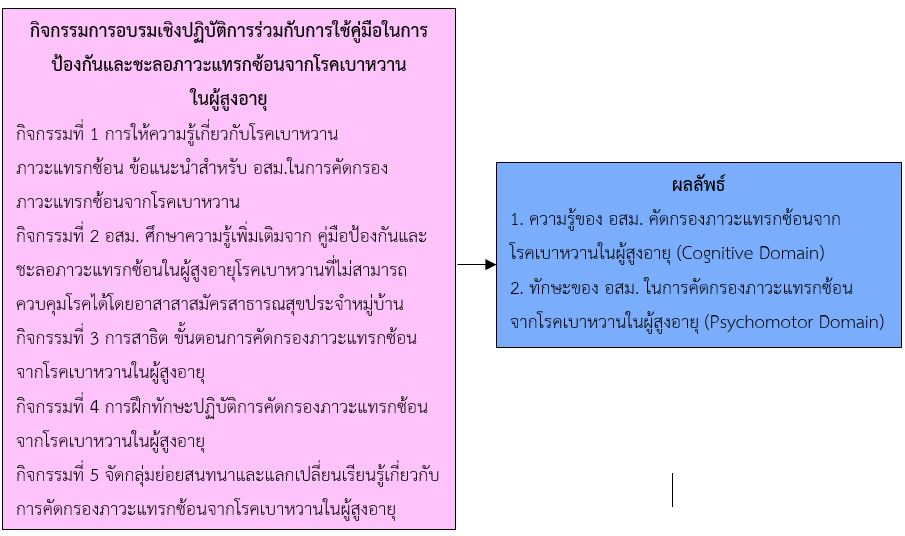
This one-group quasi-experimental study with a pretest–posttest design aimed to compare knowledge and practical skill scores of village health volunteers (VHVs) in screening for complications of diabetes among older adults before and after participating in a hands-on training program. The sample consisted of 152 VHVs, selected through purposive sampling based on predefined inclusion criteria. The research instruments included a practical training program combined with a manual for the prevention and delay of diabetes-related complications in older adults, a knowledge assessment, and a practical skills assessment. Data were analyzed using descriptive statistics, the Wilcoxon Signed-Rank Test, and the paired t-test.
The results showed that the mean knowledge score on the prevention and delay of diabetes-related complications in older adults after the training (Mean = 13.93, S.D. = 0.78) was significantly higher than before the training (Mean = 12.25, S.D. = 1.09) (z = 10.40, p-value < 0.001). Similarly, the mean practical skill score for screening diabetes-related complications among older adults after the training (Mean = 15.37, S.D. = 1.76) was significantly higher than before the training (Mean = 5.08, S.D. = 1.84) (t = 69.35, p-value < 0.001). These findings highlight the importance of implementing active learning approaches in conjunction with appropriate supporting manuals tailored to the roles of VHVs. Such strategies can effectively enhance knowledge and practical skills in screening for diabetes-related complications among older adults and may be applicable for use in other community settings to ensure continuous and effective care.
References
กรมกิจการผู้สูงอายุ. (2569). สถิติผู้สูงอายุ. สืบค้นเมื่อ 23 มกราคม 2569 จาก https://www.dop.go.th /statistics_page?cat=1&id=2588.
กรมควบคุมโรค. (2566). รายงานประจำปี 2566. สืบค้นเมื่อ 15 พฤศจิกายน 2568 จาก https://ddc.moph.go.th/uploads/ckeditor2//files.pdf.
กองยุทธศาสตร์และแผนงาน สำนักงานปลัดกระทรวงสาธารณสุข. (2566). แผนปฏิบัติราชการระยะ 5 ปี ของกระทรวงสาธารณสุข. สืบค้นเมื่อ 20 พฤศจิกายน 2568 จาก https://spd.moph.go.th/wp-content/uploads/2023/05/MOPH_plan-66-70-for-web.pdf.
เพชรรัตน์ วงค์ไชยชาญ. (2568). รูปแบบการพัฒนาศักยภาพของอาสาสมัครสาธารณสุขประจำหมู่บ้านในการส่งเสริมพฤติกรรมการดูแลตนเองของผู้ป่วยเบาหวานชนิดที่ 2. วารสารอนามัยสิ่งแวดล้อมและสุขภาพชุมชน, 10(1), 141-149.
ธัญญรัตน์ ศุภการนรเศรษฐ์ และสรรปกรณ์ ศุภการนรเศรษฐ์. (2567). การพัฒนาสมรรถนะแกนนำอาสาสมัครสาธารณสุขประจำหมู่บ้านด้านการดูแลผู้ป่วยเบาหวาน ตำบลท่างิ้ว อำเภอเมือง จังหวัดนครศรีธรรมราช. วารสารอนามัยสิ่งแวดล้อม และสุขภาพชุมชน, 9(6), 384-394.
ระพีพันธุ์ ชาติจันทึก และดารุณี จงอุดมการณ์. (2561). การพัฒนาความรู้และทักษะของอาสาสมัครสาธารณสุข ประจำหมู่บ้านในด้านการดูแลผู้ป่วยโรคเบาหวานและครอบครัวในตำบลโคกสูง อำเภอหนองกี่ จังหวัดบุรีรัมย์. วารสารโรงพยาบาลสกลนคร, 21(1), 65-76.
โรงพยาบาลส่งเสริมสุขภาพตำบลแม่สาหลวง. (2568). จำนวนอาสาสมัครสาธารณสุขประจำหมู่บ้าน (อสม.) ในเขตรับผิดชอบ [ฐานข้อมูลภายในสะสม]. เชียงใหม่: โรงพยาบาลส่งเสริมสุขภาพตำบลแม่สาหลวง จังหวัดเชียงใหม่.
สมจิตต์ สินธุชัย, กันยารัตน์ อูบคำ และนารีรัตน์ จันทรประสิทธิ์. (2560). การพัฒนาทักษะการดูแลผู้ป่วยโรคเรื้อรังของอาสาสมัครสาธารณสุขประจำหมู่บ้านโดยใช้สถานการณ์จำลองและคู่มือปฏิบัติงาน. วารสารพยาบาลกระทรวงสาธารณสุข, 27(3), 112-125.
สำนักงานสาธารณสุขจังหวัดเชียงใหม่. (2568). ระบบคลังข้อมูลด้านการแพทย์และสุขภาพ อัตราการป่วยด้วยโรคเบาหวาน ตำบลแม่สา อำเภอแม่ริม จังหวัดเชียงใหม่. สืบค้นเมื่อ 5 มกราคม 2568 จาก https://hdc.moph.go.th/cmi/public/standard-report detail/cefa42b9223ec4d1969c5ce18d762bdd.
ศิรประภา สิทธาพานิช, จิราภรณ์ ขอสุข, กาญจนา ไชยมาตร และมาดี ขันสัมฤทธิ์. (2565). ประสิทธิผลของการ พัฒนาศักยภาพ อสม. ในการดูแลผู้ป่วยโรคเบาหวาน ในคลินิกหมอครอบครัวย่อ. ยโสธรเวชสาร, 24(2), 52-61.
Best, J. W. (1981). Research in education (4th ed.). New Jersey: Prentice-Hall.
Bloom, B. S. (1982). Human characteristics and school learning (2nd edition). New York: McGrow-Hill.
Bloom, B. S., Engelhart, M. D., Fust, E. J., Hill, W. H., & Krathwohl, D. R. (1956). Taxonomy of educational objectives, handbook: The cognitive domain. New York: David McKay Inc.
Field, A. (2018). Discovering statistics using IBM SPSS statistics (5th ed.). London: Sage.
Kuder, G. F. & Richardson, M. W. (1937). The theory of the estimation of test reliability. Psychometrika, 2, 151-160. https://doi.org/10.1007/BF02288391
Kwak, S. G. & Kim, J. H. (2017). Central limit theorem: The cornerstone of modern statistics. Korean Journal of Anesthesiology, 70(2), 144-156. https://doi.org/10.4097/kjae.2017.70.2.144
Nutbeam, D. (2008). The evolving concept of health literacy. Social Science & Medicine, 67(12), 2072-2078. https://doi.org/10.1016/j.socscimed.2008.09.050
Sittipreechachan, P., Pichayapinyo, P., Lagampan, S., & Chongsuwat, R. (2022). A community health volunteer involvement program for glycated hemoglobin reduction among thai patients with uncontrolled type 2 diabetes: A mixed-method study. Journal of Primary Care & Community Health, 13, 21501319221077960. https://doi.org/10.1177/21501319221077960
Srisarakham, P., Amnatsatsue, K., Kerdmongkol, P., & Leerapan, P. (2016). Development of a capacity building program for village health volunteers to support self-management in a high risk population for diabetes in a rural community in Northeast Thailand. Asian/Pacific Island Nursing Journal, 1(2), 46-54.
World Health Organization. (2025). Noncommunicable disease. Retrieved 6 January, 2024 from https://www.who.int/news-room/fact-sheets/detail/noncommunicable-diseases.
World Health Organization. (2024). Diabetes. Retrieved 6 January, 2024 from https://www.who.int/news-room/fact-sheets/detail/diabetes.
Downloads
Published
How to Cite
Issue
Section
License
Copyright (c) 2026 Journal of Nursing and Public Health Research

This work is licensed under a Creative Commons Attribution-NonCommercial-NoDerivatives 4.0 International License.
1. บทความหรือข้อคิดเห็นใด ๆ ที่ปรากฏในวารสารวิจัยการพยาบาลและการสาธารณสุข ที่เป็นวรรณกรรมของผู้เขียน บรรณาธิการไม่จำเป็นต้องเห็นด้วย
2. บทความที่ได้รับการตีพิมพ์ถือเป็นลิขสิทธิ์ของ วารสารวิจัยการพยาบาลและการสาธารณสุข