Effectiveness of a Family-Centered Care Program on Caregiver Readiness for Patients with Traumatic Brain Injury
Keywords:
Family-Centered Care, Caregivers, Patients with Traumatic Brain Injury, Caregiving ReadinessAbstract
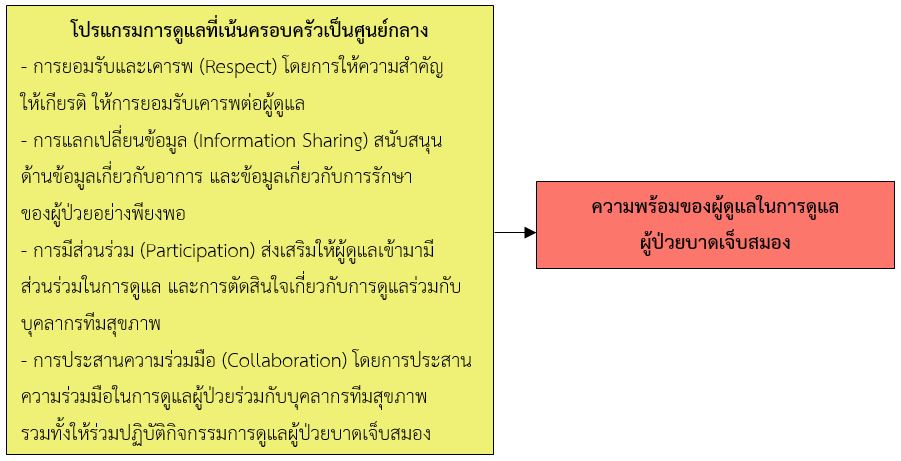
This quasi-experimental study with a two-group pretest–posttest design aimed to compare the readiness scores of caregivers of patients with traumatic brain injury between those who received a family-centered care program and those who received usual care, and compare the caregivers’ readiness scores in the experimental group before and after receiving the program. Participants consisted of 79 primary caregivers who were family members of patients with traumatic brain injury admitted from the initial stage through discharge in the trauma ward at Nakornping Hospital. The participants were divided into a control group (n=40) and an experimental group (n=39). The experimental group received the family-centered care program, while the control group received usual care. The research instrument included the family-centered care program, which comprised four components: respect and dignity, information sharing, participation, and collaboration. The program was implemented in three sessions. Data collection instruments included a demographic data form for patients and caregivers, a traumatic brain injury severity assessment based on clinical practice guidelines, and a caregiver readiness assessment scale. Data were analyzed using descriptive statistics and t-tests.
The results showed that after receiving the program, the readiness scores of caregivers of patients with traumatic brain injury in the experimental group were significantly higher than those in the control group (p-value < 0.05). Additionally, the readiness scores of caregivers in the experimental group after receiving the program were significantly higher than before participation (p-value < 0.05). These findings indicate that the family-centered care program effectively improves the readiness of caregivers of patients with traumatic brain injury. Therefore, the program should be applied in practice to enhance caregivers’ readiness in providing continuous and effective care and rehabilitation for patients with traumatic brain injury.
References
กองยุทธศาสตร์และแผนงาน กระทรวงสาธารณสุข. (2566). สรุปรายงานการป่วย. สืบค้นเมื่อ 22 เมษายน 2566 จาก https://spd.moph.go.th/wp-content/uploads/2024/11/ill_2023_full_07112567.pdf.
ณิชชารีย์ พิริยจรัสชัย และศิริพันธุ์ สําสัตย์. (2561). ปัจจัยทำนํายความพร้อมของผู้ดูแลในการดูแลผู้สูงอายุที่มีภาวะพึ่งพิงในระยะเปลี่ยนผ่านจากโรงพยาบาลสู่บ้าน. วารสารพยาบาลทหารบก, 19, 231-240.
นครชัย เผื่อนปฐม และธีระเดช ศรีกิจวิไลกุล. (2562). แนวทางเวชปฏิบัติกรณีสมองบาดเจ็บ (Clinical practice guidelines for traumatic brain injury). นนทบุรี: บริษัท พรอสเพอรัสพลัสจำกัด.
นัยน์ปพร จันทรธิมา, ทศพร คำผลศิริ และเดชา ทำดี. (2561). ผลของโปรแกรมการโค้ชต่อการเตรียมพร้อมและภาระของผู้ดูแลผู้สูงอายุที่เป็นโรคหลอดเลือดสมอง. สืบค้นเมื่อ 22 เมษายน 2566 จาก https://cmudc.library.cmu.ac.th/frontend/Info/item/dc:48073.
ปวีณา ยศสุรินทร์, จินดารัตน์ ชัยอาจ และชมพูนุท ศรีรัตน์. (2564). ผลของโปรแกรมการดูแลที่เน้นครอบครัวเป็นศูนย์กลางต่อความวิตกกังวลของผู้ดูแล ผู้ป่วยโรคหลอดเลือดสมอง. พยาบาลสาร, 48(2), 132-145.
ภาสิกา กิมหงษ์. (2566). ผลของโปรแกรมดูแลผู้ป่วยโรคหลอดเลือดสมองระยะเปลี่ยนผ่านต่อความพร้อมและ ภาระในการดูแลของญาติผู้ดูแล. วิทยานิพนธ์ปริญญาพยาบาลศาสตรมหาบัณฑิต วิทยาลัยพยาบาลบรมราชชนนี นพรัตน์วชิระ.
วีรยุทธ ศรีทุมสุข, สายทิพย์ จ๋ายพงษ์, กันยพัชร์ เศรษฐ์โชฎึก, นันทวรรณ ตีระวงศา และณฐกร นิลเนตร. (2563). ปัจจัยทำนายความต้องการของผู้ดูแลผู้ป่วยโรคหลอดเลือดสมองระยะหลังเฉียบพลันรายใหม่. วารสารพยาบาลสภากาชาดไทย, 13(2), 144-158.
วรรณภา ศรีหาบรรดิษฐ์. (2561). ความต้องการของผู้ดูแลผู้ป่วยโรคหลอดเลือดสมองและปัจจัยทำนายความต้องการของพวกเขา. วิทยานิพนธ์ปริญญาพยาบาลศาสตรมหาบัณฑิต มหาวิทยาลัยรังสิต.
หอผู้ป่วยอุบัติเหตุ 2 โรงพยาบาลนครพิงค์. (2565). สถิติผู้ป่วยที่เข้ารับการรักษาในหอผู้ป่วยอุบัติเหตุ 2. เชียงใหม่: โรงพยาบาลนครพิงค์
อรทัย บุญชูวงศ์, จงจิตร เสน่หา, วันเพ็ญ ภิญโญภาสกุล และยงชัย นิละนนท์. (2562). ปัจจัยที่มีอิทธิพลต่อความพร้อมของผู้ดูแลผู้ป่วยโรคหลอดเลือดสมองก่อนจําหน่ายออกจากโรงพยาบาล.พยาบาลสาร, 35(3), 46-57.
Archbold, P. G. & Stewart, B. J. (1986). Family caregiving inventory. Unpublished manuscript. United States: Oregon Health Science University, School of Nursing, Department of Family Nursing, Portland.
Backhaus, S. L., Neumann, D., Kreitzer, N., Hsu, N. H., & Hammond, F. M. (2022). Evaluation of a family-focused intervention for caregivers of adults with traumatic brain injury. Brain Injury, 36(4), 522-531.
Cohen, J. (1988). Statistical Power Analysis for Behavioral Sciences. New York: Academic Press.
Corallo, F., et al. (2024). Burden in caregivers of patients with acquired brain injury: Influence of family role and gender. NeuroRehabilitation, 55(1), 69-76. https://doi.org/10.3233/NRE-240056
Dawson, D. R., Zaide, A., & McAndrews, M. P. (2020). Caregiver preparedness and burden following traumatic brain injury. Journal of Head Trauma Rehabilitation, 35(1), E1-E10.
Erler, K. S., et al. (2019). Predicting the trajectory of participation after traumatic brain injury: A longitudinal analysis. Journal of Head Trauma Rehabilitation, 34(6), E57-E65.
Ettehad, D., et al. (2016). Blood pressure lowering for prevention of cardiovascular disease and death: A systematic review and meta-analysis. The Lancet, 387(10022), 957-967.
Faul, F., Erdfelder, E., Lang, A.-G., & Buchner, A. (2007). G*Power 3: A flexible statistical power analysis program for the social, behavioral, and biomedical sciences. Behavior Research Methods, 39(2), 175-191. https://doi.org/10.3758/BF03193146
Ganefianty, A., Songwathana, P., & Damkliang, J. (2024). Readiness for hospital discharge perceived by caregivers of patients with traumatic brain injury: A cross-sectional study. Belitung Nursing Journal, 10(2), 209-214.
Ilaghi, M., et al. (2024). The burden of traumatic brain injury on caregivers: Exploring the predictive factors in a multi-centric study. BMC Psychology, 12(1), 150. https://doi.org/10.1186/s40359-024-01652-6
Institute for Patient- and Family-Centered Care. (2015). What is patient- and family-centered care? Retrieved August 22, 2025 from http://www.ipfcc.org/about/pfcc.html.
Kamalakannan, S., Gudlavalleti, A. S. V., Gudlavalleti, V. S. M., Goenka, S., & Kuper, H. (2021). Barriers and facilitators for caregiver involvement in the rehabilitation of stroke survivors in India: A qualitative study. BMJ Open, 11(1), e042092.
Kew, C. L., Yoong, S. Q., & Tan, M. M. (2023). Effectiveness of caregiver interventions for patients with traumatic brain injury: A systematic review and meta-analysis. Disability and Rehabilitation, 45(2), 243-256.
Liu, J., Bai, S., Pan, H., & Huang, L. (2024). Caregiver burden and readiness in patients with moderate and severe traumatic brain injury: The chain mediation effect of disease uncertainty and mental resilience. World Neurosurgery, 185, e603-e611. https://doi.org/10.1016/j.wneu.2024.02.084
Ng, N. F., Kua, W. S., & Nayak, D. (2023). Long-term outcomes following traumatic brain injury: A review of quality of life and psychosocial outcomes. Singapore Medical Journal, 64(1), 62-68.
Saban, K. L., Hogan, N. S., Hogan, T. P., & Pape, T. L. B. (2021). He's a different person now: Caregiver perceptions of personality change in veterans with traumatic brain injury. Rehabilitation Nursing, 46(1), 40-49.
Sadler, E., et al. (2023). Interventions to support caregivers of people with traumatic brain injury: A systematic review. Clinical Rehabilitation, 37(2), 147-165.
Sirisatayawong, P., Jitpanya, C., & Chuamanochan, M. (2022). Caregiver burden and quality of life among caregivers of traumatic brain injury patients in Thailand. Pacific Rim International Journal of Nursing Research, 26(1), 38-50. https://doi.org/10.60099/prijnr.2025.274587
Wirojratana, V. (2002). Development of the Thai family care inventory. Retrieved August 22, 2025 from https://digitalcollections. ohsu.edu/record/2426?v=pdf.
World Health Organization. (2019). Emergency and trauma care. Retrieved August 22, 2025 from https://www.who.int/initiatives/global-emergency-and-trauma-care-initiative.
Yunitri, N., Chu, L., Kuo, S. Y., Kuo, C. Y., & Maio, R. F. (2021). The needs of traumatic brain injury survivors' caregivers and the implication required during the COVID-19 pandemic: Public health issues. Annals of Medicine and Surgery, 65, 102289.
Downloads
Published
How to Cite
Issue
Section
License
Copyright (c) 2026 Journal of Nursing and Public Health Research

This work is licensed under a Creative Commons Attribution-NonCommercial-NoDerivatives 4.0 International License.
1. บทความหรือข้อคิดเห็นใด ๆ ที่ปรากฏในวารสารวิจัยการพยาบาลและการสาธารณสุข ที่เป็นวรรณกรรมของผู้เขียน บรรณาธิการไม่จำเป็นต้องเห็นด้วย
2. บทความที่ได้รับการตีพิมพ์ถือเป็นลิขสิทธิ์ของ วารสารวิจัยการพยาบาลและการสาธารณสุข