ประสิทธิผลของการใช้โปรแกรมการดูแลที่เน้นครอบครัวเป็นศูนย์กลาง ต่อความพร้อมผู้ดูแลผู้ป่วยบาดเจ็บสมอง
คำสำคัญ:
การดูแลที่เน้นครอบครัวเป็นศูนย์กลาง, ผู้ดูแล, ผู้ป่วยบาดเจ็บสมอง, ความพร้อมในการดูแลบทคัดย่อ
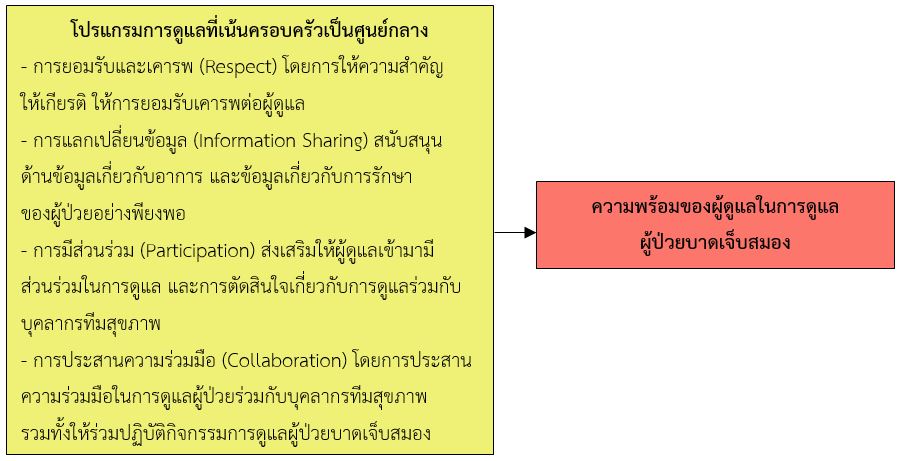
การวิจัยกึ่งทดลองแบบสองกลุ่มวัดผลก่อนและหลังการทดลองนี้มีวัตถุประสงค์เพื่อเปรียบเทียบคะแนนความพร้อมของผู้ดูแลผู้ป่วยบาดเจ็บสมองระหว่างกลุ่มที่ได้รับโปรแกรมการดูแลที่เน้นครอบครัวเป็นศูนย์กลางกับกลุ่มที่ได้รับการดูแลตามปกติ และเปรียบเทียบคะแนนความพร้อมของผู้ดูแลในกลุ่มทดลองก่อนและหลังได้รับโปรแกรมดังกล่าว กลุ่มตัวอย่าง คือ ผู้ดูแลหลักซึ่งเป็นสมาชิกในครอบครัวของผู้ป่วยบาดเจ็บสมองที่เข้ารับการรักษาตั้งแต่ระยะแรกจนสิ้นสุดการรักษาในหอผู้ป่วยอุบัติเหตุ โรงพยาบาลนครพิงค์ จำนวนทั้งสิ้น 79 คน แบ่งเป็นกลุ่มควบคุม 40 คน และกลุ่มทดลอง 39 คน กลุ่มทดลองได้รับโปรแกรมการดูแลที่เน้นครอบครัวเป็นศูนย์กลาง ส่วนกลุ่มควบคุมได้รับการดูแลตามปกติ เครื่องมือที่ใช้ในการวิจัย ได้แก่ โปรแกรมการดูแลที่เน้นครอบครัวเป็นศูนย์กลาง ซึ่งประกอบด้วย 4 องค์ประกอบ ได้แก่ การยอมรับและเคารพ การแลกเปลี่ยนข้อมูล การมีส่วนร่วม และการประสานความร่วมมือ โดยดำเนินกิจกรรมจำนวน 3 ครั้ง เครื่องมือที่ใช้ในการเก็บรวบรวมข้อมูล ได้แก่ แบบบันทึกข้อมูลทั่วไปของผู้ป่วยและผู้ดูแล แบบประเมินระดับความรุนแรงของการบาดเจ็บสมองตามแนวทางเวชปฏิบัติ และแบบประเมินความพร้อมของผู้ดูแลผู้ป่วย วิเคราะห์ข้อมูลโดยใช้สถิติเชิงพรรณนาและสถิติทดสอบที
ผลการวิจัยพบว่า หลังได้รับโปรแกรมฯ คะแนนความพร้อมของผู้ดูแลผู้ป่วยบาดเจ็บสมองในกลุ่มทดลองสูงกว่ากลุ่มควบคุมอย่างมีนัยสำคัญทางสถิติ (p-value < 0.05) และคะแนนความพร้อมของผู้ดูแลในกลุ่มทดลองหลังได้รับโปรแกรมฯ สูงกว่าก่อนได้รับโปรแกรมฯ อย่างมีนัยสำคัญทางสถิติ (p-value < 0.05) ผลการวิจัยสะท้อนให้เห็นว่าโปรแกรมการดูแลที่เน้นครอบครัวเป็นศูนย์กลางสามารถเพิ่มความพร้อมของผู้ดูแลผู้ป่วยบาดเจ็บสมองได้อย่างมีประสิทธิภาพ ดังนั้นควรนำโปรแกรมดังกล่าวไปประยุกต์ใช้เพื่อส่งเสริมความพร้อมของผู้ดูแลในการดูแลและฟื้นฟูสมรรถภาพผู้ป่วยบาดเจ็บสมองอย่างต่อเนื่องและมีประสิทธิภาพ
เอกสารอ้างอิง
กองยุทธศาสตร์และแผนงาน กระทรวงสาธารณสุข. (2566). สรุปรายงานการป่วย. สืบค้นเมื่อ 22 เมษายน 2566 จาก https://spd.moph.go.th/wp-content/uploads/2024/11/ill_2023_full_07112567.pdf.
ณิชชารีย์ พิริยจรัสชัย และศิริพันธุ์ สําสัตย์. (2561). ปัจจัยทำนํายความพร้อมของผู้ดูแลในการดูแลผู้สูงอายุที่มีภาวะพึ่งพิงในระยะเปลี่ยนผ่านจากโรงพยาบาลสู่บ้าน. วารสารพยาบาลทหารบก, 19, 231-240.
นครชัย เผื่อนปฐม และธีระเดช ศรีกิจวิไลกุล. (2562). แนวทางเวชปฏิบัติกรณีสมองบาดเจ็บ (Clinical practice guidelines for traumatic brain injury). นนทบุรี: บริษัท พรอสเพอรัสพลัสจำกัด.
นัยน์ปพร จันทรธิมา, ทศพร คำผลศิริ และเดชา ทำดี. (2561). ผลของโปรแกรมการโค้ชต่อการเตรียมพร้อมและภาระของผู้ดูแลผู้สูงอายุที่เป็นโรคหลอดเลือดสมอง. สืบค้นเมื่อ 22 เมษายน 2566 จาก https://cmudc.library.cmu.ac.th/frontend/Info/item/dc:48073.
ปวีณา ยศสุรินทร์, จินดารัตน์ ชัยอาจ และชมพูนุท ศรีรัตน์. (2564). ผลของโปรแกรมการดูแลที่เน้นครอบครัวเป็นศูนย์กลางต่อความวิตกกังวลของผู้ดูแล ผู้ป่วยโรคหลอดเลือดสมอง. พยาบาลสาร, 48(2), 132-145.
ภาสิกา กิมหงษ์. (2566). ผลของโปรแกรมดูแลผู้ป่วยโรคหลอดเลือดสมองระยะเปลี่ยนผ่านต่อความพร้อมและ ภาระในการดูแลของญาติผู้ดูแล. วิทยานิพนธ์ปริญญาพยาบาลศาสตรมหาบัณฑิต วิทยาลัยพยาบาลบรมราชชนนี นพรัตน์วชิระ.
วีรยุทธ ศรีทุมสุข, สายทิพย์ จ๋ายพงษ์, กันยพัชร์ เศรษฐ์โชฎึก, นันทวรรณ ตีระวงศา และณฐกร นิลเนตร. (2563). ปัจจัยทำนายความต้องการของผู้ดูแลผู้ป่วยโรคหลอดเลือดสมองระยะหลังเฉียบพลันรายใหม่. วารสารพยาบาลสภากาชาดไทย, 13(2), 144-158.
วรรณภา ศรีหาบรรดิษฐ์. (2561). ความต้องการของผู้ดูแลผู้ป่วยโรคหลอดเลือดสมองและปัจจัยทำนายความต้องการของพวกเขา. วิทยานิพนธ์ปริญญาพยาบาลศาสตรมหาบัณฑิต มหาวิทยาลัยรังสิต.
หอผู้ป่วยอุบัติเหตุ 2 โรงพยาบาลนครพิงค์. (2565). สถิติผู้ป่วยที่เข้ารับการรักษาในหอผู้ป่วยอุบัติเหตุ 2. เชียงใหม่: โรงพยาบาลนครพิงค์
อรทัย บุญชูวงศ์, จงจิตร เสน่หา, วันเพ็ญ ภิญโญภาสกุล และยงชัย นิละนนท์. (2562). ปัจจัยที่มีอิทธิพลต่อความพร้อมของผู้ดูแลผู้ป่วยโรคหลอดเลือดสมองก่อนจําหน่ายออกจากโรงพยาบาล.พยาบาลสาร, 35(3), 46-57.
Archbold, P. G. & Stewart, B. J. (1986). Family caregiving inventory. Unpublished manuscript. United States: Oregon Health Science University, School of Nursing, Department of Family Nursing, Portland.
Backhaus, S. L., Neumann, D., Kreitzer, N., Hsu, N. H., & Hammond, F. M. (2022). Evaluation of a family-focused intervention for caregivers of adults with traumatic brain injury. Brain Injury, 36(4), 522-531.
Cohen, J. (1988). Statistical Power Analysis for Behavioral Sciences. New York: Academic Press.
Corallo, F., et al. (2024). Burden in caregivers of patients with acquired brain injury: Influence of family role and gender. NeuroRehabilitation, 55(1), 69-76. https://doi.org/10.3233/NRE-240056
Dawson, D. R., Zaide, A., & McAndrews, M. P. (2020). Caregiver preparedness and burden following traumatic brain injury. Journal of Head Trauma Rehabilitation, 35(1), E1-E10.
Erler, K. S., et al. (2019). Predicting the trajectory of participation after traumatic brain injury: A longitudinal analysis. Journal of Head Trauma Rehabilitation, 34(6), E57-E65.
Ettehad, D., et al. (2016). Blood pressure lowering for prevention of cardiovascular disease and death: A systematic review and meta-analysis. The Lancet, 387(10022), 957-967.
Faul, F., Erdfelder, E., Lang, A.-G., & Buchner, A. (2007). G*Power 3: A flexible statistical power analysis program for the social, behavioral, and biomedical sciences. Behavior Research Methods, 39(2), 175-191. https://doi.org/10.3758/BF03193146
Ganefianty, A., Songwathana, P., & Damkliang, J. (2024). Readiness for hospital discharge perceived by caregivers of patients with traumatic brain injury: A cross-sectional study. Belitung Nursing Journal, 10(2), 209-214.
Ilaghi, M., et al. (2024). The burden of traumatic brain injury on caregivers: Exploring the predictive factors in a multi-centric study. BMC Psychology, 12(1), 150. https://doi.org/10.1186/s40359-024-01652-6
Institute for Patient- and Family-Centered Care. (2015). What is patient- and family-centered care? Retrieved August 22, 2025 from http://www.ipfcc.org/about/pfcc.html.
Kamalakannan, S., Gudlavalleti, A. S. V., Gudlavalleti, V. S. M., Goenka, S., & Kuper, H. (2021). Barriers and facilitators for caregiver involvement in the rehabilitation of stroke survivors in India: A qualitative study. BMJ Open, 11(1), e042092.
Kew, C. L., Yoong, S. Q., & Tan, M. M. (2023). Effectiveness of caregiver interventions for patients with traumatic brain injury: A systematic review and meta-analysis. Disability and Rehabilitation, 45(2), 243-256.
Liu, J., Bai, S., Pan, H., & Huang, L. (2024). Caregiver burden and readiness in patients with moderate and severe traumatic brain injury: The chain mediation effect of disease uncertainty and mental resilience. World Neurosurgery, 185, e603-e611. https://doi.org/10.1016/j.wneu.2024.02.084
Ng, N. F., Kua, W. S., & Nayak, D. (2023). Long-term outcomes following traumatic brain injury: A review of quality of life and psychosocial outcomes. Singapore Medical Journal, 64(1), 62-68.
Saban, K. L., Hogan, N. S., Hogan, T. P., & Pape, T. L. B. (2021). He's a different person now: Caregiver perceptions of personality change in veterans with traumatic brain injury. Rehabilitation Nursing, 46(1), 40-49.
Sadler, E., et al. (2023). Interventions to support caregivers of people with traumatic brain injury: A systematic review. Clinical Rehabilitation, 37(2), 147-165.
Sirisatayawong, P., Jitpanya, C., & Chuamanochan, M. (2022). Caregiver burden and quality of life among caregivers of traumatic brain injury patients in Thailand. Pacific Rim International Journal of Nursing Research, 26(1), 38-50. https://doi.org/10.60099/prijnr.2025.274587
Wirojratana, V. (2002). Development of the Thai family care inventory. Retrieved August 22, 2025 from https://digitalcollections. ohsu.edu/record/2426?v=pdf.
World Health Organization. (2019). Emergency and trauma care. Retrieved August 22, 2025 from https://www.who.int/initiatives/global-emergency-and-trauma-care-initiative.
Yunitri, N., Chu, L., Kuo, S. Y., Kuo, C. Y., & Maio, R. F. (2021). The needs of traumatic brain injury survivors' caregivers and the implication required during the COVID-19 pandemic: Public health issues. Annals of Medicine and Surgery, 65, 102289.
ดาวน์โหลด
เผยแพร่แล้ว
รูปแบบการอ้างอิง
ฉบับ
ประเภทบทความ
สัญญาอนุญาต
ลิขสิทธิ์ (c) 2026 วารสารวิจัยการพยาบาลและการสาธารณสุข

อนุญาตภายใต้เงื่อนไข Creative Commons Attribution-NonCommercial-NoDerivatives 4.0 International License.
1. บทความหรือข้อคิดเห็นใด ๆ ที่ปรากฏในวารสารวิจัยการพยาบาลและการสาธารณสุข ที่เป็นวรรณกรรมของผู้เขียน บรรณาธิการไม่จำเป็นต้องเห็นด้วย
2. บทความที่ได้รับการตีพิมพ์ถือเป็นลิขสิทธิ์ของ วารสารวิจัยการพยาบาลและการสาธารณสุข
 Indexed in TCI