Factors Influencing Infection Prevention and Control Behaviors Among Registered Nurses
Keywords:
Influencing Factors, Infection Prevention and Control Behaviors, Registered NursesAbstract
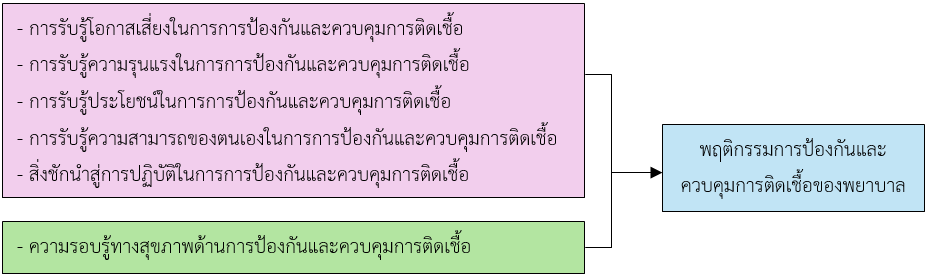
This predictive correlational study aimed to examine the level of infection prevention and control behaviors and the factors influencing these behaviors among registered nurses. The sample consisted of 135 registered nurses working at Vajira Hospital, selected through multistage sampling. The research instrument was a set of questionnaires comprising demographic information, perceived susceptibility, perceived severity, perceived benefits, perceived self-efficacy, cues to action, health literacy, and infection prevention and control behaviors. Data were analyzed using descriptive statistics, and predictive factors were analyzed using stepwise multiple regression analysis.
The results showed that most registered nurses demonstrated a very high level of infection prevention and control behaviors, accounting for 87.41%. Stepwise multiple regression analysis revealed that health literacy (ß=0.47), cues to action (ß=0.24), and perceived benefits (ß=0.16) jointly predicted infection prevention and control behaviors among registered nurses, explaining 55.70% of the variance (R² = 0.55, Adjusted R² = 0.54, F = 54.90, p-value < 0.001). These findings can be used as a guideline for designing innovations or programs to promote infection prevention and control behaviors among registered nurses by enhancing health literacy, establishing clear cues to action, and strengthening perceived benefits of adherence to standard practices.
References
กรมควบคุมโรค กระทรวงสาธารณสุข. (2565). แผนปฏิบัติการเชิงยุทธศาสตร์ ด้านการป้องกันและควบคุมการติดเชื้อในโรงพยาบาลระดับชาติ. กรุงเทพฯ: อักษรกราฟฟิคแอนด์ดีไซน์.
กัลยา วานิชย์บัญชา. (2552). การวิเคราะห์ข้อมูลหลายตัวแปร. กรุงเทพฯ: บริษัทธรรมสาร จำกัด.
ขนิษฐา เอกปัชฌาย์, วันชัย มุ้งตุ้ย และจิตตาภรณ์ จิตรีเชื้อ. (2558). ปัจจัยทำนายความตั้งใจปฏิบัติการป้องกันการติดเชื้อวัณโรคของพยาบาลวิชาชีพในโรงพยาบาลทั่วไป. พยาบาลสาร มหาวิทยาลัยเชียงใหม่, 42 (ฉบับพิเศษ), 25-36.
จิตรลดา กมลผัน, กุสุมา คุววัฒนสัมฤทธิ์ และอภิญญา ศิริพิทยาคุณกิจ. (2563). ปัจจัยที่มีความสัมพันธ์กับพฤติกรรมการดูแลเพื่อป้องกันการติดเชื้อในกระแสเลือดที่เกี่ยวกับการคาสายสวนหลอดเลือดส่วนกลางของพยาบาลในหอผู้ป่วยวิกฤติผู้ใหญ่. วารสารพยาบาลรามาธิบดี, 26(3), 271-298.
จิรพันธุ์ อินยาพงษ์, กีรดา ไกรนุวัตร และปิยะธิดา นาคะเกษียร. (2567). ปัจจัยทำนายพฤติกรรมการป้องกันและควบคุมการติดเชื้อวัณโรคของพยาบาลวิชาชีพในเขตสุขภาพที่ 10 กระทรวงสาธารณสุข. วารสารสำนักงานป้องกันควบคุมโรคที่ 10 จังหวัดอุบลราชธานี, 22(2), 25-36.
ชลธิศ บุญร่วม, อะเคื้อ อุณหเลขกะ และวันชัย เลิศวัฒนวิลาศ. (2563). ปัจจัยทำานายการปฏิบัติการป้องกันการแพร่กระจายเชื้อดื้อยาของพยาบาลวิชาชีพในโรงพยาบาลศูนย์. พยาบาลสาร มหาวิทยาลัยเชียงใหม่, 47(2), 133-142.
ธีรารัตน์ บุญกุณะ. (2566). ปัจจัยที่มีผลกระทบต่อการปฏิบัติงานในการดูแลผู้ป่วยวัณโรคในชุมชนของพยาบาลวิชาชีพ เขตอำเภอเมือง จังหวัดลำปาง. วารสารวิชาการสุขภาพภาคเหนือ, 10(2), 290-301.
ฝ่ายการพยาบาล โรงพยาบาลวชิรพยาบาล. (2568). ข้อมูลอัตรากำลังพยาบาลวิชาชีพ. ฝ่ายการพยาบาล คณะแพทยศาสตร์วชิรพยาบาล มหาวิทยาลัยนวมินทราธิราช.
ภัสธิรา ธรรมฤทัย. (2568). ปัจจัยที่มีอิทธิพลต่อพฤติกรรมการป้องกันวัณโรคของผู้สัมผัสกับผู้ป่วยวัณโรคในเขตอำเภอโนนคูณ จังหวัดศรีสะเกษ วารสารวิจัยและพัฒนาสุขภาพศรีสะเกษ, 4(1), 29-41.
วนิษา ผิวนางงาม, สุทิน ชนะบุญ และลําพึง วอนอก. (2567). ปัจจัยที่มีความสัมพันธ์กับพฤติกรรมป้องกันการติดเชื้อวัณโรคปอดในบุคลากรสาธารณสุข โรงพยาบาลชุมแพ อําเภอชุมแพ จังหวัดขอนแก่น. วารสารวิชาการป้องกันควบคุมโรค สคร.2 พิษณุโลก, 11(1), 14-29.
อริสรา สุขวัจนี. (2558). ปัจจัยที่มีความสัมพันธ์ต่อพฤติกรรมการป้องกันการติดเชื้อของพยาบาลที่ปฏิบัติงานที่ห้องอุบัติเหตุฉุกเฉิน. วารสารพฤติกรรมศาสตร์เพื่อการพัฒนา, 7(1), 2553-2265.
Alissa, N. A. & Alqadi, A. (2025). Nurses’ knowledge of infection control practices in intensive care unit in Saudi Arabia. Sage Open, 15(3), 215. https://doi.org/10.1177/21582440251359437.
Best, J. W. (1977). Research in education (3rd ed.). New Jersey: Prentice Hall.
Cohen, J. (1988). Statistical power analysis for the behavioral sciences (2nd ed.). New Jersey: Lawrence erlbaum associates.
Faul, F., Erdfelder, E., Lang, A.-G., & Buchner, A. (2007). G*Power 3: A flexible statistical power analysis program for the social, behavioral and biomedical sciences. Behavior Research Methods, 39(2), 175-191. https://doi.org/10.3758/BF03193146.
Kim, N., Gu, M., Cho, Y., Kim, O., & Sok, S. (2025). Factors influencing the performance of standard precautions for healthcare-associated infections by the nurses in intensive care units. BMC Nursing, 24, 243. https://doi.org/10.1186/s12912-025-02874-8.
Lee, M. H. & Jun, S. H. (2022). Factors affecting the infection control practices of nurses at University Hospitals. Healthcare (Basel), 10(8), 1-10. https://doi.org/10.3390/healthcare10081517.
Marcoulides, K. M. & Raykov, T. (2019). Evaluation of variance inflation factors in regression models using latent variable modeling methods. Educational and Psychological Measurement, 79(5), 874-882. https://doi.org/10.1177/0013164418817803.
Nutbeam, D. (2008). The evolving concept of health literacy. Social Science & Medicine, 67(12), 2072-2078. https://doi.org/10.1016/j.socscimed.2008.09.050
Polit, D. F. & Beck, C. T. (2021). Nursing Research: Generating and assessing evidence for nursing practice. New York: Wolters Kluwer.
Preece, P. (2002). Equal-interval measurement: The foundation of quantitative educational research. Research Papers in Education, 17(4), 363-372.https://doi.org/10.1080/0267152022000031397
Rosenstock, I. M., Strecher, V. J., & Becker, M. H. (1988). Social learning theory and the Health Belief Model. Health Education Quarterly,15(2), 175-183. https://doi.org/10.1177/109019818801500203
Sartelli, M., et al. (2024). Preventing and controlling healthcare-associated infections: the first principle of every antimicrobial stewardship program in hospital settings. Antibiotics, 13(9), 896. https://doi.org/10.3390/antibiotics13090896
Savin, N. E. & White, K. J. (1977). The durbin-watson test for serial correlation with extreme sample sizes or many regressors. Econometrica, 45(8), 1989-1996. https://doi.org/10.2307/1914122
World Health Organization. (2024). Global report on infection prevention and control. Retrieved October 1, 2025 from https://doi.org/https://www.who.int/publications/i/item/9789240103986.
Downloads
Published
How to Cite
Issue
Section
License
Copyright (c) 2026 Journal of Nursing and Public Health Research

This work is licensed under a Creative Commons Attribution-NonCommercial-NoDerivatives 4.0 International License.
1. บทความหรือข้อคิดเห็นใด ๆ ที่ปรากฏในวารสารวิจัยการพยาบาลและการสาธารณสุข ที่เป็นวรรณกรรมของผู้เขียน บรรณาธิการไม่จำเป็นต้องเห็นด้วย
2. บทความที่ได้รับการตีพิมพ์ถือเป็นลิขสิทธิ์ของ วารสารวิจัยการพยาบาลและการสาธารณสุข