ผลของโปรแกรมส่งเสริมความรอบรู้ด้านสุขภาพต่อความรอบรู้ด้านสุขภาพ และพฤติกรรมสุขภาพในผู้ป่วยโรคหลอดเลือดสมองเขตเมือง โรงพยาบาลวชิรพยาบาล
คำสำคัญ:
ความรอบรู้ด้านสุขภาพ, พฤติกรรมสุขภาพ, โรคหลอดเลือดสมอง, เขตเมืองบทคัดย่อ
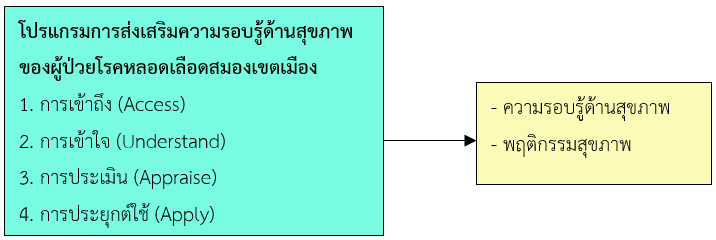
การวิจัยแบบกึ่งทดลองนี้ มีวัตถุประสงค์เพื่อศึกษาผลของโปรแกรมการส่งเสริมความรอบรู้ด้านสุขภาพ ต่อพฤติกรรมสุขภาพและระดับความรอบรู้ด้านสุขภาพของผู้ป่วยโรคหลอดเลือดสมอง เขตเมือง โรงพยาบาลวชิรพยาบาล ทำการคัดเลือกกลุ่มตัวอย่างแบบเจาะจง จำนวน 60 คน แบ่งเป็นกลุ่มทดลองและกลุ่มควบคุม กลุ่มละ 30 คน เครื่องมือที่ใช้ในการดำเนินการวิจัย ได้แก่ โปรแกรมการส่งเสริมความรอบรู้ด้านสุขภาพ เครื่องมือที่ใช้ในการเก็บรวบรวมข้อมูล ได้แก่ แบบสอบถามข้อมูลทั่วไป แบบประเมินพฤติกรรมสุขภาพ และแบบประเมินความรอบรู้ด้านสุขภาพ วิเคราะห์ข้อมูลทั่วไปโดยใช้สถิติเชิงพรรณนา และเปรียบเทียบคะแนนเฉลี่ยก่อนและหลังการทดลองด้วยสถิติ Dependent t-test และเปรียบเทียบคะแนนเฉลี่ยระหว่างกลุ่มทดลองและกลุ่มควบคุมด้วยสถิติ Independent t-test
ผลการวิจัย พบว่า หลังเข้าร่วมโปรแกรม กลุ่มทดลองมีคะแนนเฉลี่ยความรอบรู้ด้านสุขภาพ (Mean = 72.10, S.D. = 6.58) สูงกว่าก่อนเข้าร่วมโปรแกรม (Mean = 41.30, S.D. = 5.87) อย่างมีนัยสำคัญทางสถิติ (p-value < 0.001) สำหรับพฤติกรรมสุขภาพพบว่า กลุ่มทดลองมีคะแนนเฉลี่ยหลังเข้าร่วมโปรแกรม (Mean = 117.40, S.D. = 8.21) สูงกว่าก่อนเข้าร่วมโปรแกรม (Mean= 83.00, S.D. = 7.45) อย่างมีนัยสำคัญทางสถิติ (p-value < 0.001) จากผลการวิจัยเห็นควรนำโปรแกรมนี้ไปใช้ในการเพิ่มความรอบรู้ด้านสุขภาพ และส่งเสริมพฤติกรรมสุขภาพของผู้ป่วยโรคหลอดเลือดสมองในการดูแลสุขภาพตนเองให้มีประสิทธิภาพมากยิ่งขึ้น
เอกสารอ้างอิง
กรมสนับสนุนบริการสุขภาพ กระทรวงสาธารณสุข. (2567). แนวทางการประเมินพฤติกรรมสุขภาพของประชาชนตามหลัก 3อ 2ส และการป้องกันโรคอุบัติใหม่.กระทรวงสาธารณสุข. สืบค้นเมื่อ 11 มกราคม 2568 จาก https://surl.li/oelqch.
กัญญาวีญ์ ต้นสวรรค์ และอุษนีย์ รามฤทธิ์. (2566). การส่งเสริมความรอบรู้ด้านสุขภาพและพฤติกรรมการป้องกันโรคหลอดเลือดสมอง ในผู้ป่วยความดันโลหิตสูงที่มีภาวะเสี่ยงสูง. วารสารอนามัยสิ่งแวดล้อมและสุขภาพชุมชน, 8(1), 143-152.
ทิวาพร วิถี, วีณา เที่ยงธรรม และเพลินพิศ บุณยมาลิก. (2564). โปรแกรมส่งเสริมพฤติกรรมป้องกันการกลับเป็นซ้ำของผู้ป่วยโรคหลอดเลือดสมอง. วารสารเกื้อการุณย์, 28(1), 7-19.
นงลักษณ์ ตุ่นแก้ว, พิมพ์ใจ อุ่นบ้าน และศรินญาภรณ์ จันทร์ดีแก้วสกุล. (2561). ผลของโปรแกรมปรับเปลี่ยนพฤติกรรมสุขภาพตามแนวทาง 3อ.2ส.1ย. และการใช้ปิงปองจราจรชีวิต 7 สี ต่อความรู้พฤติกรรมสุขภาพ และระดับน้ำตาลในเลือดของผู้ป่วยเบาหวาน. วารสารสมาคมพยาบาลแห่งประเทศไทยฯ สาขาภาคเหนือ, 24(2), 83-95.
ปวีณา รัตนเสนา. (2566). ปัจจัยที่มีความสัมพันธ์กับพฤติกรรมสุขภาพตามหลัก 3อ.2ส. ของประชาชนที่มีอายุ 15 ปีขึ้นไป ในเขตพื้นที่กรุงเทพมหานครและปริมณฑล. วารสารวิจัยและพัฒนา วไลยอลงกรณ์ ในพระบรมราชูปถัมภ์, 18(1), 131-145.
ผุสดี ก่อเจดีย์, พันนิภา นวลอนันต์, เพ็ญพรรณ จงจิรวงศา, สุภา ธนวังศรี และอมร กัลยพฤกษ์. (2565). บทบาทพยาบาลในการดูแลผู้ป่วยโรคหลอดเลือดสมองอย่างต่อเนื่องที่บ้าน. หัวหินเวชสาร, 2(2), 1-19.
พรธิรา บุญฉวี และปชาณัฏฐ์ นันไทยทวีกุล. (2567). ผลของโปรแกรมการส่งเสริมความรอบรู้ด้านสุขภาพต่อพฤติกรรมการป้องกันโรคในผู้ป่วยโรคหลอดเลือดสมองระยะฟื้นฟูสภาพ. วารสารพยาบาล, 73(2), 51-60.
วิรารัตน์ นิลสวัสดิ์. (2565). ผลของโปรแกรมการดูแลผู้ป่วยโรคหลอดเลือดสมองและผู้ดูแลระยะเปลี่ยนผ่านจากโรงพยาบาลสู่บ้านต่อความสามารถการใช้ชีวิตประจำวัน ภาวะแทรกซ้อนของผู้ป่วยและความสามารถ การจัดการตนเองของผู้ดูแล. วารสารวิจัยการพยาบาลและการสาธารณสุข, 2(3), 57-70.
สมศักดิ์ เทียมเก่า. (2566). อุบัติการณ์โรคหลอดเลือดสมอง ประเทศไทย. วารสารประสาทวิทยาแห่งประเทศไทย, 39(2), 39-46.
สาธิต คูระทอง. (2559). เวชศาสตร์เขตเมือง. วชิรเวชสารและวารสารเวชศาสตร์เขตเมือง, 60(1), 1-4.
อรพรรณ ศฤงคาร, อังสนา บุญธรรม, สุคนธา คงศีล, สุขุม เจียมตน และภูษิต ประคองสาย. (2564). ต้นทุนต่อวันนอนในการให้บริการการดูแลระยะกลางในผู้ป่วยโรคหลอดเลือดสมองในโรงพยาบาลตติยภูมิแห่งหนึ่ง. วารสารวิจัยระบบสาธารณสุข, 15(4), 407-421.
Aljassim, N. & Ostini, R. (2020). Health literacy in rural and urban populations: A systematic review. Patient Education and Counseling, 103(10), 2142-2154. https://doi.org/10.1016/j.pec.2020.06.007
Best, J. W. & Kahn, J. V. (2014). Research in education .(10th ed.). London: Pearson education limited.
Bushnell, C., et al. (2024). 2024 guideline for the primary prevention of stroke: A guideline from the American Heart Association/American Stroke Association. Stroke, 55(12), 344-424. https://doi.org/10.1161/STR.0000000000000475
Faul, F., Erdfelder, E., Lang, A.-G., & Buchner, A. (2007). G*Power 3: A flexible statistical power analysis program for the social, behavioral, and biomedical sciences. Behavior Research Methods, 39(2), 175-191. https://doi.org/10.3758/BF03193146
Kumar, A., et al. (2022). Caregiver burden in caregivers of stroke survivors: A hospital-based study. Annals of the Indian Academy of Neurology, 25(6), 1092-1098.https://doi.org/10.4103/aian.aian_318_22
Lima, A. C. P., Maximiano-Barreto, M. A., Orlandi, F. d. S., Rezende, M. A. D., Martins, T. C. R., & Luchesi, B. M. (2025). Health literacy and likelihood of death in community-dwelling older people. Geriatric Nursing, 61(2), 506-512. https://doi.org/https://doi.org/10.1016/j.gerinurse.2024.12.031
Nakibuuka, J., et al. (2021). Barriers to secondary stroke prevention and care in urban and rural Uganda: Lived experiences of stroke survivors, carers and key stakeholders. Clinical Medicine Research, 10(3), 59. https://doi.org/10.11648/j.cmr.20211003.11
Polit, D. F., & Beck, C. K. (2004). Nursing research: Principle and methods. 7th Edition, Lippincott Williams & Wilkins: Philadelphia.
Pu, L., Wang, L., Zhang, R., Zhao, T., Jiang, Y., & Han, L. (2023). Projected global trends in ischemic stroke incidence, deaths and disability-adjusted life years from 2020 to 2030. Stroke, 54(5), 1330-1339. https://doi.org/doi:10.1161/STROKEAHA.122.040073
Sørensen, K., et al. (2012). Health literacy and public health: A systematic review and integration of definitions and models. BMC Public Health, 12(1), 1-13. https://doi.org/10.1186/1471-2458-12-80
World Stroke Organization. (2023). Pragmatic solutions to reduce the global burden of stroke. The Lancet Neurology, 22(12), 1160-1206. https://doi.org/10.1016/S1474-4422(23)00277-6
World Stroke Organization. (2025). Global stroke fact sheet 2025. International Journal of Stroke, 20(2), 132-144. https://doi.org/10.1177/17474930241308142
Ymeraj, M., et al. (2025). Health literacy in stroke disease: A systematic review. Journal of Vascular Nursing, 43(1), 33-45. https://doi.org/https://doi.org/10.1016/j.jvn.2025.01.001
ดาวน์โหลด
เผยแพร่แล้ว
รูปแบบการอ้างอิง
ฉบับ
ประเภทบทความ
สัญญาอนุญาต
ลิขสิทธิ์ (c) 2026 วารสารวิจัยการพยาบาลและการสาธารณสุข

อนุญาตภายใต้เงื่อนไข Creative Commons Attribution-NonCommercial-NoDerivatives 4.0 International License.
1. บทความหรือข้อคิดเห็นใด ๆ ที่ปรากฏในวารสารวิจัยการพยาบาลและการสาธารณสุข ที่เป็นวรรณกรรมของผู้เขียน บรรณาธิการไม่จำเป็นต้องเห็นด้วย
2. บทความที่ได้รับการตีพิมพ์ถือเป็นลิขสิทธิ์ของ วารสารวิจัยการพยาบาลและการสาธารณสุข
 Indexed in TCI